

Tanzania’s tax collections have reached TZS 22.38 trillion, 99.9% of the monthly target by February 2025, representing a 16.6% increase from February 2024.
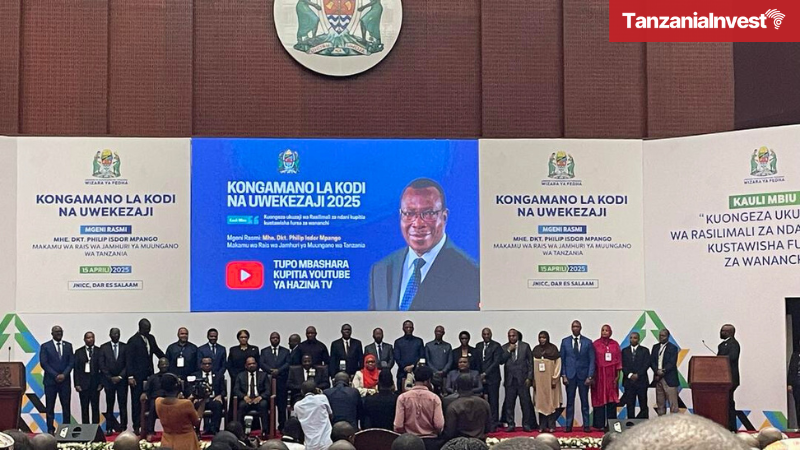
This was disclosed by Zanzibar’s Minister of Finance, Hon.Dr. Saada Mkuya, on 15th April 2025, at the Tanzania National Tax and Investment Dialogue Conference in Dar es Salaam.
The conference aimed to engage stakeholders on strategies for improving domestic revenue mobilization and investment ahead of the national budget for fiscal year 2025–2026, bringing together government officials, private sector leaders, and development partners to discuss policy reforms and fiscal strategies.

Panel discussions focused on broadening the tax base, especially in under-taxed sectors such as agriculture and the informal economy, and increasing financial inclusion.
Participants also emphasized the need for legal, policy, and institutional reforms to improve tax governance and reduce revenue leakages.
Officiating the event, Tanzania’s Vice President, Hon.Dr. Philip Mpango noted that to achieve the goals set under Tanzania’s Vision 2050, annual tax revenue must increase from the current USD 10 billion to USD 140 billion (approximately TZS 350 trillion).
“To support this ambition, the country’s GDP needs to grow from USD 85 billion today to USD 1 trillion by 2050 and requires doubling the current GDP growth rate of 5.1% to at least 10% annually,” added Mpango.
The Vice President also expressed concern over the declining number of registered active taxpayers, which dropped from 3.36 million in 2021–2022 to 2.82 million in 2024, urging renewed efforts to expand the taxpayer base.

He highlighted the importance of equitable tax systems, improved enforcement, and increased financial inclusion as critical areas for reform.
On his part, the Chief Executive Officer of the Tanzania Private Sector Foundation (TPSF), Raphael Maganga, stated that 85% of all tax revenue, both direct and indirect, is contributed by the private sector.
He emphasized that while 70% of businesses are privately owned, only 30% are formally registered with the Tanzania Revenue Authority (TRA), and called for greater education and reduced enforcement pressure to encourage compliance.
He also stressed the importance of supportive regulatory and legal frameworks to enable companies to grow and pay more taxes without coercion.
Professor Jehovanes Aikaeli from the University of Dar es Salaam called for improved policy implementation, urging stakeholders to move from theory to action.
He emphasized the need to empower small and medium enterprises, strengthen tax administration, and enable Tanzanian companies to participate in high-value national projects.
The Deputy Permanent Secretary of Tanzania’s Ministry of Finance, Hon. Elijah Mwandumbya, emphasized the importance of public participation in shaping tax policies.
He highlighted that the conference serves as a platform for stakeholders to provide feedback and suggestions to improve the tax system, aiming to foster economic growth.
Tanzania Tax Revenues
Tanzania’s current tax-to-GDP ratio stands at 14.9%, which remains below the Sub-Saharan Africa average of 18.6% and is lower than peer countries such as Botswana (28.8%), Kenya (18%), Ghana (17.2%), and Zambia (21%).
Raising this ratio to at least 14% by 2050 is necessary to meet the projected tax revenue target of TZS 350 trillion.
An analysis of the first half of FY2024–2025 (ending December 2024) showed tax contributions distributed as follows: direct taxes at 31.7%, indirect taxes at 27%, and customs and excise duties at 40%.
The Tanzanian government projects total collections of TZS 34.61 trillion for the 2024–2025 fiscal year, including TZS 28.12 trillion from taxes and TZS 5.14 trillion from non-tax revenue and local governments.
Want to know more about the Economy in Tanzania? Our free overview of the Tanzania Business and Investment Guide 2026 covers the Economy, plus key sectors and investment opportunities. The complete 141-page edition includes policies, taxation, key regulations, full macroeconomic data, and sources, and is also available at no cost upon completion of a short form.
Download Free OverviewGet the Full Edition for Free