

Tanzania’s Ministry of Energy has tabled a TZS 2.525 trillion budget for the 2026/27 financial year, with TZS 2.462 trillion (97.5%) directed to development projects that expand power generation, transmission, and natural gas infrastructure.
The budget was presented to the National Assembly by Minister of Energy Deogratius Ndejembi on 22 April 2026 in Dodoma.
The 2026/27 allocation represents an increase of about 28% compared to TZS 1,965,745,445,000 approved for 2025/26.

The 2026/27 budget anchors Tanzania’s Mission 300 commitment to deliver 100% electricity access by 2030 and to mobilise USD 4.39 billion (about TZS 11.218 trillion) of private capital into the energy sector.
Table of Contents
- Tanzania Energy Budget 2026/27 Structure
- Tanzania Electricity Generation and Distribution Performance in 2025/26
- Power Generation Projects in 2026/27
- Transmission and Distribution Investment in 2026/27
- Rural Electrification in 2026/27
- National Energy Compact and Clean Cooking Strategy
- Petroleum and Natural Gas Sub-sector in 2026/27
Tanzania Energy Budget 2026/27 Structure
The Ministry has requested Parliament to approve TZS 2,525,401,129,000 for the Ministry of Energy and its institutions for the 2026/27 financial year.
Development expenditure accounts for TZS 2,462,364,836,000 (97.5%), with TZS 1,602,449,735,000 financed from domestic sources and TZS 859,915,101,000 from external sources, while recurrent expenditure stands at TZS 63,036,293,000 (2.5%).
Tanzania Electricity Generation and Distribution Performance in 2025/26
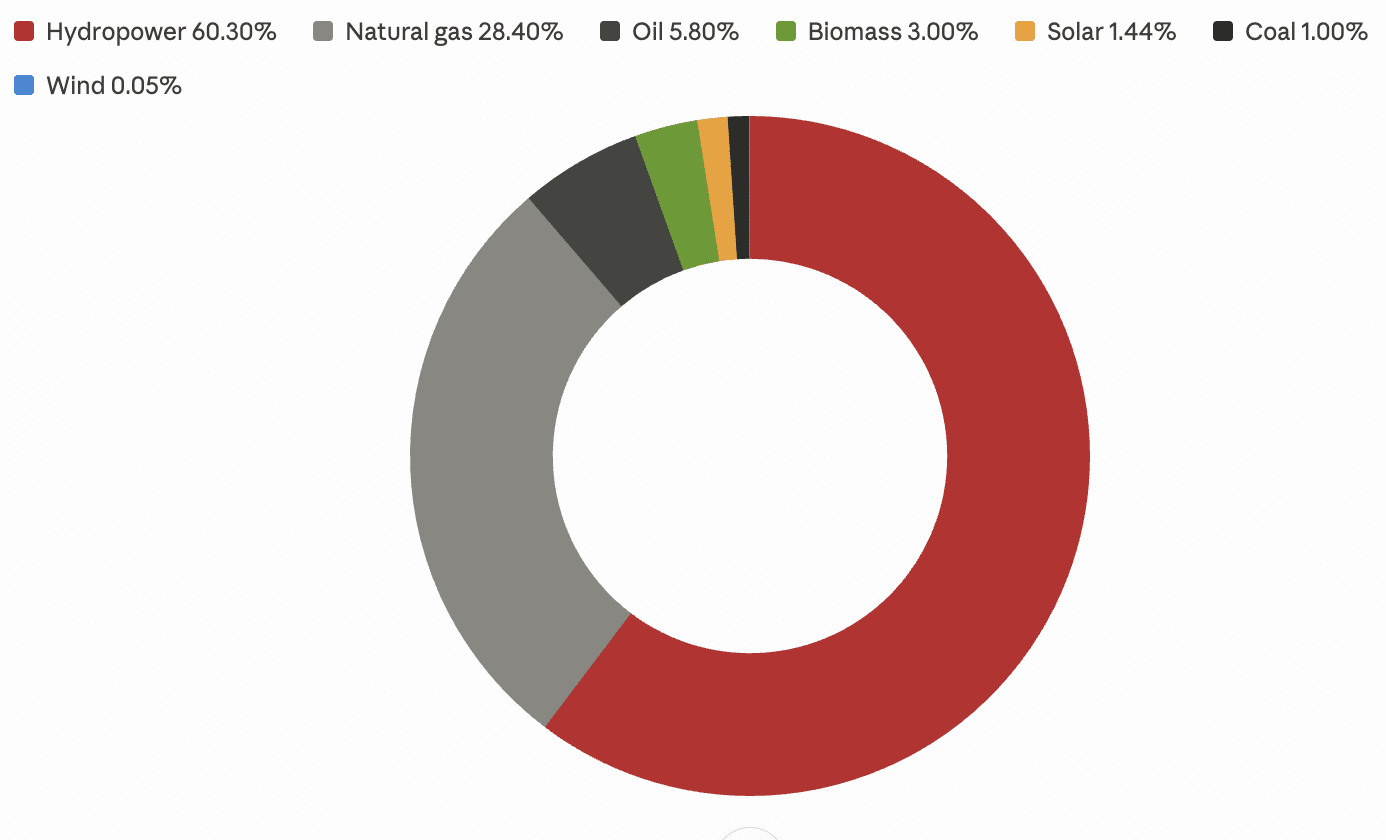
Tanzania Installed Power Generation Capacity by Source in % of MW, March 2026
Minister Ndejembi highlighted that installed power generation capacity reached 4,522.54 MW by March 2026, a 12.17% increase from 4,031.71 MW a year earlier, with electricity access rising to 85.5% from 78.4% in 2020.

Hydropower accounted for 60.30% of installed capacity at 2,727.31 MW, followed by natural gas at 1,284.58 MW (28.40%), oil at 262.36 MW (5.80%), biomass at 135.49 MW (3.00%), solar at 65 MW (1.44%), coal at 45.40 MW (1.00%) and wind at 2.40 MW (0.05%).
A further 492.94 MW of capacity is operated outside the national grid, with TANESCO contributing 98.16 MW and private operators 394.78 MW.
To stabilise supply in border regions, TANESCO imports 47 MW from Uganda for the Kagera region and 20 MW from Zambia for the Rukwa region.
The transmission network expanded by 9% to 8,500.38 kilometres by March 2026, comprising 1,524.75 km at 400 kV, 4,095.62 km at 220 kV, 2,300.01 km at 132 kV and 580 km at 66 kV.
The distribution network grew by 20% to 240,229.56 kilometres over the same period.
Electricity access reached 85.5% in 2026 from 78.4% in 2020, while household connectivity rose to 52.1% from 37.7% in 2020, with the Government targeting 75% connectivity by 2030 through 8.3 million new household connections.
Peak electricity demand reached 2,199.06 MW on 4 February 2026, up 15.24% from 1,908.15 MW in February 2025.
By March 2026, 105,739 customers had been connected to smart meters under TANESCO’s ongoing rollout, and 5,770,559 customers were receiving outage and service notifications by SMS.
Power Generation Projects in 2026/27
The 150 MW Kishapu solar project in Shinyanga will receive TZS 83.49 billion in external financing to complete the first phase and begin construction of an additional 100 MW; the first 50 MW phase, built at a cost of TZS 118.68 billion, is already connected to the national grid.
The 49.5 MW Malagarasi hydropower project in Kigoma will receive TZS 74.82 billion in external financing for the main dam, headrace culvert, surge tank, powerhouse and switchyard.
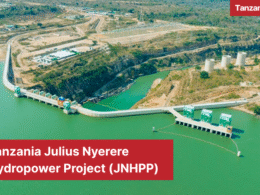
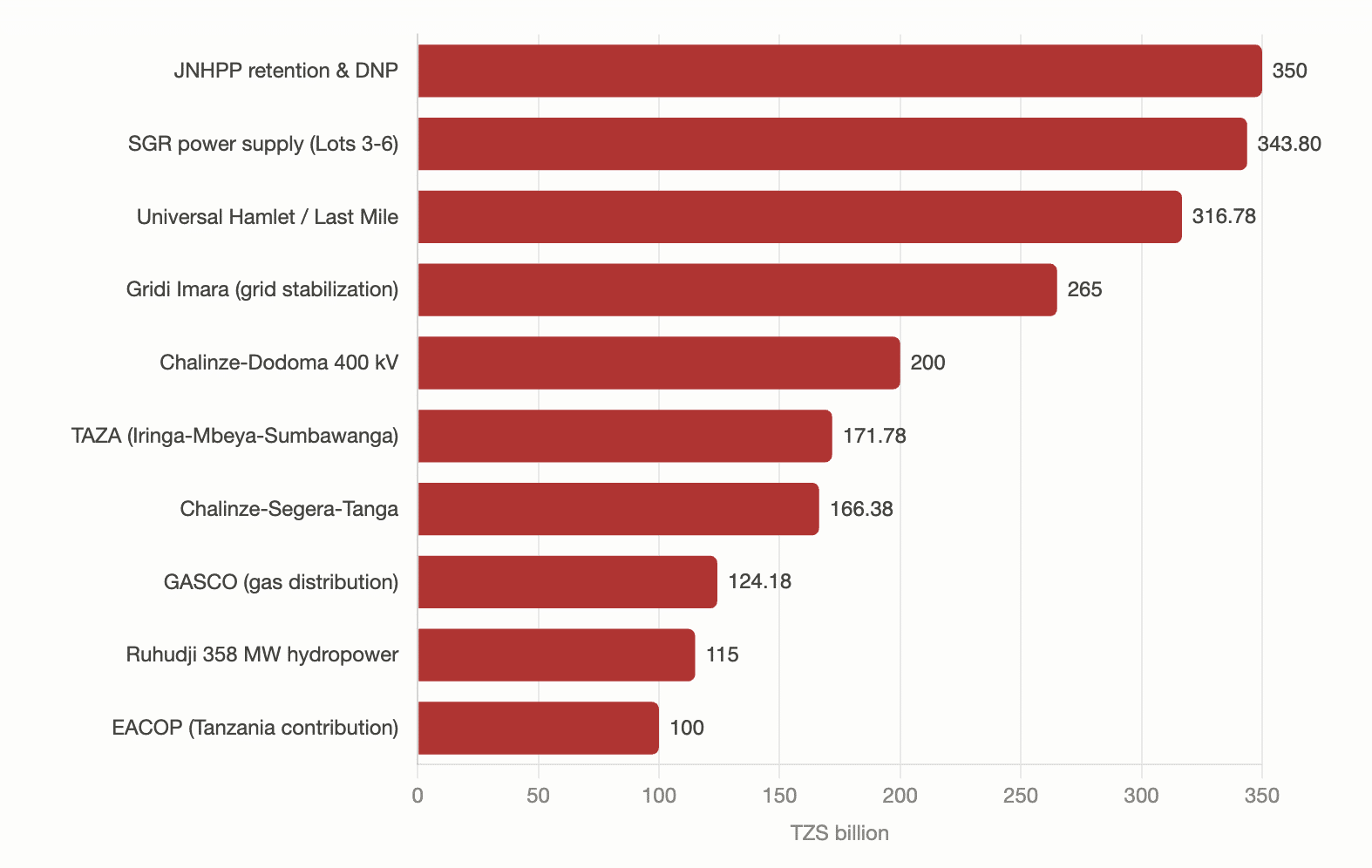
The 2,115 MW Julius Nyerere Hydropower Project (JNHPP), which now has all nine turbines operational, will receive TZS 350 billion in domestic financing for retention payments, the Defects Notification Period, and continued oversight.
The 87.8 MW Kakono hydropower project in Kagera will receive TZS 2 billion in domestic and TZS 93.19 billion in external financing for compensation payments and contractor procurement.
The 185 MW Kinyerezi I Extension gas-to-power project will receive TZS 20 billion domestic and TZS 3.85 billion external for final commissioning works at the Mbagala and Gongolamboto substations.
In the project preparation pipeline, the 358 MW Ruhudji hydropower project in Njombe will receive TZS 115 billion domestic; the 222 MW Rumakali hydropower in Njombe TZS 20 billion domestic for Public Private Partnership preparation; the 100 MW Same and 100 MW Singida solar projects TZS 1.15 billion external for feasibility studies; the 321 MW Kikonge hydropower in Ruvuma TZS 100 million; and the 300 MW Mtwara gas-to-power TZS 500 million for revised compensation valuation.
A new 1,000 MW Kinyerezi III gas-to-power project in Dar es Salaam has been allocated TZS 200 million for feasibility update and resettlement assessment.
Tanzania has also allocated TZS 7 billion in domestic financing to start preparation for nuclear power generation, with the Government targeting 8,000 MW of installed capacity by 2030 and 70,000 MW by 2050 under Vision 2050 (Dira 2050).
Top 10 Energy Projects Allocation, Budget 2026/27
Transmission and Distribution Investment in 2026/27
The 616.5 km Iringa-Mbeya-Tunduma-Sumbawanga 400 kV line (TAZA) receives TZS 4 billion domestic and TZS 167.78 billion external to finalise compensation payments and commission the substations.
The 345 km Chalinze-Dodoma 400 kV line receives TZS 200 billion domestic to complete construction, testing and energisation.
The 280 km Nyakanazi-Kigoma 400 kV line receives TZS 28.43 billion external to finalise the Kidahwe and Nyakanazi substations.
The 166.17 km Benaco-Kyaka 220 kV line in Kagera receives TZS 3 billion domestic and TZS 63.47 billion external for tower foundations, conductor stringing and the Benaco substation.
The National Grid Stabilization Project, known as Gridi Imara, receives TZS 265 billion domestic to deliver the 20 remaining sub-projects out of 27 covering transmission and distribution upgrades across multiple regions.
The TANESCO Transmission Grid Rehabilitation and Upgrading Programme (TTGRUP), co-financed by the French Development Agency (AFD), receives TZS 26.89 billion external to close out works at Mlandizi, Same, Bukoba, Mbeya, Tabora, Mufindi, Musoma and Mwanza substations.
The Ibadakuli substation in Shinyanga receives TZS 20 billion domestic to complete civil works and install a STATCOM voltage controller.
The 220 kV power supply lines for the Standard Gauge Railway (SGR Lots 3 to 6, covering Makutopora-Tabora-Isaka, Mwanza-Isaka and Tabora-Kigoma) receive USD 125 million, equivalent to about TZS 343.80 billion, through the SGR financing facility.
The submarine cable links from Tanzania Mainland to Zanzibar (49.95 km of 220 kV), from Tanga to Pemba (87 km of 132 kV) and from Mkuranga to Mafia (109.2 km of 33 kV) receive TZS 1.5 billion domestic and TZS 31.28 billion external.
The Chalinze-Segera 400 kV, Segera-Tanga 220 kV and Chalinze-Bagamoyo 220 kV lines receive TZS 15 billion domestic and TZS 151.38 billion external for consultant procurement and compensation.
The Tanzania-Uganda interconnector from Ibadakuli to Masaka, also at 400 kV, receives TZS 1.9 billion domestic for consultant and contractor procurement.
The Dodoma Ring Circuit receives TZS 6.06 billion through TANESCO for compensation and contractor procurement.
Rural Electrification in 2026/27
The Rural Energy Agency (REA) will continue the Hamlet Electrification Project Phase IIB across 9,009 hamlets in 25 regions, building 13,181 km of medium-voltage lines, 14,016 km of low-voltage lines, installing 9,009 transformers and connecting an initial 290,300 customers, with TZS 20 billion in domestic financing allocated for 2026/27.
A parallel Phase IIA targets 3,060 hamlets across the country’s 204 electoral constituencies, with TZS 75 billion in domestic financing covering 528 km of medium-voltage lines, 6,040 km of low-voltage lines, 3,056 transformers and 100,704 initial customer connections.
The Universal Hamlet Electrification and Last Mile Customer Connection programme, part of Tanzania’s Mission 300 commitment, receives TZS 188.8 billion domestic and TZS 127.98 billion external to extend power to 279 streets in Pwani, Morogoro and Dodoma, with rollout to other regions to follow.
A Norway-financed hamlet electrification project in Lindi region receives TZS 2 billion to extend 352.45 km of medium-voltage lines, 430 km of low-voltage lines and 230 transformers, reaching 230 hamlets and 7,590 initial customers.
The Island Densification Project, co-financed by the World Bank, receives TZS 18 billion to connect 7,257 households on 143 small islands in the Indian Ocean, Lake Victoria and Lake Tanganyika through a combination of standalone solar systems and mini-grids.
A separate programme to electrify communities along the East African Crude Oil Pipeline (EACOP) corridor receives TZS 5.20 billion domestic and TZS 2.60 billion from the EACOP company itself, connecting an initial 759 customers across 17 hamlets in Kagera and Geita regions.
National Energy Compact and Clean Cooking Strategy
Tanzania’s National Energy Compact 2025-2030, also known as Mission 300, aims to lift electricity access from 78.4% in 2025 to 100% by 2030, raise household connectivity from 46% to 75%, lift the renewable share of generation from 61.8% to 75%, and bring clean cooking adoption from 6.9% in 2021 to 75% by 2030.
The plan also targets USD 4.39 billion, equivalent to about TZS 11.218 trillion, in private sector investment across the energy sector by 2030, and 1.7 million new household connections per year, with TZS 5.4 billion allocated for programme coordination in 2026/27.
The National Clean Cooking Strategy 2024-2034 receives TZS 10 billion domestic for awareness, regulatory updates and technology research.
REA will supply LPG cylinders, energy-efficient stoves and electric cookers to 200,000 rural households across 25 Mainland regions at a cost of TZS 15 billion, and equip 300 institutions that serve more than 100 meals a day with clean cooking systems at a further cost of TZS 15 billion.
A pilot scheme with the Tanzania Petroleum Development Corporation (TPDC) will extend a natural gas distribution network to 500 households in Kisemvule village in Mkuranga district, Pwani region, at TZS 3 billion.
REA will also fund subsidies for women, youth and entrepreneurs producing alternative charcoal and improved stoves at a cost of TZS 3 billion.
Petroleum and Natural Gas Sub-sector in 2026/27
In oil and gas exploration, TPDC will continue work in the Eyasi-Wembere block with TZS 20 billion domestic for a second phase of 2D seismic data acquisition over 321 km and processing of 1,360 km of 2D data.
The Lindi-Mtwara block receives TZS 20 billion domestic for a second phase of 3D seismic acquisition over 386.3 square kilometres and parallel discussions with potential strategic partners.
The Songo Songo West block receives TZS 83.21 billion through TPDC for 3D seismic acquisition over 421 square kilometres in shallow waters.
In gas production, the Mnazi Bay block in Mtwara receives TZS 81.04 billion through TPDC for continued production and completion of the Kasa-1 exploration well.
The Ntorya field in the Ruvuma block receives TZS 20.35 billion through TPDC for the Chikumbi-1 exploration well and refurbishment of the Ntorya-1 and Ntorya-2 wells, expected to deliver 40 to 60 million cubic feet of gas per day on commissioning.
The Liquefied Natural Gas (LNG) project receives TZS 20 billion domestic to finalise host government agreements with international energy partners and progress the Project Development Plan.
The 34.2 km Ntorya-Madimba gas pipeline receives TZS 21.82 billion through TPDC, with a planned throughput of around 140 million cubic feet of gas per day.
In gas distribution, TPDC will roll out five mobile CNG stations across Dar es Salaam, Morogoro and Dodoma at a cost of TZS 22.06 billion, and extend gas distribution to government offices, embassies, hotels and homes in Mtumba, Dodoma at a cost of TZS 14.40 billion.
A separate gas distribution scheme in Mtwara town receives TZS 5.20 billion, and an industrial gas connection programme in the Coast region receives TZS 8.23 billion.
In oil transport and storage, Tanzania’s contribution to the East African Crude Oil Pipeline (EACOP) is set at TZS 100 billion in domestic financing for the Chongoleani marine terminal in Tanga and other works.
The new TAZAMA pipeline carrying refined products from Tanzania to Zambia receives TZS 5 billion for front-end engineering design and the Environmental and Social Impact Assessment.
The refurbishment of Tank 8 at the TIPER terminal in Kigamboni, Dar es Salaam, with storage capacity of 45 million litres, receives TZS 9.72 billion through TPDC.
The cross-border gas pipeline projects to Uganda and to Kenya receive TZS 4.18 billion through TPDC for feasibility studies and consultant procurement.
TPDC subsidiaries TANOIL and GASCO receive TZS 78.21 billion and TZS 124.18 billion respectively, with GASCO continuing infrastructure operations and gas distribution to homes, institutions and CNG stations.
Want to know more about Energy in Tanzania? Our free overview of the Tanzania Business and Investment Guide 2026 covers Energy, plus key sectors and investment opportunities. The complete 141-page edition includes policies, taxation, key regulations, full macroeconomic data, and sources, and is also available at no cost upon completion of a short form.
Download Free OverviewGet the Full Edition for Free