Construction of New Dar Selander Bridge Start

Selander Bridge

On 20th December 2018, Tanzania’s President Hon. Dr. John Magufuli laid the foundation stone for the construction of the new Selander bridge in Dar es Salaam.

The bridge will link the area of ​​Aga Khan and Coco Beach and is aimed at reducing traffic congestion on Ali Hassan’s Mwinyi road.

The bridge will be 6.2 kilometers long and 20.5 m wide and will have 4 ways for cars and 2 pedestrian routes.
Tanzania Investment Guide 2026 Free Edition

During the foundation stone-laying ceremony the Chief Executive Officer of the Tanzania Road Agency (TANROADS) Engineer Patrick Mfugale said the construction of the bridge would last 30 months and will cost TZS 256 billion.

The funding is provided by a concessionary loan from the Republic of Korea through its Economic Development Cooperation Fund(EDCF), established to promote economic cooperation between Korea and developing countries.

President Magufuli thanked the Government of Korea for the funding, saying that “The Republic of Korea is our true friends, they have helped us build the Kikwete Bridge across the Malagarasi River in Tanzania, and have helped build other projects.”

The new Selander Bridge is meant to replace the old Sealander bridge that was first built in 1929 to connect the central Dar es Salaam to the southeastern Oyster Bay neighborhood.

The present bridge was funded by the Japan International Cooperation Agency in 1980 and was its first road project in Tanzania.
TanzaniaInvest Capital Markets Report Banner

Want to know more about Transport in Tanzania? Our free overview of the Tanzania Business and Investment Guide 2026 covers Transport, plus key sectors and investment opportunities. The complete 141-page edition includes policies, taxation, key regulations, full macroeconomic data, and sources, and is also available at no cost upon completion of a short form.

Download Free OverviewGet the Full Edition for Free
Related Posts
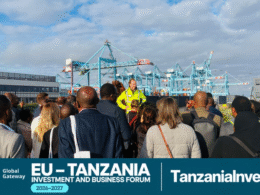
EU-Tanzania Roadshow 2026 APM Terminals at Maasvlakte Rotterdam
Read More

EU–Tanzania Roadshow Ends With Rotterdam and Antwerp Port Visits as Tanzania Pitches Port, Rail and Logistics Opportunities to European Companies

The EU-Tanzania roadshow ended in Antwerp on 6 October 2026 after port visits in Rotterdam, with Tanzania's port and rail authorities pitching openings for terminal operators, EPC contractors, private rail operators and digital rolling stock tracking, while rail operator Vecturis, minerals logistics group Polytra, heavy lifting company Sarens and marine data company GEOxyz outlined their plans in Tanzania. The EU said it will join the World Bank and the EIB, which has a formal financing request, in supporting the Dar es Salaam port expansion, and offered Global Gateway guarantees, equity and feasibility funding for company projects screened by member states.
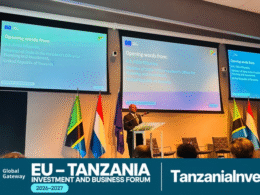
EU-Tanzania Roadshow 2026 The Hague day 1 opening Mkumbo
Read More

EU–Tanzania Roadshow Reaches The Hague With Coffee, Cashew, Critical Minerals, and Port Investment Pitches

The EU-Tanzania roadshow reached The Hague on 5 October 2026 for its final leg, where Tanzania pitched coffee and cashew processing, wheat and edible oils, critical minerals, the new Bagamoyo and Mwambani ports on the mainland, Zanzibar's Mangapwani port hub, four dry ports, and two new lines of the standard gauge railway network to around 90 businesses. Agriculture emerged as the priority sector for European and Dutch investors, with the best opportunities in food production and value addition, backed by Dutch expertise as the world's second-largest agricultural exporter.
Read More

Tanzanian Delegation Visits Agribusiness, AI, Data Centre and Railway Facilities on Day Two of EU–Tanzania Roadshow in Italy

On 2 October, Tanzanian agribusiness and digital delegations visited facilities in Emilia-Romagna during the EU–Tanzania roadshow’s Italian leg. On the second day of the EU–Tanzania roadshow in Italy, the agribusiness delegation visited Apofruit–Almaverde, Martini Group and Unitec to examine post-harvest handling and cold storage, livestock and food operations, and fruit sorting, grading and training. A separate group led by Deputy Minister Pius Chaya visited the University of Bologna, DAMA Tecnopolo and Bologna San Donato to learn about artificial intelligence, Industry 4.0, supercomputing, data centres and railway testing.