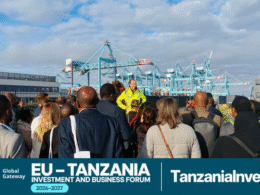
The World Bank is assessing whether to finance a second phase of the Dar es Salaam Port improvement programme, after the first phase reached 85% completion and helped lift the port’s annual cargo throughput from 14 million tonnes in 2015/16 to 32.8 million tonnes in 2025/26.
The signal came during a three-day working visit to Tanzania by the World Bank Regional Vice President for Eastern and Southern Africa, Dr. Ndiamé Diop, who toured the port and held talks with senior government officials in Dar es Salaam and Zanzibar.
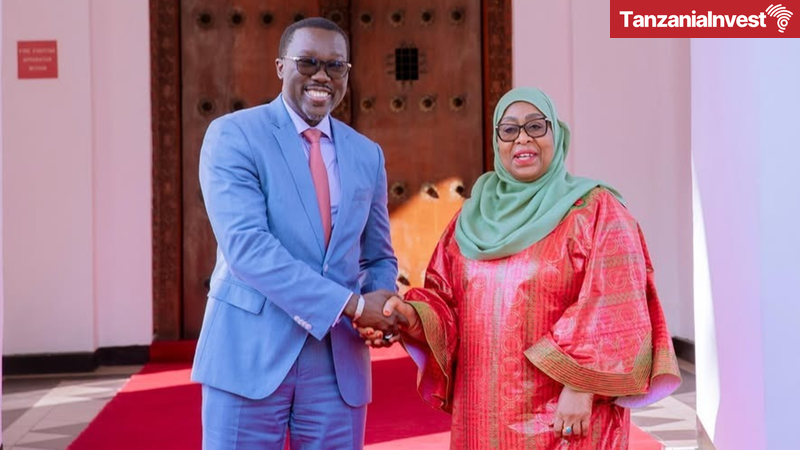
The President of the United Republic of Tanzania, Dr. Samia Suluhu Hassan, received Diop at State House in Dar es Salaam on 20 August 2026 for discussions centred on accelerating strategic investments behind the country’s economic transformation.

The talks covered the Standard Gauge Railway (SGR), regional transport and energy connectivity, modern agriculture, fisheries, education and skills development, alongside options for mobilising private capital into productive sectors.
Samia thanked the institution for its longstanding engagement in education, energy, infrastructure and agriculture, and pressed for cooperation more tightly aligned with Tanzania’s long-term development priorities.
“We appreciate the World Bank’s contribution to Tanzania’s development. As we move into the next phase of our transformation, our priority is to ensure that investments in infrastructure translate into greater production, trade, investment and jobs for our people,” Samia said.
The President framed Tanzania’s location as a gateway to East, Central and Southern Africa, arguing that railway, port, road and energy spending should deepen regional integration while opening commercial opportunities along the central corridor.
She set out an expansive reading of what the country’s flagship railway investment is meant to deliver beyond transport capacity itself.

“The SGR project is more than a railway. We see it as an economic corridor that can stimulate industries, agriculture, logistics, new urban centres and regional trade. We want to maximise the economic opportunities created by these major investments,” she said.
On agriculture, Samia set out a shift towards commercial and climate-resilient farming underpinned by irrigation, mechanisation, technology, value addition and stronger links between producers and markets.
Diop, for his part, commended the country’s development record and restated the World Bank’s commitment to supporting delivery of the National Development Vision 2050, the long-term framework guiding public investment.
He singled out progress under Mission 300, the joint World Bank and African Development Bank drive to connect 300 million Africans to electricity by 2030, and pointed to education gains he had observed in Zanzibar.
“We are very excited to support Tanzania’s Vision 2050. What we are seeing in areas such as energy and education demonstrates what can be achieved when investments are linked to clear development outcomes,” Diop said.
Both sides gave weight to the private sector’s role in delivering the transformation agenda, with the World Bank expressing interest in helping create the conditions for stronger private-sector growth and in mobilising private capital into infrastructure and productive sectors.
At the port itself, Diop reported that the first phase of the improvement programme had produced significant efficiency gains, shortening vessel turnaround times and speeding up cargo operations for Tanzania and its landlocked neighbours.
The Director General of Tanzania Ports Authority (TPA), Plasduce Mbossa, credited the World Bank’s technical and financial support with the improvement in service levels and the port’s competitive position on the regional market.
The Minister for Finance, Ambassador Khamis Mussa Omar, met Diop separately on the same day, with the World Bank signalling that its next tranche of cooperation would target the conversion of the central corridor into a fully-fledged economic corridor.
Diop said that future engagement would extend past transport infrastructure into agriculture, agro-processing, mining, manufacturing and logistics along the route, and would include extending the railway network towards Burundi.
The meeting was also attended by the Acting Permanent Secretary in the Ministry of Finance, Nsubili Joshua, and the World Bank Country Director for Tanzania, Firas Raad.
Earlier in the visit, on 19 August 2026, Diop met the President of Zanzibar, Dr. Hussein Ali Mwinyi, at State House in Zanzibar, where the two sides agreed to concentrate cooperation on education, health, energy and infrastructure.
Mwinyi called for faster implementation of development projects so that benefits reach citizens sooner, while setting out plans to expand school and college infrastructure, recruit more teaching staff and digitalise education delivery.
World Bank Engagement in Tanzania and the Dar es Salaam Maritime Gateway Project
The World Bank is Tanzania’s largest single development finance partner, with an active portfolio of approximately USD 8.96 billion across 35 operations, of which 32 national projects account for USD 8.78 billion and three regional projects for roughly USD 180 million.
Transport, education, energy, urban resilience and water absorb the bulk of those commitments, and recent approvals include USD 300 million for a second education and skills programme and USD 272 million for the third phase of the Productive Social Safety Net, both cleared in March 2026.
The first phase of the port upgrade is formally the Dar es Salaam Maritime Gateway Project, approved by the World Bank Board on 30 June 2017 and financed through a USD 345 million International Development Association (IDA) credit and a USD 12 million grant from the United Kingdom’s development agency, alongside a government contribution that brought the total programme cost to about USD 421 million.
Its works package covers deepening and strengthening berths 1 to 7, dredging the entrance channel and turning basin to accommodate larger vessels, constructing a roll-on/roll-off terminal, and improving the Gerezani creek area, with the objective of raising handling capacity and cutting dwell times.
The World Bank does not finance the SGR, which is being built with a mix of domestic budget resources and syndicated commercial debt, including a USD 1.2 billion syndication led by the African Development Bank and a USD 2.33 billion package arranged in 2026 for completion of the first phase.
Its railway exposure instead sits on the parallel metre gauge line, through a USD 200 million second phase of the Tanzania Intermodal and Rail Development Project covering the Dar es Salaam to Tabora and Tabora to Isaka sections.
On 17 August 2026, days before Diop’s arrival, the government and the World Bank finalised KAZI MPA, the Catalyzing Jobs and Resilient Growth in the Central Corridor programme, designed to raise youth employment and competitiveness along the trade route linking the port of Dar es Salaam to landlocked neighbours.
Under Mission 300, which was launched at a heads of state summit in Dar es Salaam in January 2025, 7.5 million Tanzanians have gained first-time access to electricity, representing a five-fold acceleration on the average annual pace recorded before the initiative began.
Want to know more about Transport in Tanzania? Our free overview of the Tanzania Business and Investment Guide 2026 covers Transport, plus key sectors and investment opportunities. The complete 141-page edition includes policies, taxation, key regulations, full macroeconomic data, and sources, and is also available at no cost upon completion of a short form.
Download Free OverviewGet the Full Edition for Free