
President Kikwete Advocates the Involvement of Tanzanian Companies in Economic Growth and Gas Industry

President Jakaya Kikwete had opened the 19th Annual Research Workshop of the Research for Poverty Alleviation (REPOA) in Dar es Salaam with a speech on importance of translating economic growth into jobs, promotion of micro, small, and medium enterprises (MSMEs), and finalization of policy legislation on oil.

Addressing researchers, Regional Commissioners, District Comissioners, Honourable Ministers, and Heads of diplomatic missions, President Kikwete promised to present oil and gas extraction legislation to the Parliament by October 2014 or by February 2015.

Given that oil and gas were named a priority subsector, the legislation will ensure productive participation of people of Tanzania in the utilization of the natural resources, as well as collaboration between government and private companies.

Tanzania Investment Guide 2026 Free Edition

“We hope that the private sector, working closely with the government, will proactively engage in the efforts to build the capacity of Tanzanians in different disciplines that are relevant to the various segments of our natural resources”, said President Kikwete, adding: “Promotion of MSMEs is a critical matter in ensuring social and economic development”.

REPOA is an independent research institution, aimed at facilitating socio-economic development in Tanzania.

Its 19th Annual Research Workshop focused on inclusive growth transformation and improving productivity in Tanzania.

Want to know more about the Economy in Tanzania? Our free overview of the Tanzania Business and Investment Guide 2026 covers the Economy, plus key sectors and investment opportunities. The complete 141-page edition includes policies, taxation, key regulations, full macroeconomic data, and sources, and is also available at no cost upon completion of a short form.

Download Free OverviewGet the Full Edition for Free


Related Posts
Interview Jana Bricco IMF Resident Representative Tanzania no logo
Read More

Interview with Jana Bricco, New IMF Resident Representative in Tanzania, on Economic Growth, Private Investment, and Needed Reforms

In this exclusive interview with TanzaniaInvest, the new IMF Resident Representative Jana Bricco says Tanzania can sustain growth of around 6% by preserving macroeconomic stability and accelerating reforms supporting private investment, productivity and jobs. She calls for fewer regulatory obstacles, more predictable taxation, faster VAT refunds and better access to finance for businesses and SMEs, and explains how IMF support will evolve following the end of its financing programmes, with the relationship now focused on policy dialogue and capacity development.
Tanzania Qatar Tax Treaty Signature
Read More

Tanzania and Qatar Sign Tax Treaty to Boost Investment

Tanzania and Qatar signed a Double Taxation Agreement (DTA) on 29 September 2026, eliminating double taxation on cross-border income between the two countries. Both countries are now moving toward rapid implementation, aiming to deepen economic cooperation and attract new investment across infrastructure, energy, tourism and financial services.
Samia Suluhu Hassan Tanzania Cabinet reshuffle September 2026
Read More

Tanzania Names New Works, Energy and Legal Affairs Ministers

President Samia Suluhu Hassan reshuffled Tanzania's Cabinet on 27 September 2026, naming new ministers for Works, Energy, and Constitution and Legal Affairs. Four other senior appointments were also announced, including a new Chief Medical Officer and Deputy Permanent Secretary for Finance.
TISEZA Investment Bulletin Q2 2026: USD 1.88 Billion Registered, SEZ Capital Hits USD 3.38 Billion as China Leads FDI
Read More

Tanzania Investment Bulletin Q2 2026: USD 1.88 Billion Registered Mostly in Manufacturing, China Leads FDI

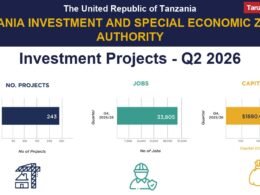
The Tanzania Investment and Special Economic Zones Authority (TISEZA) registered 243 investment projects worth USD 1.88 billion between April and June 2026, while seven Export Processing Zone (EPZ) and Special Economic Zone (SEZ) projects attracted USD 3.38 billion, led by China. The seven EPZ and SEZ projects are projected to create 30,235 jobs and generate USD 517.8 million in export turnover, mostly in agriculture and forestry.