

The fifth review of the International Monetary Fund (IMF) program in Tanzania concluded that the country’s macroeconomic performances remain strong.
The conclusion was made by the IMF staff after their visit to Tanzania on October 18th–28th, 2016 for the fifth review of the Policy Support Instrument (PSI).
The PSI helps low-income countries to design effective economic plans that once approved by the IMF, are addressed to international donors, multilateral development banks, and foreign markets.

“Preliminary data for the first half of 2016 indicate that economic growth was strong and that the projected growth rate of around 7% for the year as a whole remains within reach. […]Inflation declined to 4.5% in September, below the target of 5%. […]Implementation of the PSI-supported program has been satisfactory,” the IMF staff commented.
The IMF staff also notes that Tanzania has made notable progress in increasing revenue collection and that the country is at low risk of external debt distress and has room to borrow externally to meet its financing needs.
However, current spending has been lower than programmed, which had led to a fiscal surplus in Q1 2016.
The IMF commended the Tanzanian authorities’ efforts to improve the efficiency of spending and noted that it should not compromise the delivery of essential services.
However, the mission concluded that it was essential for Tanzania to improve the dialogue with the private sector and accelerate reforms to bolster the business environment.

Tanzania Macroeconomic Performances
Tanzania’s GDP grew by 7% in 2015, with activity particularly strong in the construction, communication, finance, and transportation sectors.
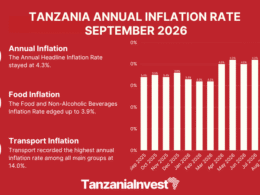
Inflation in Tanzania remained in single digits throughout 2015, averaging 5.6%, close to the authorities’ target of 5%. In September 2016, the country’s annual inflation rate fell to 4.5%.
Want to know more about the Economy in Tanzania? Our free overview of the Tanzania Business and Investment Guide 2026 covers the Economy, plus key sectors and investment opportunities. The complete 141-page edition includes policies, taxation, key regulations, full macroeconomic data, and sources, and is also available at no cost upon completion of a short form.
Download Free OverviewGet the Full Edition for Free