


The African Development Bank (AfDB) recently presented the 2023 edition of its flagship African Economic Outlook report.
The report shows that Africa has remained broadly resilient despite experiencing significant shocks, particularly from the Covid-19 pandemic, climate change, and the Russian invasion of Ukraine.
From an economic growth of 3.8% in 2022, the continent is set to climb to 4.1% in 2023 and 2024, exceeding the global average by 2.9% and the European average by 1.1%.

Recent Macroeconomic and Financial Developments in Tanzania
According to the report, Tanzania’s real GDP growth slowed to 4.7% in 2022 from 4.9% in 2021 due in part to the impact of Russia’s invasion of Ukraine, notably on food and energy prices.
Growth was driven by services and agriculture on the supply side and by investment and consumption on the demand side.
The accommodative monetary policy was tapered in June 2022 to contain inflationary pressures while supporting the growth recovery.
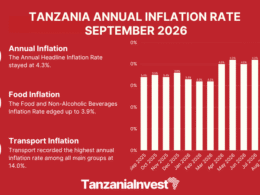
But rising food and fuel prices pushed inflation to 4.3% in 2022 from 3.7% in 2021. Exchange rates remained stable, supported by high gold exports and tourism receipts.
The fiscal deficit narrowed to an estimated 3.4% of GDP in 2022 from 3.8% in 2021, in line with the pickup in revenue performance, and was financed by external and domestic borrowing.

Public debt remains sustainable and stabilized at 40.4% of GDP in 2021 and 40.9% in 2022.
The current account deficit widened to 5.7% of GDP in 2022 from 3.4% in 2021, driven by the uptick in the import bill due in part to higher oil prices, and was financed mainly by external commercial debt as other financial flows including foreign direct investment and grants declined.
International reserves dropped to 4.7 months of import cover in December 2022 from 6.6 months in December 2021, reflecting the tighter external financing environment.
The poverty rate increased from 26.1% in 2019 to 27.7% in 2020 due to the economic slowdown induced by the COVID-19 pandemic, while inequality, measured by the Gini coefficient, increased from 0.42 in 2015 to 0.44 in 2021.
Economic Outlook and Risks for Tanzania
The AfDB estimates that real GDP growth is projected to rise to 5.3% in 2023 and 6.3% in 2024, driven by the sustained recovery in tourism and gradual stability in supply and value chains.
Inflation is projected to increase to 4.7% in 2023 due to higher food and energy prices before moderating to 4.0% in 2024 due to better agricultural performance.
The fiscal deficit is projected to widen to 3.5% of GDP in 2023 and 2024 due to higher spending on infrastructure, financed by domestic and external borrowing.
The current account deficit is projected to narrow to 4.8% of GDP in 2023 and 4.4% in 2024 due to higher merchandise exports and tourism receipts and is projected to be financed mainly by external borrowing.
However, headwinds include the lingering possibility of new COVID-19 variants and the effects of Russia’s invasion of Ukraine, which could aggravate food and oil prices.
Want to know more about the Economy in Tanzania? Our free overview of the Tanzania Business and Investment Guide 2026 covers the Economy, plus key sectors and investment opportunities. The complete 141-page edition includes policies, taxation, key regulations, full macroeconomic data, and sources, and is also available at no cost upon completion of a short form.
Download Free OverviewGet the Full Edition for Free