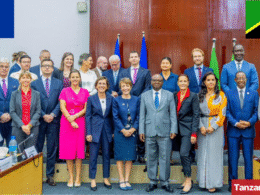


On 19th October 2023, the Tanzanian and the US governments signed a Memorandum of Cooperation (MoC) in Dar es Salaam designed to amplify the trade relationship between the two countries.
Key areas within the agreement include the digital economy, market access, regulatory and business climate reforms, and trade missions.
The agreement aligns with the Tanzanian government’s ongoing efforts to create a conducive environment for foreign and local investors.

Dr. Ashatu Kijaji, Minister for Industries and Trade of Tanzania, commented, “This commercial dialogue agreement will boost the commercial and investment relationship between the two countries.”
For his part, the US Ambassador to Tanzania, Michael Battle, added, “At the heart of this commercial dialogue is the commitment by the governments to build a stronger, more robust, and equally beneficial trade relationship.”
The American Embassy in Tanzania shared on their Twitter account, “The bilateral commercial dialogue signed by US Secretary of Commerce Raimondo and Tanzania Minister of Industry and Trade Kijaji is about much more than cooperation between our two governments. It’s about unleashing the potential of the private sectors of both the US and Tanzania to increase overall bilateral commercial trade. Through annual meetings in both the US and Tanzania, our two countries will identify barriers to increased trade and will jointly implement solutions.”
Earlier in the year, US Vice President, Kamala Harris, visited Tanzania, emphasizing the potential for expanded business cooperation between the two nations.
US-Tanzania Trade and Investments
According to the US Trade Representative, bilateral trade between the US and Tanzania in 2022 amounted to USD 424 million.

The US exported USD 260 million worth of goods to Tanzania, while Tanzania exported USD 164 million worth of goods to the US.
The US’s main exports to Tanzania in 2022 included machinery, vehicles, and aircraft.
Tanzania’s main exports to the US in 2022 included coffee, cashews, and spices.
According to the same source, US FDI (stock) in Tanzania was USD 1.4 billion in 2022.
The main sectors attracting US FDI to Tanzania in 2022 were energy, mining, and manufacturing.
The US and Tanzania are working to deepen their economic ties through the African Growth and Opportunity Act (AGOA), which provides preferential access to the US market for goods from eligible African countries.
AGOA was authorized by the US Congress in 2000 and has been renewed several times since then.
The current authorization expires in 2025.
Want to know more about Trade in Tanzania? Our free overview of the Tanzania Business and Investment Guide 2026 covers Trade, plus key sectors and investment opportunities. The complete 141-page edition includes policies, taxation, key regulations, full macroeconomic data, and sources, and is also available at no cost upon completion of a short form.
Download Free OverviewGet the Full Edition for Free