


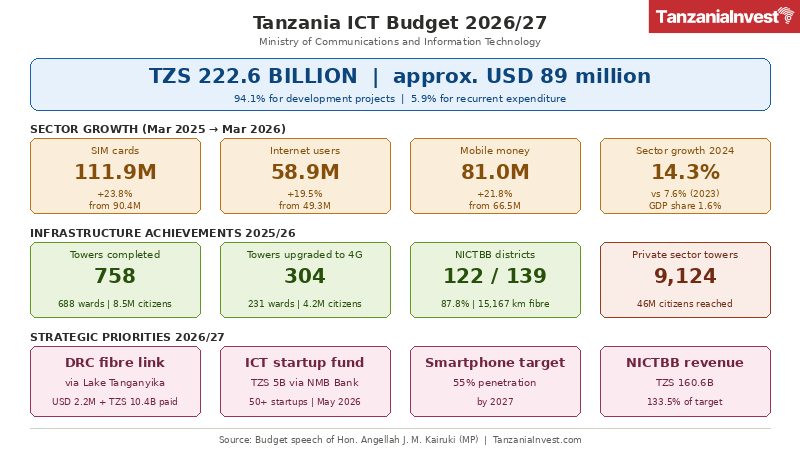
Tanzania’s Ministry of Communications and Information Technology has tabled a budget of TZS 222.6 billion (approximately USD 89 million) for the financial year 2026/27, with 94.1% allocated to development projects aimed at accelerating the country’s digital economy transformation.
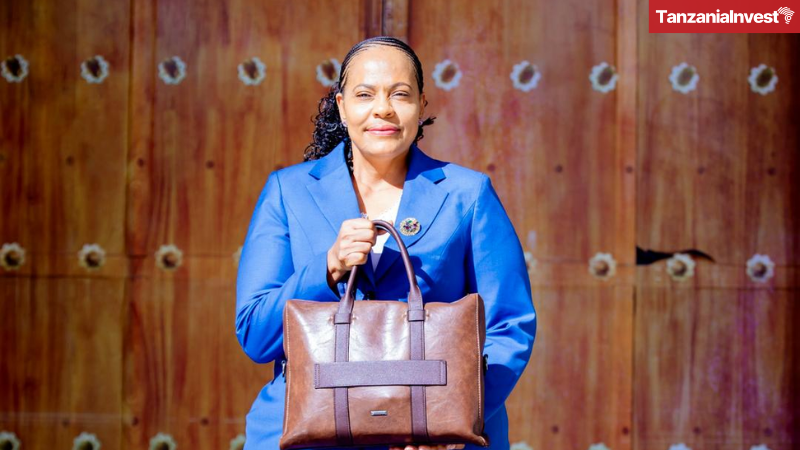
The budget was presented to Parliament by the Minister of Communications and Information Technology, Hon. Angellah Jasmine Mbelwa Kairuki (MP), and represents a strategic shift toward expanding digital infrastructure, supporting ICT startups, and strengthening cybersecurity nationwide.
Of the total TZS 222,589,451,000 allocation, TZS 13.1 billion is earmarked for recurrent expenditure, while TZS 209.4 billion is dedicated to development projects.

Within the development budget, TZS 98.5 billion will come from domestic sources and TZS 110.9 billion from external financing.
The Ministry projects revenue collection of TZS 160.3 billion for 2026/27, generated entirely from National ICT Broadband Backbone (NICTBB) services.
Sector Performance and Economic Contribution
Tanzania’s information and communications sector grew by 14.3% in 2024, compared to 7.6% in 2023, according to the National Economic Survey 2024.
The sector’s contribution to GDP increased from 1.5% in 2023 to 1.6% in 2024.
Registered SIM cards rose from 90.4 million in March 2025 to 111.9 million in March 2026, marking a 23.8% increase.

Internet users grew from 49.3 million to 58.9 million over the same period, equivalent to a 19.5% rise.
Mobile money users expanded from 66.5 million in March 2025 to 81.0 million in March 2026, an increase of 21.8%.
Communications infrastructure providers reached 52 in March 2026 from 38 in March 2025, a 36.8% increase, while application and value-added services providers grew from 136 to 173, a 27.2% rise.
Infrastructure Achievements in 2025/26
The Ministry completed the construction of 758 telecommunications towers across 688 wards, benefiting approximately 8.5 million citizens.
An additional 304 towers in 231 wards were upgraded from 2G to 2G/3G and 4G, serving 4.2 million people.
Under the Rural Communications Project, 456 of 636 planned towers have been completed, equivalent to 72% of the target, with 342 already operational.
The remaining 180 towers are expected to be completed by December 2026, ultimately reaching 2.5 million additional citizens.
The National ICT Broadband Backbone (NICTBB) now connects 122 of 139 districts (87.8%) following the addition of 13 districts in the current fiscal year.
A total of 801 km of new fibre was built, while 1,193 km was received from the Consortium of Telco Operators, bringing the total network length to 15,167 km.
NICTBB revenue surged from TZS 56.3 billion in April 2025 to TZS 160.6 billion in March 2026.
Revenue collection reached TZS 160.7 billion against the TZS 120.4 billion target, equivalent to 133.5% of the planned amount.
USD 5 Million Startup Fund and Private Sector Engagement
President Samia Suluhu Hassan has fulfilled a campaign pledge by allocating TZS 5 billion for ICT startup financing as part of a broader TZS 200 billion package for SMEs and startups.
The funds will be disbursed through NMB Bank, targeting at least 50 ICT startups operating in fintech, legal tech, agri-tech, tourism tech, insur-tech, edu-tech, logistics tech, SaaS, and e-commerce.
Loan disbursements are expected to begin in May 2026, with applications processed through a digital platform integrated with NMB Bank.
A total of 402 ICT startups were registered during 2025/26 to facilitate access to capital.
Strategic Priorities for 2026/27
The Ministry has outlined eight priorities for the upcoming fiscal year, including completion of 636 rural towers and construction of 280 strategic towers along the SGR, MGR, and TAZARA railway corridors, national parks, and border areas.
Ten additional districts will be connected to the NICTBB, and the network will be extended to the Democratic Republic of Congo (DRC) via Lake Tanganyika, with initial payments of TZS 10.4 billion and USD 2.2 million already disbursed.
The Ministry will support the construction of National Data Centres in Dodoma and Zanzibar, install video conferencing equipment in 100 districts, and deliver Wi-Fi services to 100 public locations.
Broadband connections will be extended to 100 public institutions, the Mtumba Government City, and 100 public schools, while 321,000 fibre-to-the-home connections are targeted.
The National Digital Technology Institute (NDTI) will be established at Nala in Dodoma on a 1,619,000-square-metre site, alongside seven ICT innovation hubs.
The Ministry also plans to launch one satellite into space and coordinate the launch of the CUBESAT training satellite under the UNOOSA KIBOCUBE programme.
Want to know more about Telecoms in Tanzania? Our free overview of the Tanzania Business and Investment Guide 2026 covers Telecoms, plus key sectors and investment opportunities. The complete 141-page edition includes policies, taxation, key regulations, full macroeconomic data, and sources, and is also available at no cost upon completion of a short form.
Download Free OverviewGet the Full Edition for Free