


The Bank of Tanzania (BOT) released its Monthly Economic Review — May 2026, covering key macroeconomic indicators for the year ending April 2026, and the data points to an economy expanding on credit and exports while absorbing imported fuel-price pressure.
Headline inflation rose to 4% in April 2026, up from 3.2% in both the previous month and a year earlier, on fuel pass-through tied to Middle East tensions.
Exports grew 13.5% to USD 18,876.7 million, led by gold and travel receipts.

Credit to the private sector expanded 23.6%, with trade lending up 44.2%, while foreign exchange reserves reached USD 5,722.5 million, covering 4.4 months of imports.
The Central Bank Rate (CBR) was held at 5.75%, and the Tanzanian Shilling appreciated 2.7% year-on-year.
Inflation Rises to 4% on Fuel Pass-Through
Headline annual inflation increased to 4% in April 2026, from 3.2% in March 2026 and 3.2% in April 2025.
The rise reflected the pass-through of higher fuel prices linked to the geopolitical conflict in the Middle East, while remaining within the national target and the East African Community (EAC) and Southern African Development Community (SADC) benchmarks.
Core inflation, which excludes unprocessed food, energy and utilities, rose to 3.1% from 2.2% in both the previous month and a year earlier, driven by transport and household goods prices.

Core inflation contributed 2.4 percentage points to headline inflation, the largest share.
Annual food inflation reached 5.7%, up from 5.5% in March 2026 and 5.3% in April 2025, on higher wheat, rice and maize prices.
Energy, fuel and utilities inflation climbed to 5.3% from 2.1% the previous month, though below the 7.3% recorded in April 2025.
Transport inflation jumped to 9.2% on a 5.2% month-on-month increase in pump prices.
National Food Reserve Agency (NFRA) stocks stood at 500,962.3 tonnes at end-April 2026, down from 533,634 tonnes the previous month after the release of 32,672.05 tonnes of maize to traders.
Food inflation is expected to moderate with the harvest season beginning in May 2026.
Monetary Policy: CBR Held at 5.75%, Corridor Narrowed
At its April 2026 meeting, the Monetary Policy Committee (MPC) maintained the Central Bank Rate (CBR) at 5.75% for the quarter ending June 2026.
The MPC narrowed the CBR corridor from 200 basis points to 150 basis points to strengthen monetary policy transmission.
The 7-day interbank cash market (IBCM) rate averaged 6.15%, remaining within the corridor.
Banks’ demand for reverse repo fell to TZS 379.7 billion (approximately USD 145.3 million) from TZS 585.7 billion (approximately USD 224.2 million), reflecting improved liquidity.
Extended broad money supply (M3) grew 22% in April 2026, broadly similar to 23.2% the previous month, driven by private sector credit.
Private sector credit expanded 23.6% in the year to April 2026, from 24.3% the previous month.
Trade recorded the highest sectoral credit growth at 44.2%, followed by mining and quarrying and transport and communication, both at 39.7%, with agriculture at 30.5%.
Personal loans, largely financing micro, small and medium-sized enterprises (MSMEs), accounted for the largest share of outstanding credit at 35%.
Interest Rates Edge Higher
The overall lending rate rose to 15.33% in April 2026, from 15.11% in March 2026.
Negotiated lending rates for prime customers increased to 12.56% from 12.21%.
The overall deposit rate edged up to 8.54% from 8.33%, while the negotiated deposit rate eased to 11.37% from 11.57%.
The spread between one-year lending and deposit rates narrowed to 5.50 percentage points from 5.85 percentage points.
Financial Markets
Government Securities
The Bank conducted two Treasury bill auctions with a combined tender of TZS 429.8 billion (approximately USD 164.5 million).
Both were oversubscribed, attracting bids of TZS 859.5 billion (approximately USD 329 million), of which TZS 450.4 billion (approximately USD 172.4 million) was successful.
The overall weighted average yield on Treasury bills declined to 5.06% from 5.21% in March 2026.
The 5-year and 10-year Treasury bond auctions carried tender sizes of TZS 174.9 billion and TZS 144.6 billion respectively.
Both were oversubscribed, with total bids of TZS 408.3 billion (approximately USD 156.3 million), of which TZS 291.3 billion (approximately USD 111.5 million) was accepted.
Yields fell to 9.54% on the 5-year bond and 9.40% on the 10-year bond.
Interbank Cash Market
Interbank cash market turnover totalled TZS 2,708.5 billion (approximately USD 1.04 billion), up from TZS 2,699.5 billion the previous month.
The 7-day tenor dominated activity at 60.5%.
The overall IBCM rate rose to 7.32% from 6.32% in March 2026.
Interbank Foreign Exchange Market
Total transactions in the Interbank Foreign Exchange Market (IFEM) amounted to USD 64.6 million, compared with USD 137.5 million in March 2026 and USD 48.4 million in April 2025.
The Bank sold USD 15.3 million to maintain orderly market conditions.
The Shilling appreciated 2.7% year-on-year, trading at an average of TZS 2,612.46 per USD against TZS 2,684.41 per USD in April 2025, reversing a 3.9% depreciation in the year-earlier period.
Government Budgetary Operations
Revenue collection exceeded the monthly target by 8.5%, with total revenue of TZS 3,836.8 billion (approximately USD 1.47 billion) in March 2026.
Central government revenue reached TZS 3,703.3 billion (approximately USD 1.42 billion), 9.3% above target and 96.5% of the total.
Tax revenue rose to TZS 3,317.6 billion (approximately USD 1.27 billion), 10.8% above target, led by income tax which exceeded its target by 17.2%.
Non-tax revenue was TZS 385.7 billion (approximately USD 147.7 million), 1.7% below target.
Total expenditure stood at TZS 4,273.5 billion (approximately USD 1.64 billion), comprising TZS 2,545.3 billion (approximately USD 974.5 million) in recurrent spending and TZS 1,728.1 billion (approximately USD 661.6 million) in development spending.
Debt Developments
The national debt stock reached USD 51,067.2 million at end-April 2026, a 0.5% increase on the previous month, with external debt accounting for 70.4%.
External Debt
External debt stock (public and private) stood at USD 35,949.6 million, of which 82.7% was public.
External loan disbursements during the month totalled USD 54 million, mainly to the central government.
External debt service payments were USD 242 million, including USD 190.4 million in principal repayments.
Multilateral institutions remained the largest creditor category, followed by commercial lenders.
Transport and telecommunication accounted for the largest share of disbursed outstanding debt by use, followed by balance of payments and budget support.
The US Dollar dominated the currency composition at 66%, followed by the Euro at 17.7%.
Domestic Debt
Domestic debt rose 2.3% to TZS 39,335.8 billion (approximately USD 15.06 billion), mainly on use of the overdraft facility.
The Government raised TZS 392.3 billion (approximately USD 150.2 million) through securities, comprising TZS 245.1 billion in Treasury bonds and TZS 147.2 billion in Treasury bills.
Domestic debt servicing totalled TZS 552.1 billion (approximately USD 211.4 million), including TZS 275.2 billion in principal and TZS 276.9 billion in interest.
External Sector Performance
Current Account
The current account deficit widened to USD 2,651.8 million in the year ending April 2026, from USD 2,107.1 million a year earlier, a 25.6% increase.
The widening was driven by import growth that outpaced export gains.
Exports
Total exports of goods and services grew 13.5% to USD 18,876.7 million in the year ending April 2026, led by gold and travel receipts.
Goods exports, accounting for 59.7% of the total, rose to USD 11,215 million from USD 9,682.7 million a year earlier.
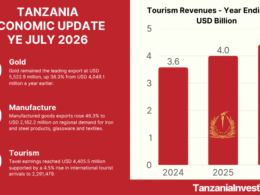
Gold exports increased 37.9% to USD 5,268.9 million, from USD 3,821.2 million, on sustained favourable global prices.
Manufactured goods exports grew 36.5% to USD 1,897.2 million, from USD 1,389.9 million, driven by iron and steel, glassware, and textiles.
Among traditional exports, tobacco rose 20% to USD 589.1 million, cashew nuts increased 20.3% to USD 479.7 million, and coffee grew 16.3% to USD 388.7 million.
Edible vegetable exports declined 18.2% to USD 326.3 million, from USD 398.9 million.
On a monthly basis, goods exports increased to USD 788 million in April 2026, from USD 649.9 million in April 2025, driven by gold and manufactured goods.
Service receipts grew 10.4% to USD 7,661.7 million, with travel receipts, at 57% of the total, the main driver.
Travel receipts rose 9.5% to USD 4,385.3 million, reflecting an increase in international arrivals to 2,281,340 from 2,162,487 a year earlier.
Transport receipts increased 17.2% to USD 2,834.8 million, from USD 2,419.3 million.
On a monthly basis, service receipts amounted to USD 525.8 million in April 2026, up from USD 493.8 million in April 2025.
Imports
Imports of goods and services increased 15.5% to USD 19,944.6 million, from USD 17,270.5 million.
Growth was led by industrial supplies, transport equipment and machinery, reflecting expanded manufacturing, construction and transport activity.
Imports of refined white petroleum products, about 14.4% of total goods imports, declined 3.6% to USD 2,415.8 million.
Monthly goods imports rose to USD 1,751.3 million in April 2026, from USD 1,111 million a year earlier.
Services payments increased 11.3% to USD 3,376.1 million, driven by higher freight costs.
The primary income account deficit narrowed to USD 1,852 million from USD 1,998.4 million.
The secondary income surplus fell to USD 268.1 million from USD 531.9 million on lower personal transfers.
Foreign Exchange Reserves
Foreign exchange reserves stood at USD 5,722.5 million in April 2026, up from USD 5,307.7 million a year earlier.
This covers 4.4 months of projected imports, consistent with national and EAC benchmarks.
Want to know more about Trade in Tanzania? Our free overview of the Tanzania Business and Investment Guide 2026 covers Trade, plus key sectors and investment opportunities. The complete 141-page edition includes policies, taxation, key regulations, full macroeconomic data, and sources, and is also available at no cost upon completion of a short form.
Download Free OverviewGet the Full Edition for Free