



The Bank of Tanzania (BOT) released its Monthly Economic Review-August 2024 which covers key macroeconomic indicators for the year ending July 2024.
GDP Growth
National accounts data released by the National Bureau of Statistics (NBS) in August 2024 indicate the economy to have grown at 5.6% in the first quarter of 2024 compared with 5% in the corresponding period in 2023.
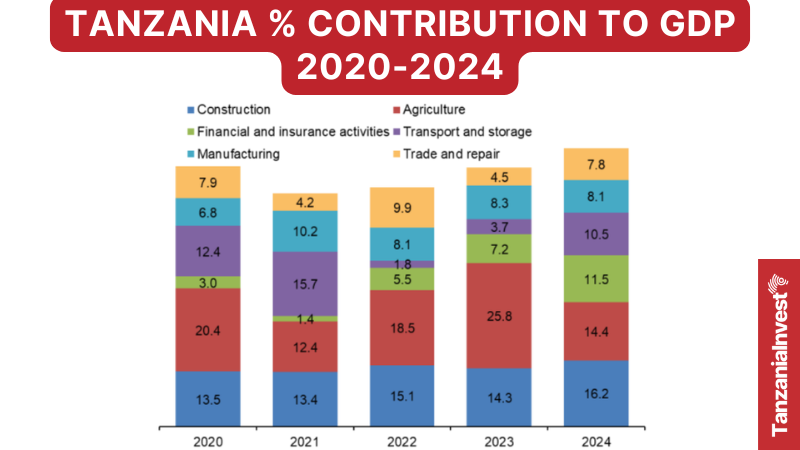
Construction, agriculture, and financial and insurance activities contributed the most to the growth outturn.

The fastest-growing economic activities were financial and insurance, information and communication, and electricity.
The structure of the economy remained virtually unchanged, dominated by agriculture, construction, and mining activities.
The BOT’s assessment of the economy’s performance based on high-frequency indicators for the second quarter of 2024 also shows continued strong growth. Therefore, there is a high likelihood of attaining a growth projection of 5.4% for 2024.
The performance is attributable to steady increases in public and private sector investment and growth of exports.
Inflation
Inflation remains low and stable, consistent with the country target of 5% and the EAC and SADC convergence criteria of a maximum of 8% and 3-7%, respectively.

Twelve-month headline inflation fell slightly to 3% in July 2024 from 3.1% in June 2024.
Core inflation also eased, declining to 3.3% in July 2024 from 3.6% in the previous month.
In contrast, food inflation saw a modest increase, rising to 1% in July 2024 from 0.9% in June 2024.
This increase was primarily driven by higher retail prices of key food crops, including maize, sorghum, round potatoes, wheat, and finger millet.
External Sector Performances
The external sector performance has shown continued improvement, driven by the ongoing recovery in the global economy.
This recovery was enhanced by export performance and reduced import values, supported by favorable global commodity prices.
As a result, the current account deficit narrowed to USD 2,497.5 million for the year ending July 2024, down from USD 4,460.6 million during the same period in 2023.
Foreign Exchange Reserves
Foreign exchange reserves amounted to USD 5,292.2 million by the end of July 2024, sufficient to cover 4.3 months of projected imports of goods and services. This level of reserves remains within the country’s benchmark of 4 months and close to the East African Community (EAC) benchmark of 4.5 months.
Exports
During the year ending July 2024, exports of goods and services reached USD 14,673.4 million, up from USD 13,037.3 million during the same period in 2023.
The increase was largely driven by higher service receipts, particularly from tourism, and increased exports of gold, traditional goods such as tobacco, cashew nuts, and horticultural products.
Traditional exports reached USD 1,074.4 million, compared to USD 782.5 million in the previous year, with notable growth in tobacco and cashew nuts.
Non-traditional exports amounted to USD 6,454.6 million, up from USD 6,299.1 million in 2023.
The rise was largely driven by gold exports, totaling USD 3,147.9 million, representing 48.8% of total non-traditional exports.
Additionally, horticultural exports nearly doubled to USD 437 million, compared to USD 296.5 million in the previous year, driven by increased shipments of vegetables.
On a monthly basis, exports of goods increased to USD 858.3 million in July 2024, compared to USD 760.7 million in July 2023.
Service and Tourism Receipts
Services receipts increased to USD 6,706.4 million in the year to July 2024, up from USD 5,541.5 million in the corresponding period in 2023, with much of it coming from travel and transport services.
Travel receipts increased by USD 531.8 million to USD 3,533.9 million. The rise in travel receipts is due to the recovery in the tourism industry, reflected by the 22% increase in tourist arrivals to 2,026,378.
Meanwhile, transport earnings, predominantly from freight charges, rose to USD 2,609.8 million compared to USD 2,096.9 million in the corresponding period in 2023, supported by increased trade relations with neighboring landlocked countries.
Month-on-month, services receipts amounted to USD 503.1 million in July 2024, compared to USD 594.8 million in the same period in 2023.
Imports
Imports of goods and services decreased to USD 16,098.2 million from USD 16,706 million in the year ending July 2023.
This decline was primarily influenced by favorable global commodity prices, especially for refined white petroleum products.
Notably, imports of refined white petroleum products, constituting 20.5% of total goods imports, declined by 3.7% to USD 2,846.1 million.
Other significant decreases were observed in the imports of fertilizers, iron and steel, as well as food and beverages for households.
On a monthly basis, imports of goods amounted to USD 1,089.8 million in July 2024, compared to USD 1,025.4 million in July 2023.
Services payments also registered a decline of 9.9% to USD 2,248.3 million from USD 2,495.2 million in the same period of 2023.
This reduction in services payments aligns with the overall decrease in import bills.
On a monthly basis, service payments were USD 181.6 million in July 2024, compared to USD 174.6 million in the corresponding period in 2023.
Want to know more about Tourism in Tanzania? Our free overview of the Tanzania Business and Investment Guide 2026 covers Tourism, plus key sectors and investment opportunities. The complete 141-page edition includes policies, taxation, key regulations, full macroeconomic data, and sources, and is also available at no cost upon completion of a short form.
Download Free OverviewGet the Full Edition for Free