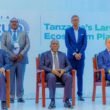


Tanzania and Singapore signed five agreements and memoranda of understanding in Dar es Salaam on 9th June 2026 during a three-day state visit by Singapore President Tharman Shanmugaratnam.
The agreements cover the avoidance of double taxation, prevention of tax evasion, public service capacity building, trade facilitation, and policy consultations between the foreign ministries of the two countries.
The Double Taxation Agreement (DTA) was signed by Indranee Rajah, Minister in the Prime Minister’s Office, Second Minister for Finance, and Second Minister for National Development of the Republic of Singapore, and Ambassador Khamis Mussa Omar, Minister for Finance of the United Republic of Tanzania.

President Shanmugaratnam and President Samia Suluhu Hassan witnessed the signing.
The DTA clarifies the taxing rights of both countries on income arising from cross-border business activities, and addresses the double taxation of such income. This will lower barriers to cross-border investment, trade, and economic flows between the two countries.
Furthermore, Tanzania and Singapore have agreed to deepen cooperation in trade, investment, skills development, digital transformation, healthcare, environmental sustainability, and public sector modernization, marking a significant new chapter in relations between the two countries.
On the same day, the Tanzania Investment and Special Economic Zones Authority (TISEZA) hosted the Tanzania-Singapore Business Forum in Dar es Salaam to outline a new agenda for trade, investment, and strategic cooperation as the two countries marked 45 years of diplomatic relations.
The forum brought together government officials–including Tanzania`s and Singapore`s Presidents, investors, and private-sector leaders from both countries to explore opportunities to expand bilateral economic relations and increase investment flow between East Africa and Asia.

The forum also highlighted recently concluded agreements between the two countries, including an Avoidance of Double Taxation Agreement and a Memorandum of Understanding (MOU) on carbon credits cooperation, which are expected to support business activity and reduce investment barriers.
A key highlight of the event was the exchange of a formally signed tripartite MoU among the Singapore Business Federation (SBF), the Tanzania National Chamber of Commerce (TNCC), and the Zanzibar National Chamber of Commerce (ZNCC).
In her opening remarks, Tanzania’s President Dr. Samia Suluhu Hassan noted that the bilateral trade reached USD 74 million in 2024, with a decline in Tanzanian exports to Singapore, underscoring the need to strengthen commercial ties and diversify exports.
President Samia added that Singapore has registered 36 investment projects in Tanzania since 1997, with a combined value exceeding USD 535 million.
She added that the projects have created 3,228 jobs, with 21 investments concentrated in the manufacturing sector.
The President also pointed to Singapore’s achievements in logistics and financial services as examples Tanzania could learn from as it pursues its economic transformation agenda.
She noted that while Tanzania recorded a 12% increase in air passenger traffic between late 2025 and early 2026, Singapore’s Changi Airport handled nearly 70 million passengers and two million tonnes of cargo in 2025.
President Samia further cited the Singapore International Arbitration Centre, which handled 886 new cases from nearly 80 jurisdictions in 2025, 89% of which were international in nature.
She said Tanzania aims to develop similar capabilities through the establishment of an international financial centre and accredited arbitration services.
President Samia noted: “Tanzania views Singapore as a strategic partner in nature and a bridge to action. We stand ready to serve as Singapore’s gateway to East Africa and the broader African continent market of over 1.4 billion people.”
The Tanzanian president also outlined six priority areas for future collaboration with Singapore, including trade facilitation, port partnerships, value-added industries, tourism connectivity, financial services, and dispute resolution mechanisms.
Speaking at the forum, Tanzania’s Minister for Planning and Investment, Prof. Kitila Mkumbo, said Singapore remains one of the world’s leading sources of foreign investment capital.
He noted that Singaporean companies currently invest between USD 26 billion and USD 32 billion across Africa through approximately 100 companies operating in 40 countries.
Among the examples he highlighted was Wilmar International, which operates what Tanzanian officials described as Africa’s largest rice milling factory.
Mkumbo added: “Your story of development is traceable because 1965 is only recent. We can trace where you have come from, a GDP per capita of USD 500 in 1965 to over USD 100,000 today, and draw some of the lessons.”
On his part, Singapore’s President Tharman Shanmugaratnam said countries must build new economic partnerships and diversify supply chains amid growing uncertainty in global trade.
“In such a world, the answer must be to diversify to build new corridors of opportunity and wider and more resilient supply chains,” he said.
He added that the proposed East African Community-Singapore Free Trade Agreement would become Singapore’s first free trade agreement with an African partner.
On his part, the acting Chairman of Singapore’s Business Federation, Mark Lee said Tanzania’s investments in infrastructure have strengthened investor confidence.
“Travelling from Dar es Salaam to Morogoro on your Standard Gauge Railway, I was visibly impressed. That combination of infrastructure, connectivity, and human capital gives Singapore businesses confidence,” said Mark Lee.
On her part, the President of the Tanzania Private Sector Foundation, Angelina Ngalula, encouraged businesses from both countries to focus on concrete partnerships and commercial opportunities.
Tanzania and Singapore Bilateral Relations
Tanzania and Singapore established diplomatic relations on 12th December 1980, and since then, economic cooperation between the two countries has expanded steadily, particularly in trade and investment.
Key Tanzanian exports to Singapore include cocoa beans, copper, precious stones, cloves, coffee, and frozen fish, while imports from Singapore include petroleum products, chemicals, machinery, electrical equipment, and pharmaceuticals.
Bilateral trade has expanded significantly in recent years, with Tanzania’s exports to Singapore increasing from USD 43.0 million in 2020 to USD 183.0 million in 2022, then easing to USD 142.0 million in 2023.
Singaporean investment in Tanzania spans manufacturing, energy, transport, construction, and natural resources.
One of the largest Singapore-linked investments was Pavilion Energy’s acquisition of a 20% stake in Tanzania’s offshore gas Blocks 1, 3, and 4 for USD 1.288 billion, generating more than USD 200 million in capital gains tax revenue for the Government of Tanzania.
Want to know more about the Economy in Tanzania? Our free overview of the Tanzania Business and Investment Guide 2026 covers the Economy, plus key sectors and investment opportunities. The complete 141-page edition includes policies, taxation, key regulations, full macroeconomic data, and sources, and is also available at no cost upon completion of a short form.
Download Free OverviewGet the Full Edition for Free