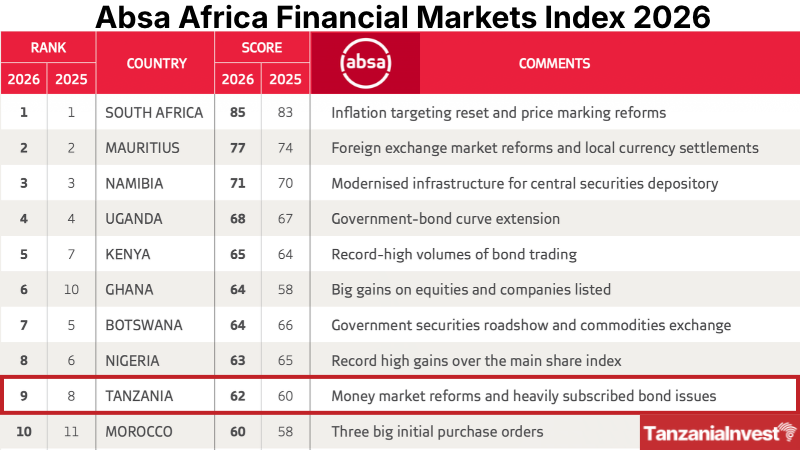
Tanzania’s score in the Absa Africa Financial Markets Index 2026 rose to 62 from 60, placing the country ninth among the 29 African economies assessed.
The 10th edition of the index was launched on 14 October 2026 in Bangkok, Thailand, during the International Monetary Fund (IMF) and World Bank Annual Meetings, by the Official Monetary and Financial Institutions Forum (OMFIF) and Absa Group (JSE: ABG), with support from the United Nations Economic Commission for Africa (UNECA).
The report credited Tanzania’s higher score to money market reforms, heavily subscribed government bond issuance, and the launch of the country’s first exchange-traded funds (ETFs) during the 2025-26 review period.

Despite a higher score, Tanzania slipped from eighth in 2025 to ninth after Ghana overtook it, with South Africa leading at 85, Mauritius at 77, and Namibia at 71.
The greatest improvement came in market depth, where Tanzania’s score rose 9 points to 43, as positive turnover in the horizontal repurchase agreement market lifted the country’s primary dealer system score.
Tanzania scored 53 for product diversity and 70 for depth, while market size and liquidity remained low at 21 and 15, respectively, reflecting a still narrow domestic capital market.
According to the report, corporations hold more than half of listed equities in Tanzania, while domestic institutional investors account for less than 5%.
Market transparency improved 5 points to 85, as Tanzania gained an additional sovereign credit rating and scored the maximum 100 on financial, monetary policy, fiscal, and macroeconomic data transparency.

Fitch affirmed Tanzania’s sovereign rating at B+ with a stable outlook in March 2026, reaffirmed in August 2026, citing relatively strong economic growth, low inflation, and reforms to improve access to external funding under the IMF programme.
The report noted that Tanzania is developing a framework to recognise and supervise credit rating agencies and opinion providers, alongside a planned daily sovereign yield curve to strengthen bond pricing transparency.
The legal standards, tax, and regulatory environment score rose 6 points to 65 after the Bank of Tanzania (BoT) implemented a climate-related financial risk framework requiring banks to conduct regular climate scenario analysis and stress testing.
The BoT also carried out a sector-level climate assessment covering more than half of banking-sector assets, focused on physical risks such as drought and flooding, making Tanzania one of 11 index countries with climate stress testing.
Tanzania still scores only 10 on both close-out netting and collateral enforceability, and the report noted that the country is pursuing legal and regulatory reform in this area following work with UNECA and Frontclear.
On taxation, Tanzania introduced a deemed dividend withholding tax, under which 30% of undistributed after-tax profits may be treated as distributed if not paid within 12 months, triggering a 10% withholding tax.
Tanzania was featured as the index’s 10-year top performer for the macroeconomic environment pillar, although its score eased 6 points to 85 this year.
The decline was partly due to a 4.2 percentage point rise in the non-performing loan (NPL) ratio, the largest increase among the 29 countries.
In an interview included in the report, the Capital Markets and Securities Authority (CMSA) noted that Tanzania’s Development Vision 2050 recognises the need for vibrant capital markets, stronger public-private partnerships, and innovative financing mechanisms to support long-term economic transformation.
Reforms to develop the domestic government securities market, according to the regulator, included obtaining a sovereign credit rating and eliminating restrictions on foreign investment in government securities.
Access to foreign exchange edged up 1 point to 60, with a perfect score for reporting standards and 77 for FX arrangements and controls, while interbank FX liquidity remained at the minimum score of 10.
Pension fund development fell 4 points to 35, with pension fund size scoring 16 and pension assets relative to domestically listed securities scoring 54.
The report also found that linking mobile money wallets directly to central securities depository accounts has raised retail investor activity on the Dar es Salaam Stock Exchange (DSE).
Under the index’s new methodology, Tanzania’s recalculated overall scores stood at 60 in 2022, 58 in 2023, 61 in 2024 and 60 in 2025, making 2026 its highest score in five years.
Absa Africa Financial Markets Index
The index was launched in 2017 by OMFIF and Absa, and the 2026 edition covers 29 economies representing approximately 80% of Africa’s population and gross domestic product.
Countries are scored from 10 to 100 across six pillars: market depth, access to foreign exchange, market transparency, pension fund development, macroeconomic environment, and legal standards, tax and regulatory environment.
The 2026 edition draws on public data and a survey of more than 40 organisations conducted between June and August 2026, including the BoT and the CMSA.
This year the index moved to fixed reference bounds for scoring, so that changes reflect each country’s own performance rather than shifts elsewhere in the sample, and recalculated all scores back to 2022.
Across the index, the average score reached 56, the highest in 10 years and 6 points above the 2017 launch, with 21 of the 29 countries improving their scores.
Absa Group holds majority stakes in two Tanzanian banks, Absa Bank Tanzania, and the National Bank of Commerce (NBC).
Want to know more about Capital Markets in Tanzania? Our upcoming Capital Markets Guide covers the Dar es Salaam Stock Exchange (DSE), listed companies, bonds, and private equity, plus the regulatory framework for investing in Tanzania’s capital markets.
Learn MoreWant to know more about the Capital Markets in Tanzania? Our free overview of the Tanzania Business and Investment Guide 2026 covers the Capital Markets, plus key sectors and investment opportunities. The complete 141-page edition includes policies, taxation, key regulations, full macroeconomic data, and sources, and is also available at no cost upon completion of a short form.
Download Free OverviewGet the Full Edition for Free