


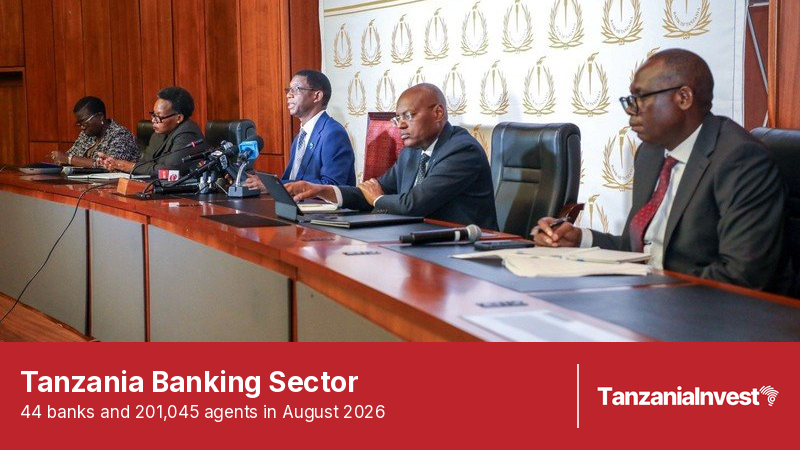
Tanzania’s banking sector had 44 banks, 1,095 branches and 201,045 agents at 31 August 2026, according to the Bank of Tanzania (BoT).
The figures were published in the sixth issue of Uchumi Wetu, BoT’s quarterly magazine, which was listed on the central bank’s website on 16 October 2026.
The 44 institutions comprised 35 commercial banks, five microfinance banks, two community banks and two development banks.

Dar es Salaam had 280 branches, equivalent to about 26% of the national total, followed by Mwanza with 72, Arusha with 71, Dodoma with 52 and Kilimanjaro with 48.
Core capital stood at 17.86% against the statutory minimum of 10%, while total capital was 19.16% against a minimum of 12%.
Liquidity stood at 26.05% against the statutory minimum of 20%, while non-performing loans accounted for 2.50% of total loans, below the 5% benchmark cited by BoT.
Return on assets was 4.68% and return on equity was 22.26% at August 2026.
Loans, loan guarantees and overdraft accounts reached TZS 57.09 trillion (± USD 21.68 billion) at June 2026, up 32.27% from TZS 43.16 trillion (± USD 16.39 billion) at June 2025.

Most of this credit was directed to trade, industry, agriculture, construction, communications and transport, according to the magazine.
BoT’s Financial Sector Supervision Directorate said the capital and liquidity ratios indicated that banks could withstand challenges and meet customers’ cash requirements and other obligations.
The directorate also said that greater use of digital platforms, mobile banking, artificial intelligence and cloud systems was changing service delivery, while creating cybersecurity, customer-data and operational risks requiring closer supervision.
Banks accounted for more than 70% of financial-sector assets, according to the directorate.
Outside the banks, the microfinance sector comprised 3,229 credit-only institutions, 1,030 savings and credit cooperative societies (SACCOS), and 81,878 community groups providing financial services.
Want to know more about Banking in Tanzania? Our free overview of the Tanzania Business and Investment Guide 2026 covers Banking, plus key sectors and investment opportunities. The complete 141-page edition includes policies, taxation, key regulations, full macroeconomic data, and sources, and is also available at no cost upon completion of a short form.
Download Free OverviewGet the Full Edition for Free