

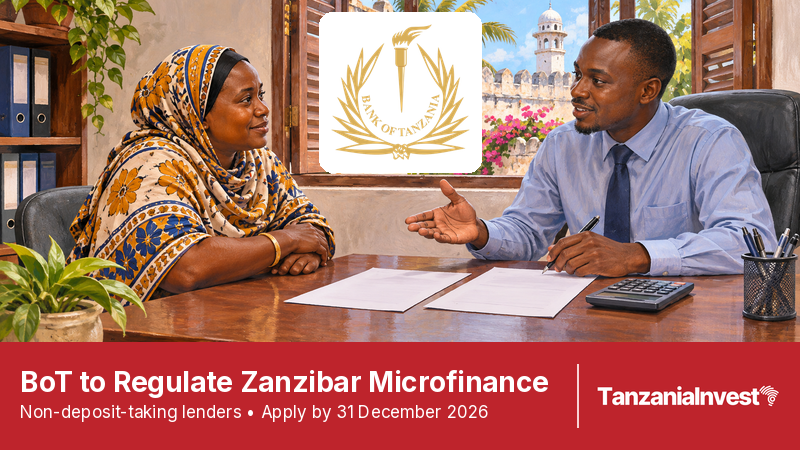
The Bank of Tanzania (BoT) has assumed responsibility for regulating and supervising non-deposit-taking microfinance providers in Zanzibar.
Licensing was previously handled by Zanzibar’s Ministry of Finance and Planning, which had licensed 15 Tier II providers by the end of 2025, according to BoT’s Tanzania Financial Stability Report for December 2025.
Under BoT’s public notice dated 20 November 2026, existing providers and those intending to offer these services must submit licence applications to BoT’s Zanzibar Branch, with existing operators required to apply by 31 December 2026.

The affected microfinance providers include credit companies, housing microfinance companies, individual moneylenders, and digital microfinance lenders.
BoT said its mandate to regulate and supervise the sector derives from sections 15 and 16 of the Zanzibar Microfinance Service Act, No. 9 of 2023.
In the public notice signed by Governor Emmanuel M. Tutuba, BoT reminded operators that conducting microfinance business without a licence issued by the central bank or a delegated authority is an offence under section 6 of the Act.
The Act was passed by the Zanzibar House of Representatives and came into force in 2025 as part of the implementation of the Zanzibar Microfinance Policy of 2019, according to BoT.
Zanzibar’s Ministry of Finance, working with financial sector stakeholders, developed the implementing rules governing licensing, capital requirements and corporate governance.

The Zanzibar Microfinance Service (Non-Deposit Taking Microfinance Service Providers) Regulations, 2025 require providers to start operations with and maintain minimum capital of TZS 50 million (± USD 18,800), rising to TZS 100 million (± USD 37,500) where the majority shareholders are foreign individuals or entities.
The regulations also prescribe a non-refundable application fee of TZS 500,000 (± USD 188) and require BoT to grant or reject a licence within three months of receiving a complete application.
Providers other than individual moneylenders must have a governing body with at least two Tanzanians, while Tier II providers are prohibited from accepting public deposits or conducting foreign exchange business.
Want to know more about Banking in Tanzania? Our free overview of the Tanzania Business and Investment Guide 2026 covers Banking, plus key sectors and investment opportunities. The complete 141-page edition includes policies, taxation, key regulations, full macroeconomic data, and sources, and is also available at no cost upon completion of a short form.
Download Free OverviewGet the Full Edition for Free