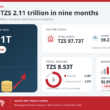

Tanzania banking sector profit rose 17.1% to TZS 2.11 trillion (± USD 798.9 million) in the nine months to September 2026, while total assets reached TZS 97.73 trillion (± USD 37.0 billion).
The figures come from the Tanzania Banking Performance and Outlook analysis, released in November 2026 by Dar es Salaam-based microfinance company AML Finance Limited and prepared by its Managing Director, Reginald Massawe.
The analysis covers 43 banks and financial institutions and draws on published unaudited financial statements for the nine months ended 30 September 2026, extending AML Finance’s earlier first-quarter and half-year reviews of 2026 results.
Table of Contents
Banking Sector Key Indicators
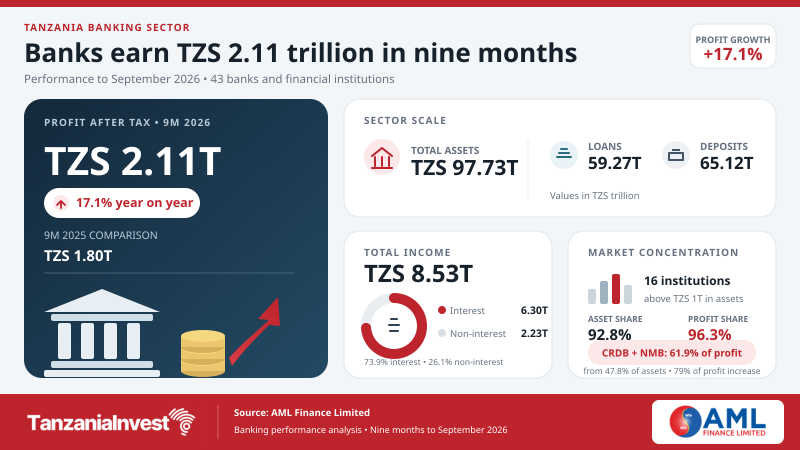
Profit after tax reached TZS 2.11 trillion (± USD 798.9 million) in the nine months to September 2026, compared with TZS 1.80 trillion (± USD 682.5 million) in the same period of 2025, an increase of 17.1%.
Total assets stood at TZS 97.73 trillion (± USD 36.9 billion), loans and advances at TZS 59.27 trillion (± USD 22.4 billion), and customer deposits at TZS 65.12 trillion (± USD 24.7 billion) at the end of September 2026.
Total income reached TZS 8.53 trillion (± USD 3.23 billion), comprising TZS 6.30 trillion (± USD 2.39 billion) in interest income and TZS 2.23 trillion (± USD 844.9 million) in non-interest income.
Interest expenses totalled TZS 2.17 trillion (± USD 820.9 million), non-interest expenses TZS 3.00 trillion (± USD 1.13 billion), and staff costs TZS 1.48 trillion (± USD 559.7 million).
The sector recorded an average return on assets of 1.7%, return on equity of 9.6%, a cost-to-income ratio of 69.3% compared with 66.0% a year earlier, and a non-performing loan (NPL) ratio of 5.8%.
The sector employed 22,307 staff, with cost per staff averaging TZS 66 million (± USD 25,000), portfolio per staff TZS 2,657 million (± USD 1.0 million), and productivity per staff TZS 95 million (± USD 36,000).
Staff costs accounted for 49% of total costs, while the ratio of interest income to interest expense stood at 3.
Bank Concentration
The 16 institutions with assets above TZS 1 trillion (± USD 378.6 million) hold 92.8% of industry assets and earn 96.3% of its profit.
CRDB Bank Plc (DSE: CRDB) and NMB Bank Plc (DSE: NMB) alone earn 61.9% of sector profit from 47.8% of assets and account for 79% of the profit increase.
CRDB earned TZS 672.07 billion (± USD 254.4 million), up 29%, on assets of TZS 27.45 trillion (± USD 10.4 billion), while NMB earned TZS 634.60 billion (± USD 240.2 million), up 17%, on assets of TZS 19.31 trillion (± USD 7.3 billion).
Their combined asset share has stayed near 48% since 2023, so their dominance is strengthening mainly through earnings rather than a much larger share of the market.
National Bank of Commerce (NBC) earned TZS 119.49 billion (± USD 45.2 million), up 7%, followed by Stanbic Bank at TZS 103.22 billion (± USD 39.1 million), down 1%, and People’s Bank of Zanzibar at TZS 67.01 billion (± USD 25.4 million), up 20%.
Among institutions with assets above TZS 500 billion, profit growth was strongest at Access Bank with 110%, Ecobank Tanzania with 107%, Equity Bank with 59% and Mwanga Hakika Bank with 48%, while Standard Chartered fell 51% and Citi Bank 27%.
Ecobank Tanzania posted the highest return on equity at 34.0%, followed by CRDB at 29.3%, Mwanga Hakika and Mkombozi Commercial Bank at 27.0% each, and NMB at 26.0%.
Tanzania has about 35 commercial banks against estimated 2026 GDP of USD 94.9 billion, or roughly one bank per USD 2.7 billion of GDP, compared with Kenya’s 38 commercial banks and GDP of about USD 147.3 billion, or one per USD 3.9 billion.
The comparison points to a fragmented lower tier rather than simply too many banks, and South Africa’s five largest banks hold roughly 90% of banking assets, which makes Tanzania less concentrated at the top but far more uneven below it, according to the report.
Credit Growth Compared With Profit Growth
Private-sector credit is reported to be growing by 34.2%, compared with real economic growth of about 6% and nominal growth of about 10.6%.
Between September 2024 and September 2026, reported assets grew 59.9%, and loans 65.7%, but nine-month profit rose only 31.1%, a comparison the report qualifies because the institutions covered have changed.
The report notes that new loans incur funding costs and loan-loss allowances before earning a full period’s interest, which can delay profits but cannot justify weak returns indefinitely.
It defines marginal income as revenue from additional business and marginal cost as the extra funding, servicing and expected loan losses it brings, with the difference being marginal profit before tax.
A new loan may be profitable yet earn less per shilling than existing loans, and higher lending rates do not guarantee better returns if deposit costs rise too, the report adds.
Bank Rankings, Turnarounds, And Losses
Azania Bank’s assets increased from TZS 3.68 trillion (± USD 1.39 billion) in December 2025 to TZS 7.31 trillion (± USD 2.77 billion) in September 2026, lifting it from fifth to third place by assets.
Between December 2025 and September 2026, Standard Chartered re-entered the top ten by assets, rising from eleventh to ninth, while Diamond Trust Bank (DTB) slipped from ninth to eleventh despite asset growth.
A proposed merger of two established banks, which the report does not name, would create an institution with combined September assets of approximately TZS 8.77 trillion (± USD 3.3 billion), placing it ahead of Azania if completed on those figures.
The report notes that such consolidation could strengthen competition with the two largest banks while also increasing concentration in the market.
TIB Development Bank moved from a TZS 9.25 billion (± USD 3.5 million) loss to a TZS 6.68 billion (± USD 2.5 million) profit over the period under review.
Eight smaller institutions reported combined losses of TZS 10.16 billion (± USD 3.8 million), led by Co-operative Bank Tanzania, Selcom Microfinance Bank, United Bank for Africa and Akiba Commercial Bank, with DCB Commercial Bank, Guaranty Trust Bank Tanzania, Uchumi Commercial Bank and FINCA Microfinance Bank also in the red.
Smaller institutions’ combined profit growth falls from 45.9% to 13.5% when TIB’s turnaround is excluded, showing how one recovery can make the group appear stronger.
Mwanga Hakika and Mkombozi, by contrast, earned TZS 13.97 billion (± USD 5.3 million) and TZS 11.63 billion (± USD 4.4 million) respectively, which the report cites as confirmation that smaller banks can be profitable.
The report states that the contrasting results require bank-level investigation, since losses may reflect insufficient income, expensive funding, high operating costs, loan-loss provisions or a combination, and the figures alone cannot establish the main cause.
Tanzania Banks Ranking
| Rank | Bank | Total Assets (TZS billion) | Total Income (TZS billion) | Profit After Tax (TZS billion) | Profit Growth vs 2025 |
|---|---|---|---|---|---|
| 1 | CRDB Bank | 27,452.2 | 2,513.9 | 672.1 | 29% |
| 2 | NMB Bank | 19,308.3 | 1,910.1 | 634.6 | 17% |
| 3 | Azania Bank | 7,306.6 | 459.2 | 54.9 | 23% |
| 4 | National Bank of Commerce (NBC) | 6,708.7 | 536.0 | 119.5 | 7% |
| 5 | Exim Bank | 4,974.7 | 371.6 | 64.4 | 7% |
| 6 | Stanbic Bank | 4,334.2 | 344.0 | 103.2 | -1% |
| 7 | People’s Bank of Zanzibar (PBZ) | 3,198.9 | 208.7 | 67.0 | 20% |
| 8 | Tanzania Commercial Bank (TCB) | 2,672.3 | 262.0 | 30.7 | 15% |
| 9 | Standard Chartered | 2,454.3 | 112.7 | 30.1 | -51% |
| 10 | KCB Bank | 2,295.3 | 191.2 | 55.8 | 17% |
| 11 | Diamond Trust Bank (DTB) | 2,247.5 | 190.5 | 50.8 | 38% |
| 12 | ABSA | 2,057.1 | 201.1 | 46.4 | -2% |
| 13 | Equity Bank | 1,923.4 | 210.1 | 47.6 | 59% |
| 14 | Tanzania Agricultural Development Bank (TADB) | 1,500.9 | 89.5 | 23.5 | 16% |
| 15 | Citi Bank | 1,149.0 | 82.1 | 20.4 | -27% |
| 16 | I&M Bank | 1,098.7 | 137.2 | 12.2 | 19% |
| Total, 43 institutions | 97,729.5 | 8,534.6 | 2,110.3 | 17% |
Source: AML Finance Limited, based on published unaudited financial statements for the nine months ended 30 September 2026.
Non-Performing Loans And Weather Risk
The 2026 NPL ratios of individual institutions stand at 2.3% at CRDB and 2.5% at NMB, but reach 31.1% at TIB Development Bank, 25.0% at China Dasheng Bank, and 24.3% at Uchumi Commercial Bank.
The report explains that credit can expand rapidly while the NPL ratio falls, because new loans increase the denominator before repayment problems have time to appear.
It recommends that banks examine the amount and age of troubled debt, revised repayment arrangements, write-offs and funds set aside for losses.
El Niño warnings had raised expectations of heavy rains from September, yet by the time of writing in November the experience had been heating rather than downpours, according to the report.
Businesses and lenders therefore face the challenge of preparing for heavy rains, prolonged heat, neither, or both at different times or in different locations, and the report advises remaining flexible rather than relying on any one forecast.
Non-Interest Income, Digital Banking, And Staffing
Non-interest income, which includes fees and foreign-exchange earnings, rose from TZS 1.66 trillion (± USD 628.4 million) in January to September 2024 to TZS 2.23 trillion in the same period of 2026.
Its share of total income nevertheless fell from 28.0% to 27.4% in 2025 and 26.1% in 2026, meaning digital activity is expanding while income is becoming more dependent on interest.
Staff numbers rose about 6.9% in 2026 while assets grew 30.7%, which the report says does not establish any contribution from artificial intelligence.
The report recommends comparing spending on systems, software, cybersecurity and outsourced services with verified improvements in income, costs and customer service, and tracking service speed, fraud losses, total transaction costs and output per employee.
Recommendations To Banks And Boards
According to Massawe, banks should judge growth by marginal profit, lend within available funding and capital, and preserve cash for withdrawals while backing businesses with credible repayment capacity, the report recommends.
Boards should investigate individual banks’ results before attributing success or failure to size or technology, and loss-making banks need recovery milestones with named owners and deadlines grounded in their own diagnosis.
To assess banks’ contribution to Vision 2050, attention should extend beyond loan growth to whether lending helps businesses produce more, creates jobs, improves access to reliable financial services, and earns sustainable profit.
“These results mirror life’s paradoxes: banks are expanding faster than the economy, yet profits lag behind asset growth; digital activity is rising, yet income remains increasingly dependent on interest. Large banks dominate earnings, while smaller banks show that neither success nor failure is determined by size alone. Lending is surging even as bad-loan ratios fall. Come rain or shine, there are grounds for optimism, but a better future must be built, not assumed,” Massawe said.
Proposed NBC And Absa Bank Tanzania Merger
NBC and Absa Bank Tanzania, whose September assets of TZS 6.71 trillion (± USD 2.5 billion) and TZS 2.06 trillion (± USD 778.8 million) add up to the TZS 8.77 trillion cited in the report, are the subject of a proposed merger.
Bloomberg reported in July 2026 that South Africa’s Absa Group (JSE: ABG) was nearing a deal to consolidate its Tanzanian operations, creating a bank with combined assets of about USD 3 billion.
Absa Bank Tanzania, formerly Barclays Bank Tanzania, is wholly owned by Absa Group, which also holds 55% of NBC, while the Tanzanian government holds 30%.
The Bank of Tanzania (BOT) stated that it had no objection to the proposed merger.
Want to know more about Banking in Tanzania? Our free overview of the Tanzania Business and Investment Guide 2026 covers Banking, plus key sectors and investment opportunities. The complete 141-page edition includes policies, taxation, key regulations, full macroeconomic data, and sources, and is also available at no cost upon completion of a short form.
Download Free OverviewGet the Full Edition for Free