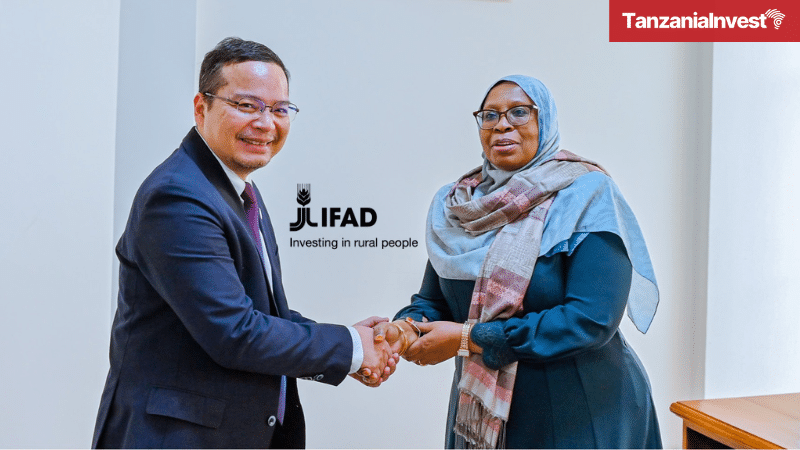
Tanzania is set to receive approximately USD 74 million from the International Fund for Agricultural Development (IFAD) to support agricultural initiatives, financial solutions for smallholder farmers, and ongoing rural development projects.
The announcement was made on 19th March 2025, by the Deputy Permanent Secretary of the Ministry of Finance, Amina Khamis Shaaban, following a meeting with IFAD’s new Country Director, Sakphouseth Meng, who visited the ministry in Dodoma to introduce himself.
Shaaban explained that the funds will be allocated under IFAD’s 13th funding cycle and highlighted the government’s ongoing collaboration with IFAD in implementing various programs, including those focused on crops, agriculture, and fisheries.

She further noted that IFAD’s priorities include empowering women and youth and improving nutrition in rural communities.
“We are grateful to IFAD for their continued partnership in implementing agricultural and fisheries projects across the country,” Shaaban said.
For his part, IFAD’s new Country Director, Sakphouseth Meng, reaffirmed the organization’s commitment to working with Tanzania in key areas such as agriculture, fisheries, and rural infrastructure.
He emphasized that IFAD’s projects aim to benefit communities by addressing poverty and improving livelihoods.
“When we talk about people, we work for the people, ensuring that they remain our top priority. Our ultimate goal is to help people progress in their lives and lift them out of poverty,” Meng stated.

Meng also highlighted IFAD’s focus on empowering women economically and ensuring their active participation in decision-making processes, with a strong emphasis on gender equality.
He added that the programs provide significant opportunities for youth to engage in small businesses and entrepreneurship, including initiatives such as milk processing centers.
Additionally, Meng stressed the importance of ensuring access to nutritious food, aiming to help communities not only produce food but also consume meals rich in essential nutrients.
He concluded by pledging to work diligently to achieve these goals and contribute to Tanzania’s development.
IFAD and Smallholder Farmers in Tanzania
The International Fund for Agricultural Development (IFAD) is a specialized agency of the United Nations established in 1977 with the primary goal of eradicating poverty and hunger in rural areas of developing countries.
IFAD focuses on empowering rural communities, particularly smallholder farmers, by providing financial and technical assistance to improve agricultural productivity, enhance food security, and promote sustainable rural development.
The organization works closely with governments, non-governmental organizations, and local communities to implement projects that address poverty and inequality.
In Tanzania, smallholder farmers are the backbone of the agricultural sector, which contributes 26% of the country’s GDP and employs 65% of the population.
These farmers typically operate on small plots of land, growing staple crops like maize and rice, and cash crops such as coffee and cotton.
However, they face challenges such as limited access to modern farming tools, markets, and financial services, as well as the impacts of climate change and poor infrastructure.
To address these challenges, IFAD has been a key development partner in Tanzania for decades, funding numerous projects in agriculture, fisheries, and rural infrastructure.
The organization has focused on empowering women and youth, providing financial solutions for smallholder farmers, improving access to markets, and promoting sustainable farming practices.
One of IFAD’s notable contributions in Tanzania is its emphasis on addressing gender inequality and youth unemployment. Through its programs, IFAD has created opportunities for women and young people to engage in income-generating activities, such as small businesses and entrepreneurship.
Additionally, IFAD has supported projects that enhance food security and nutrition by promoting the production and consumption of nutritious foods.
Want to know more about Agriculture in Tanzania? Our free overview of the Tanzania Business and Investment Guide 2026 covers Agriculture, plus key sectors and investment opportunities. The complete 141-page edition includes policies, taxation, key regulations, full macroeconomic data, and sources, and is also available at no cost upon completion of a short form.
Download Free OverviewGet the Full Edition for Free