Tanzania to Build TZS 3.5 Trillion Fertilizer Plant in Lindi Region

MOU Signing Ceremony for Lindi Fertilizer Plant

Tanzania has entered into a landmark agreement with Indonesia’s ESSA Group to build a fertilizer plant worth TZS 3.5 trillion (approximately USD 1.4 billion) in the Lindi Region.

The Memorandum of Understanding (MoU) was signed on 31st July 2024 in Dar es Salaam, with key stakeholders including the Tanzania Petroleum Development Corporation (TPDC), the Tanzania Investment Centre (TIC), and the Tanzania Fertiliser Regulatory Authority (TFRA) in attendance.

The plant, to be located at the Likong’o-Mchinga site, will have an annual production capacity of 1.3 million tonnes of urea fertilizer. This capacity is expected to meet Tanzania’s domestic demand of 700,000 tonnes per year and provide excess for export.

Tanzania Investment Guide 2026 Free Edition

The ESSA Group, a prominent player in the global fertilizer industry, will oversee the construction of the plant, which is expected to be completed within 36 months.

Prof Kitila Mkumbo, the Planning and Investments state minister in the President’s Office, emphasized the project’s importance during the signing ceremony, noting its potential to drive industrial growth and meet the country’s fertilizer needs.

Rahul Puri, an ESSA Group board member, expressed optimism about the project’s impact, highlighting that it will add value to Tanzania’s natural resources, boost agricultural growth, and improve livelihoods. He emphasized the goal of achieving price stability for fertilizer and enhancing food security.

Francis Mwakapalila, the TPDC acting director general, mentioned that the plant will initially require 70 million cubic feet of natural gas per year, with deliveries expected to start in 2027 and continue for 20 years.

Tanzania Fertilizer Demand

The fertilizer plant project was initiated following President Hassan’s state visit to Indonesia in January, where she encouraged Indonesian firms to invest in Tanzania.
TanzaniaInvest Capital Markets Report Banner

Tanzania currently imports 90% of its fertilizer, costing approximately USD 400 million annually. The new plant is part of a broader strategy to industrialize the economy, reduce import dependency, and enhance agricultural productivity. The agricultural sector represents about 27% of Tanzania’s GDP and employs over 65% of the workforce.

The plant is projected to create over 5,000 direct and indirect jobs during its construction phase and around 3,500 permanent positions once operational. It will also spur the development of ancillary industries and infrastructure in the Lindi Region, potentially transforming it into a hub for industrial activity in southern Tanzania.

This initiative aims to significantly boost the country’s agricultural sector by leveraging its natural gas reserves to produce urea fertilizer.

Want to know more about Agriculture in Tanzania? Our free overview of the Tanzania Business and Investment Guide 2026 covers Agriculture, plus key sectors and investment opportunities. The complete 141-page edition includes policies, taxation, key regulations, full macroeconomic data, and sources, and is also available at no cost upon completion of a short form.

Download Free OverviewGet the Full Edition for Free
Related Posts
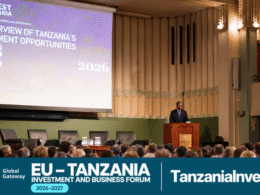
EU-Tanzania Investment & Business Forum 2026-2027 Helsinki day 1
Read More

Tanzania Pitched a 68-Project, USD 30.1 Billion Pipeline at the EU–Tanzania Roadshow in Finland, Italy, the Netherlands and Belgium Ahead of the Early 2027 Dar es Salaam Forum

The EU-Tanzania roadshow 2026 took Tanzanian ministers and agencies to Helsinki, Cesena, The Hague, Rotterdam, and Antwerp between 28 September and 6 October, pitching critical minerals, agribusiness, renewable energy, digital, and port and rail projects from a 68-project, USD 30.1 billion pipeline. The roadshow leads to a high-level EU-Tanzania Investment and Business Forum in Dar es Salaam planned for early 2027.
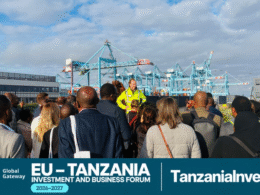
EU-Tanzania Roadshow 2026 APM Terminals at Maasvlakte Rotterdam
Read More

EU–Tanzania Roadshow Ends With Rotterdam and Antwerp Port Visits as Tanzania Pitches Port, Rail and Logistics Opportunities to European Companies

The EU-Tanzania roadshow ended in Antwerp on 6 October 2026 after port visits in Rotterdam, with Tanzania's port and rail authorities pitching openings for terminal operators, EPC contractors, private rail operators and digital rolling stock tracking, while rail operator Vecturis, minerals logistics group Polytra, heavy lifting company Sarens and marine data company GEOxyz outlined their plans in Tanzania. The EU said it will join the World Bank and the EIB, which has a formal financing request, in supporting the Dar es Salaam port expansion, and offered Global Gateway guarantees, equity and feasibility funding for company projects screened by member states.
EU-Tanzania Roadshow 2026 The Hague day 1 opening Mkumbo
Read More

EU–Tanzania Roadshow Reaches The Hague With Coffee, Cashew, Critical Minerals, and Port Investment Pitches

The EU-Tanzania roadshow reached The Hague on 5 October 2026 for its final leg, where Tanzania pitched coffee and cashew processing, wheat and edible oils, critical minerals, the new Bagamoyo and Mwambani ports on the mainland, Zanzibar's Mangapwani port hub, four dry ports, and two new lines of the standard gauge railway network to around 90 businesses. Agriculture emerged as the priority sector for European and Dutch investors, with the best opportunities in food production and value addition, backed by Dutch expertise as the world's second-largest agricultural exporter.
Read More

Tanzanian Delegation Visits Agribusiness, AI, Data Centre and Railway Facilities on Day Two of EU–Tanzania Roadshow in Italy

On 2 October, Tanzanian agribusiness and digital delegations visited facilities in Emilia-Romagna during the EU–Tanzania roadshow’s Italian leg. On the second day of the EU–Tanzania roadshow in Italy, the agribusiness delegation visited Apofruit–Almaverde, Martini Group and Unitec to examine post-harvest handling and cold storage, livestock and food operations, and fruit sorting, grading and training. A separate group led by Deputy Minister Pius Chaya visited the University of Bologna, DAMA Tecnopolo and Bologna San Donato to learn about artificial intelligence, Industry 4.0, supercomputing, data centres and railway testing.