
Tanzania Inflation Projected to Remain at 5% in H1 2017

Tanzania inflation 2015 2016

Tanzania’s inflation rate is projected to remain stable at 5% throughout H1 2017 and to remain constant in the medium term.

This is indicated in the Guidelines for the Preparation of Plans and Budget for 2017–2018, issued by Tanzania’s Ministry of Finance in November 2016.

The slowdown in Tanzania’s inflation rate is due to:

Tanzania Investment Guide 2026 Free Edition

  • Reduction in the production costs on account of reliable and affordable power supply resulting from completion of natural gas pipeline project, completion of Kinyerezi I power plant and cost reduction in oil import for power generation;
  • Improvement in food supply in 2016 and 2017 on account of favorable weather conditions in the region;
  • Prudent fiscal policy including public expenditure management and continued monetary policy tightening;
  • Low and stable oil prices in the world market;
  • Stability of the Shilling exchange rate against the US Dollar.

Tanzania Inflation

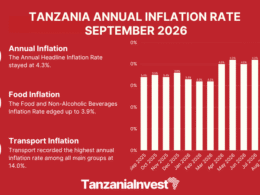
The inflation rate of Tanzania peaked at 6.8% in December 2015. Since then, it has been steadily decreasing, reaching 5.1% in April 2016, slightly increasing to 5.5% in June, and again, falling to 5.1% in July, 4.9% in August, and 4.5% in September and October 2016.

The Bank of Tanzania (BOT) Monetary Policy Statement of June 2016 indicates that the BOT target is to keep inflation close to 5%.

Want to know more about the Economy in Tanzania? Our free overview of the Tanzania Business and Investment Guide 2026 covers the Economy, plus key sectors and investment opportunities. The complete 141-page edition includes policies, taxation, key regulations, full macroeconomic data, and sources, and is also available at no cost upon completion of a short form.

Download Free OverviewGet the Full Edition for Free

Related Posts
Tanzania national land database digital service
Read More

Tanzania National Land Database to Centralize Records as Land Boards Digitize Services

Tanzania is building a central national land database under the National Land Data Infrastructure (NLDI) project to deliver accurate, modern, and officially recognised land information. The system aims to cut land disputes arising from conflicting boundaries and ownership and make tenure more secure for investment. The valuers’ and town planners’ registration boards have also been directed to accelerate the digitization of their services.
Tanzanian and JETRO officials exchange an Invest Tanzania gift set during Tanzania's investment promotion campaign in Japan
Read More

Tanzania Targets Doubling Japanese Investments

Tanzania's government told a Tokyo investment seminar on 8 September 2026 that it is ready to attract long-term Japanese investment, aiming to double Japanese-invested projects, under the Vision 2050 plan. State Minister Kitila Mkumbo pointed to opportunities across automotive assembly, pharmaceuticals, agro-processing, strategic minerals, energy and other sectors, citing Tanzania's EAC and SADC membership as access to a combined market of around 300 million consumers.
AIM Dubai 2026 Tanzania Investment and Special Economic Zones Authority (TISEZA) Award
Read More

Tanzania’s TISEZA Wins Title of Africa’s Best Investment Promotion Agency in 2026

The Tanzania Investment and Special Economic Zones Authority (TISEZA) has been named Best Investment Promotion Agency (IPA) 2026 in Africa at the AIM Investment Awards in Dubai, recognising its performance in attracting and facilitating foreign direct investment projects in Tanzania. The award follows the Authority’s 2025 recognition among the world’s leading investment promotion agencies by the World Association of Investment Promotion Agencies (WAIPA).