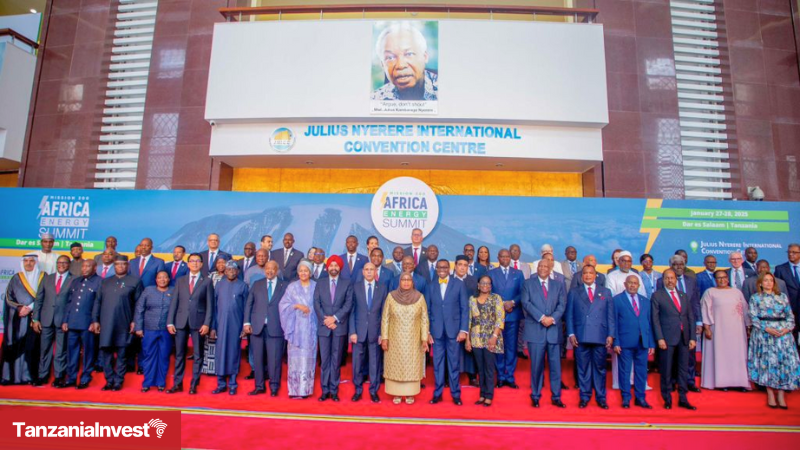
The Mission 300 Africa Energy Summit, held in Dar es Salaam from January 27 to 28, 2025, concluded with significant achievements, including the adoption of the Dar es Salaam Energy Declaration, commitments of $40 billion in funding from the World Bank and the African Development Bank (AfDB), and the launch of Tanzania’s National Energy Compact.
The summit, hosted by Tanzania and organized in collaboration with the AfDB, World Bank, and global partners, focused on addressing Africa’s energy access gap.
Currently, nearly 600 million Africans lack reliable electricity, hampering economic growth and quality of life.

President of Tanzania, Samia Suluhu Hassan, emphasized the importance of the summit outcomes in transforming energy access and driving sustainable development.
During the summit, President Samia unveiled Tanzania’s National Energy Compact, which targets connecting 8.3 million additional households to electricity by 2030.
The compact also aims to expand electricity access in all 64,359 villages and increase national electrification rates from 46% to 75%.
Other goals include enhancing cross-border electricity trade by integrating Tanzania’s national grid with neighboring countries and promoting clean cooking solutions through innovative technologies such as natural gas and improved cookstoves.
“We are committed to accelerating energy access to drive economic transformation, support industrial growth, reduce poverty, and improve the well-being of our people,” President Samia stated.

She also emphasized the transformative power of clean energy, stating, “The National Energy Compact will not only connect millions of households to electricity but also expand opportunities for regional trade in energy and empower local communities with sustainable solutions for clean cooking.”
The summit resulted in the Dar es Salaam Energy Declaration, reflecting a unified vision among African governments to achieve universal electricity access by 2030.
Key aspects of the declaration include mobilizing $40 billion in funding from the World Bank and AfDB, implementing regulatory reforms to encourage private sector investments, prioritizing renewable energy solutions and clean cooking technologies, and developing National Energy Compacts with country-specific targets and timelines.
Accountability mechanisms, such as the Africa Energy Regulatory Index, will be used to monitor progress.
AfDB President Dr. Akinwumi Adesina remarked, “This declaration is about delivering results, not rhetoric. Africa must transition from talking megawatts to delivering megawatts. With universal access to energy, Africa’s economic potential will soar.”
World Bank President Ajay Banga highlighted the importance of creating an enabling environment to attract private sector investment, stating, “This ambitious objective is achievable, but it requires hard work and predictability—predictability in currencies, regulatory frameworks, and land acquisition processes. The private sector will lean in only when the message is clear: Africa is ready for investment.”
He emphasized the need for designing and financing energy initiatives in parallel with regulatory policies, noting, “When you want to put together the financing for energy, it is not easy. It requires many stakeholders at the table, working simultaneously on policy, regulation, and project design.”
Electrification in Africa and Tanzania
Africa faces an average electrification rate of 50%, leaving nearly 600 million people without access to power. This gap impedes economic growth, job creation, and the delivery of essential services.
Tanzania’s electrification rate currently stands at 46%, with significant progress made over the past decade, increasing access from just 7% in 2011 to 38% in 2020.
The government now aims to reach 75% electrification by 2030, connecting millions more households and villages.
Mission 300 is a collaborative initiative led by the AfDB, World Bank, and other global partners to close this gap. By leveraging innovative financing, technology, and partnerships, the initiative aims to achieve universal energy access by 2030, prioritizing off-grid electrification, clean energy solutions, and regulatory reforms
Want to know more about Energy in Tanzania? Our free overview of the Tanzania Business and Investment Guide 2026 covers Energy, plus key sectors and investment opportunities. The complete 141-page edition includes policies, taxation, key regulations, full macroeconomic data, and sources, and is also available at no cost upon completion of a short form.
Download Free OverviewGet the Full Edition for Free