


Data on Tanzania’s banking sector for the first half (H1) of 2024 reveals a complex landscape of rapid profitability growth, asset expansion, and intriguing trends in lending, efficiency, and cost management.
According to an analysis compiled by AML Finance, the banking sector’s profitability surged by a staggering 48.1% in H1 2024, even as the broader economy grew at a more modest pace of 5.0%. This disconnect raises critical questions about the relationship between banking sector performance and the overall economic health of the country.
Banking Sector Assets Surpass TZS 60 Trillion

The total assets of Tanzanian banks have now reached an impressive TZS 60 trillion, accounting for 50% of the nation’s GDP. In a regional context, this figure is lower than sub-Saharan Africa’s 76.9% (based on 2021 data) but significantly higher than Sudan’s 8%, and still far from Hong Kong’s 270%.
Interestingly, only 60% of these assets are allocated to loans and advances, with the remainder invested in various instruments, including TZS 4.4 trillion or 16% of total assets in government securities by the two largest banks. This raises questions about the impact of the recent reduction in the Statutory Minimum Reserve (SMR) on private sector lending.
CRDB Bank Leads in Assets, NMB Dominates Profitability
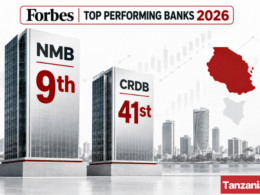
While CRDB Bank continues to hold the title of Tanzania’s largest bank by assets, valued at TZS 15 trillion, NMB Bank remains the most profitable. Investors may want to closely monitor the Earnings Per Share (EPS) of these banking giants as a key indicator of their performance.
Mixed Signals in Banking Efficiency and Cost Management

Efficiency metrics reveal that Citi Bank stands out with zero Non-Performing Loans (NPLs) and a productivity index of 905, far surpassing Standard Chartered Bank’s 254, and the sector average of 57. However, Citi Bank also reported the highest cost per staff, closely followed by Standard Chartered Bank.
The average Return on Assets (ROA) for the sector was recorded at 2.2%, with Return on Equity (ROE) at 14.4%. While these figures are solid, experts suggest that a ROA of 5% is considered good, and an ROE of 20% or higher is deemed excellent.
The sector’s cost-to-income ratio averaged 61.6%, with staff costs accounting for 49% of total expenses. This is in line with global trends, where major international banks have seen staff costs balloon to over 81% of total costs since the financial crisis, a significant rise from pre-crisis levels of 58%.
Credit Growth Slows, NPLs Remain a Concern
Credit growth to the private sector decelerated to 17% from 22% in the same period last year. Of the 41 banks analyzed, 13 (32%) reported NPLs above the regulatory threshold of 5%. Notably, the composition of private sector credit reveals that personal loans dominate at 40%, followed by trade and agriculture. However, loans to the agriculture sector saw the highest growth, followed by manufacturing and construction.
Non-Interest Income Plays a Significant Role
Non-interest income, primarily from fees and commissions, remains a vital revenue stream for Tanzanian banks. The two largest banks alone generated TZS 537 billion in non-interest income, which is a substantial contrast to the TZS 11 billion garnered by the bottom 10 banks.
Commenting on the results, the CEO of AML Finance, Reginald Massawe, said: “The H1 results are impressive, especially for the large banks. Full-year results will most likely be even better than this.”
Download here the AML Finance the unaudited results of Tanzania’s banks and financial institutions for H1 2024: https://www.tanzaniainvest.com/wp-content/uploads/2024/08/AML-Finance-Tanzania-Banks-Results-H1-2024.pdf
Want to know more about Banking in Tanzania? Our free overview of the Tanzania Business and Investment Guide 2026 covers Banking, plus key sectors and investment opportunities. The complete 141-page edition includes policies, taxation, key regulations, full macroeconomic data, and sources, and is also available at no cost upon completion of a short form.
Download Free OverviewGet the Full Edition for Free