
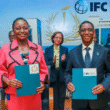

Standard Bank, also trading as Stanbic Bank in Tanzania, has signed an agreement with CCRManager Pte Ltd, a global trade FinTech company that enables banks to manage the entire process of distributing trade finance internationally to other banks, credit insurers, and fund managers.
“We are delighted to have joined CCRManager’s distribution platform, which offers an automated, fast and transparent platform for trade risk distribution and participation”, says Vinod Madhavan, Group Head of Trade for Standard Bank.
“As the first African bank to have joined this network, this presents us with many opportunities, including being able to show African trade risk to international banks that are members of CCRM, and is aligned with our desire to connect Africa to the world.”

“CCRManager is delighted to have Standard Bank as its first African member bank,” says Kah Chye Tan, Chairman, CCRManager. “Africa is a major trade partner for countries all over and trade finance has played an important role in promoting African imports and exports for many decades. We are confident that CCRManager will help Standard Bank with its trade finance for its clients.”
Users of CCRManager are able to list trade assets and contingents for distribution, negotiate deals, and manage supporting documentation in a secure environment.
Users also have access to tools for data analytics, market benchmarking, and pricing indices.
In addition, CCRManager provides users with the ability to manage their portfolio, reporting, and compliance activities 24-hours a day.
“This partnership represents Standard Bank’s dedication to leveraging world-leading digital platforms that help realize efficiencies in a globally competitive marketplace. At Standard Bank, we recognize the potential of trade as a key driver for growth, especially in emerging and frontier markets,” says Madhavan.

About Standard Bank Group
Standard Bank Group is the largest African bank by assets with a unique footprint across 20 African countries.
The group has been operating in Tanzania under the Stanbic Bank brand since 1995 focusing on all the key growth sectors in Tanzania, including agriculture, telecommunications, oil and gas, power and infrastructure and fast-moving consumer goods.
The group’s largest shareholder is the Industrial and Commercial Bank of China (ICBC), the world’s largest bank, with a 20,1% shareholding.
Standard Bank Group and ICBC share a strategic partnership that facilitates trade and deal flow between Africa, China and select emerging markets.
Want to know more about Banking in Tanzania? Our free overview of the Tanzania Business and Investment Guide 2026 covers Banking, plus key sectors and investment opportunities. The complete 141-page edition includes policies, taxation, key regulations, full macroeconomic data, and sources, and is also available at no cost upon completion of a short form.
Download Free OverviewGet the Full Edition for Free