


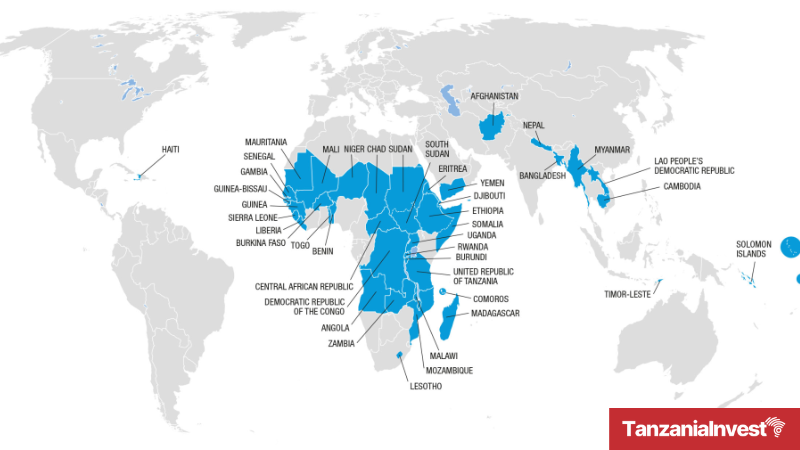
Tanzania has been listed by the United Nations Committee for Development Policy as a country expected to graduate from the group of Least Developed Countries to a developing country.
The announcement was made in Dodoma by the Permanent Secretary of the Ministry of Finance, Dr. Natu El-maamry Mwamba, during the preliminary country review meeting conducted by the United Nations Conference on Trade and Development (UNCTAD).
Dr. Mwamba said the listing reflects Tanzania’s significant economic and social progress over the past two decades, supported by consistent economic policies that led to an average GDP growth of 6.2% between 2000 and 2024.

“Per capita income has increased from USD 453 in 2000 to USD 1,277 in 2023, while extreme poverty declined from 36% in 2000 to 26% in 2024 due to sound fiscal policies and expanded access to private sector credit,” Dr. Mwamba stated.
He noted that inflation has remained in single digits, strengthening economic stability and improving citizens’ ability to cope with living costs.
Dr. Mwamba highlighted strategic investments, particularly in energy infrastructure, including the Julius Nyerere Hydropower Project, the nation’s largest electricity generation and construction initiative.
He also pointed to ongoing passenger and cargo transport projects, such as the Dar es Salaam–Morogoro–Dodoma Standard Gauge Railway (SGR), as well as improvements in education, health services, industry, and employment.
“These developments, combined with a focus on industrialization and job creation, have contributed to meeting the criteria for graduation from least developed status,” he said.

Dr. Mwamba thanked the UNCTAD technical team conducting the preliminary assessment and pledged full government cooperation to support the evaluation process.
Mhe. Shigeki Komatsubara, Resident Representative of the United Nations Development Programme (UNDP), said the UN is ready to support Tanzania in successfully transitioning to a middle-income economy.
He emphasized that the current assessment is part of ongoing collaboration between the UN, development partners, and Tanzania, noting that the process will involve listening to citizens of all ages.
The preliminary review meeting included stakeholders from government institutions, the private sector, non-governmental and civil society organizations, and development partners from mainland Tanzania and Zanzibar.
The assessment aims to strengthen the country’s structural, social, and economic resilience while identifying challenges and opportunities during the preparation and post-graduation phases from least developed country status.
UNCTAD Country Assessment
The UNCTAD-led assessment process evaluates a country’s readiness to graduate from least developed status based on economic, social, and structural indicators.
It provides recommendations for national policies and international support needed to sustain development gains during the transition to developing country status.
The Committee for Development Policy (CDP) will assess Tanzania again in 2027. If it meets the criteria again, Tanzania could be recommended for graduation.
Want to know more about the Economy in Tanzania? Our free overview of the Tanzania Business and Investment Guide 2026 covers the Economy, plus key sectors and investment opportunities. The complete 141-page edition includes policies, taxation, key regulations, full macroeconomic data, and sources, and is also available at no cost upon completion of a short form.
Download Free OverviewGet the Full Edition for Free


