



Brussels Airlines will introduce scheduled flights between Kilimanjaro and Brussels starting June 3, 2026, adding Tanzania to its long-haul network with two weekly services.
Kilimanjaro is the main airport for travelers heading to Mount Kilimanjaro as well as to Serengeti National Park and the Ngorongoro Conservation Area.
The new route will initially operate on Wednesdays and Saturdays and will expand the airline’s sub-Saharan Africa network to 18 destinations.

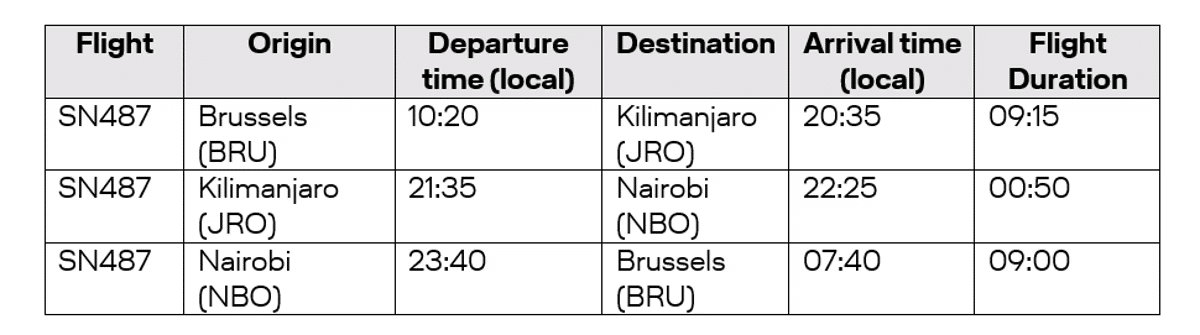
It becomes the carrier’s fifth destination in East Africa after Entebbe in Uganda, Kigali in Rwanda, Bujumbura in Burundi, and Nairobi in Kenya.
The service will be operated with the Airbus A330-300, which offers 288 seats in Business Class, Premium Economy Class, and Economy Class.
“Sub-Saharan Africa is our second home, and we’re happy to add an attractive destination to our network on this beautiful continent. Tanzania is a top destination for safaris, and we’re proud to contribute to the local economy by connecting Kilimanjaro to Brussels and beyond,” Dorothea von Boxberg, CEO of Brussels Airlines, said.
Want to know more about Tourism in Tanzania? Our free overview of the Tanzania Business and Investment Guide 2026 covers Tourism, plus key sectors and investment opportunities. The complete 141-page edition includes policies, taxation, key regulations, full macroeconomic data, and sources, and is also available at no cost upon completion of a short form.
Download Free OverviewGet the Full Edition for Free