


The International Monetary Fund (IMF) has approved an immediate disbursement of approximately USD 443.9 million to Tanzania after completing the final reviews under the country’s Extended Credit Facility (ECF) and Resilience and Sustainability Facility (RSF) arrangements.
The approval follows the completion of the sixth and seventh reviews under the ECF arrangement and the third and fourth reviews under the RSF arrangement, bringing total IMF support under both programmes to about USD 1.7 billion.
The latest disbursement consists of SDR 113.37 million (about USD 154.1 million) under the ECF and SDR 213.12 million (about USD 289.7 million) under the RSF.

The ECF programme has now provided Tanzania with approximately USD 1.063 billion since its approval in July 2022, while total access under the RSF has reached approximately USD 636.5 million.
The IMF said Tanzania’s reform programme remained broadly on track and supported the authorities’ efforts to maintain macroeconomic stability, strengthen policy frameworks and advance institutional reforms.
According to the IMF, all end-June 2025 quantitative performance criteria were met. All end-September 2025 indicative targets were achieved except for the domestic primary balance. At the end of December 2025, all quantitative performance criteria were met except the target on net domestic assets, for which the authorities requested a waiver.
Four structural benchmarks were implemented on schedule, while three were completed with delays.
Under the RSF programme, five reform measures were completed, while three energy-sector reform measures remained outstanding.

The IMF said Tanzania continued to record strong economic performance, with GDP growth reaching 5.9% in calendar year 2025.
Growth is projected to reach around 6.2% over the medium term, supported by the mining, agriculture, and tourism sectors.
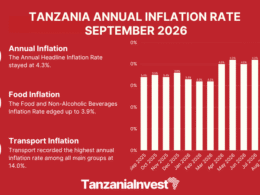
Headline inflation remained contained at 4.0% year-on-year in June 2026, although rising global fuel prices have started to increase inflationary pressures.
The Fund also noted that despite fiscal overspending during the first quarter of the 2025/26 financial year, the domestic primary balance target at end-December was achieved.
The current account deficit is expected to remain broadly stable during FY2025/26, with higher gold exports partially offsetting increased import costs resulting from the conflict in the Middle East.
In its projections, the IMF estimates Mainland Tanzania’s GDP at current prices will increase from TZS 240.1 trillion (USD 92.9 billion) in FY2025/26 to TZS 267.2 trillion (USD 100.1 billion) in FY2026/27.
Gross public debt is projected to decline from 49.1% of GDP to 47.4%, while the overall fiscal deficit is forecast to narrow from 3.0% to 2.9% of GDP.
Commenting after the Executive Board meeting, IMF Deputy Managing Director and Acting Chair Bo Li said Tanzania had maintained macroeconomic stability despite domestic and external shocks.
“Macroeconomic stability has been preserved, with strong economic activity and low and stable inflation.”
He said continued fiscal consolidation supported by stronger domestic revenue mobilisation, VAT refund reforms and improved public financial management would create additional fiscal space for spending on education and healthcare.
Li also stressed the importance of strengthening social safety nets, maintaining adequate international reserves, preserving exchange rate flexibility and continuing reforms to improve the business environment and private sector development.
He added that further climate-related reforms would help mobilise climate finance and strengthen Tanzania’s resilience to external shocks.
The 40-month Extended Credit Facility programme was approved by the IMF in July 2022 with total access equivalent to 200% of Tanzania’s IMF quota and was subsequently extended by nine months.
The programme aims to support economic recovery, preserve macro-financial stability and promote sustainable and inclusive growth.
The 23-month Resilience and Sustainability Facility, approved in June 2024 and later extended, supports reforms designed to strengthen climate resilience and reduce future balance of payments risks.
The IMF warned that while Tanzania’s medium-term outlook remains positive, prolonged conflict in the Middle East could weaken growth prospects through higher fuel prices and inflation, making continued implementation of economic reforms critical for achieving the country’s Vision 2050 objectives.
Want to know more about the Economy in Tanzania? Our free overview of the Tanzania Business and Investment Guide 2026 covers the Economy, plus key sectors and investment opportunities. The complete 141-page edition includes policies, taxation, key regulations, full macroeconomic data, and sources, and is also available at no cost upon completion of a short form.
Download Free OverviewGet the Full Edition for Free