

Tanzania and the World Bank are identifying Central Corridor investment opportunities in agriculture, mining, tourism, and logistics, while UNDP prepares projects for a June 2027 investment conference.
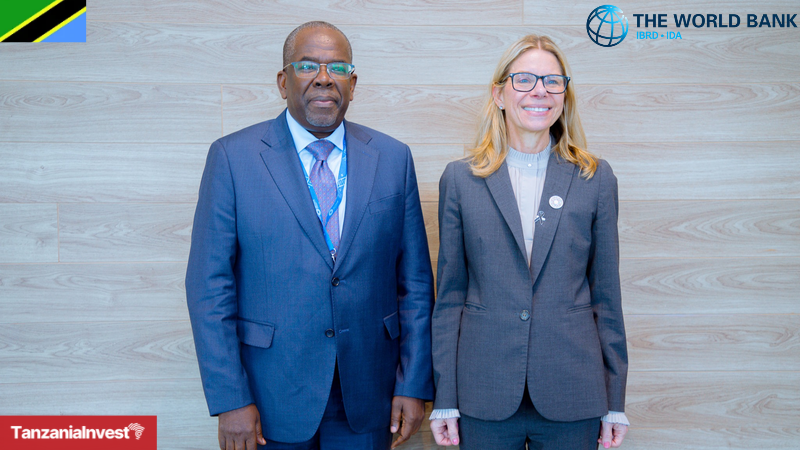
The Minister for Finance, Ambassador Khamis Mussa Omar, met the Managing Director of Operations at the World Bank, Anna Bjerde, in Bangkok, Thailand, on the sidelines of the International Monetary Fund (IMF) and World Bank Annual Meetings held from 12 to 18 October 2026.
The talks focused on accelerating economic development through infrastructure construction, job creation, and private sector investment, with Omar stressing that progress should be measured by higher production, wider employment opportunities, and rising incomes rather than growth indicators alone.
The meeting also discussed the Central Corridor as a key transport route able to strengthen regional trade, ease the movement of goods, and connect Tanzania’s markets with neighbouring countries.
Omar described tourism as a sector able to create jobs quickly, noting that opportunities around the great lakes and along the coast remain underused and should be developed to raise tourist arrivals and open more employment.
Bjerde said job creation is the World Bank’s top priority in supporting economic development, and that the Bank is advancing a strategy to strengthen micro, small, and medium enterprises (MSMEs), which account for a large share of business activity and employment.
To support this, the two sides discussed shifting small business lending from reliance on asset collateral towards assessment of business cash flow, so that firms obtain capital according to their capacity to generate revenue, grow, and add jobs.
Bjerde also commended Tanzania’s focus on building an industrial economy through agriculture, livestock, and mineral value addition, a strategy that aims to keep more of the value of national resources inside the country and reach a 40% value addition target.
On education, the World Bank urged a focus on quality and learning outcomes rather than enrolment numbers alone, including better teaching methods and education systems that use artificial intelligence to prepare young people for the global economy and labour market.
World Bank officials said they intend to speed up project preparation and implementation by cutting the time needed before projects start, and the Bank is drafting a special plan to identify and remove the bottlenecks that delay delivery.
Both sides agreed to continue their strategic partnership to accelerate Tanzania’s development priorities, and the Bank encouraged the Government to keep presenting its development needs with confidence so that cooperation and support can be used effectively.
The World Bank Vice President for Eastern and Southern Africa, Dr. Ndiamé Diop, the Minister for Finance of Zanzibar, Dr. Juma Malik Akil, the Permanent Secretary in the Ministry of Finance, Dr. Natu El-Maamry Mwamba, and the Permanent Secretary in the President’s Office for Planning, Dr. Tausi Kida, also attended the meeting.
In a separate meeting in Bangkok, Omar held talks with the Administrator of the United Nations Development Programme (UNDP), Alexander De Croo, a former Prime Minister of Belgium, on youth employment, education, investment attraction, and private sector growth.
Omar said youth employment is a key development priority because young people make up a large share of the population, which calls for strategies that equip them with skills, capital, technology, and markets to become self-employed or employable.
“Employment and youth issues are very broad. We need to ensure that young people gain the right skills, affordable start-up capital, technology, knowledge, and access to markets so that they can participate fully in production and national development,” Omar stated.
Omar added that the Government will keep investing in education and education infrastructure to meet demand from population growth, which continues to raise requirements for schools, teachers, books, and other facilities.
He explained that Tanzania continues working with development partners to identify investment opportunities and prepare projects able to attract domestic and foreign investors.
The Government and the World Bank are currently mapping trade and investment opportunities along the Central Corridor, which links the Port of Dar es Salaam with the interior through transport infrastructure including the Standard Gauge Railway (SGR), with potential to extend the opportunities to Rwanda.
“This corridor has great opportunities in the agriculture, mining, tourism, and transport sectors and in the development of transport and supply centres (logistics centres), which can attract investment and stimulate production as well as employment,” Omar noted.
Omar also said the Government is improving the business and investment environment, including through recommendations from committees formed to examine challenges in the tax system and in the conduct of business.
De Croo expressed UNDP’s readiness to keep supporting Tanzania’s development agenda, including empowering young people, strengthening skills, and expanding economic opportunities in partnership with the Government, the private sector, and other development institutions.
He said investment should be viewed as a long-term development strategy, particularly in the use of natural resources, including rare minerals needed for the global energy transition.
De Croo commended the Government for preparing the Integrated National Financing Framework (INFF), which he said will help improve the availability and coordination of resources for financing development priorities.
He explained that UNDP, together with the Tanzania Investment Growth Facility (TIGF), aims to turn the identified opportunities into projects backed by documented plans and robust financial and commercial structures able to attract investors ahead of the investment conference expected in Tanzania in June 2027.
“We are ready to work with Tanzania in preparing for that conference and in seeking financing for sustainable infrastructure and blue economy projects through partnership with the Asian Infrastructure Investment Bank (AIIB), with the aim of accelerating project implementation and increasing the contribution of investment to economic growth and the prosperity of citizens,” De Croo stated.
The meeting was also attended by Akil, Mwamba, the Permanent Secretary in the Zanzibar Ministry of Finance, Aboud Hassan Mwinyi, and Enock Koola, a Member of Parliament and member of the Parliamentary Standing Committee on Budget, alongside other Government and UNDP officials.
Central Corridor Programmes and the Tanzania Investment Growth Facility
The Central Corridor is Tanzania’s main transport and trade route, connecting the Port of Dar es Salaam with the interior and with landlocked markets including Rwanda, Burundi, Uganda, Zambia, Malawi, and the Democratic Republic of Congo.
In August 2026, the Government and the World Bank finalized technical preparations for KAZI MPA, the Catalyzing Jobs and Resilient Growth in the Central Corridor Multiphase Programmatic Approach, which targets youth employment and private sector-led growth along the route.
During a visit to Tanzania that included talks on 20 August 2026, Diop said the Bank’s next phase of cooperation would aim to transform the corridor from a transit route into a fully fledged economic corridor.
TIGF is a platform hosted by the Economic and Social Research Foundation (ESRF) and supported by UNDP to strengthen project preparation, mobilise capital, and fast-track investment in priority sectors, and it was launched during the Tanzania Investment Summit 2026 held in Arusha on 1 and 2 June 2026.
At that summit, the Government presented 60 investment-ready public projects worth USD 6.35 billion, up from USD 2.85 billion at an earlier stage.
Want to know more about Agriculture in Tanzania? Our free overview of the Tanzania Business and Investment Guide 2026 covers Agriculture, plus key sectors and investment opportunities. The complete 141-page edition includes policies, taxation, key regulations, full macroeconomic data, and sources, and is also available at no cost upon completion of a short form.
Download Free OverviewGet the Full Edition for Free