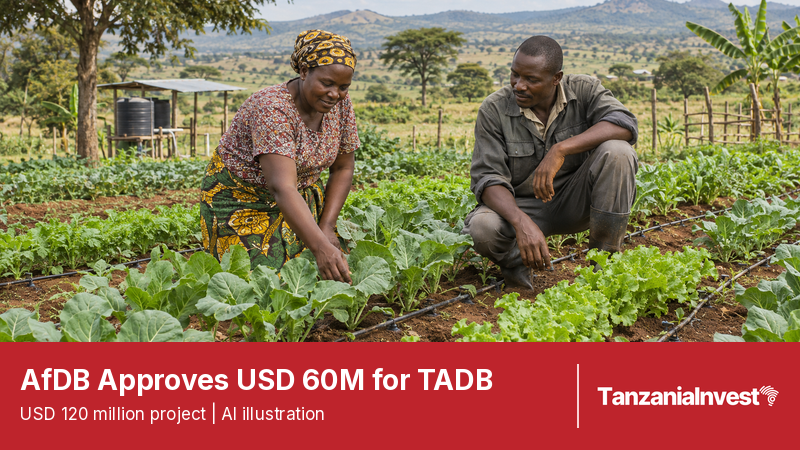
The African Development Bank Group (AfDB) has approved a USD 60 million loan to Tanzania to recapitalise the Tanzania Agricultural Development Bank (TADB).
AfDB’s board approved the sovereign loan on 21 October 2026, and the bank announced the decision on 4 November as part of the USD 120 million third phase of the TADB Equity Enhancement Project, which aims to support the creation of 8,000 jobs.
The Ministry of Finance and the Office of the Treasury Registrar will channel the loan proceeds into TADB as equity, while the government will contribute a further USD 60 million by converting eligible retained earnings into equity capital.

The capital increase will allow TADB to extend more and longer-term loans to smallholder farmers and agribusinesses, both directly and through wholesale lending and co-financing with partner financial institutions, including commercial banks.
AfDB expects at least 30% of the jobs supported by the project to benefit women and has set a separate 30% target for young people.
By 2030, TADB aims for financing to women-owned enterprises to account for 30% of its portfolio and financing to youth-led businesses to account for 20%.
Climate-smart agricultural loans are expected to rise from 3% of TADB’s portfolio in 2025 to 12% by 2030, with financing for efficient irrigation, renewable energy, improved storage and technologies that reduce crop losses.
Ahmed Attout, Director of AfDB’s Financial Sector Development Department, said the recapitalisation would put “more capital within reach of farmers and entrepreneurs” and help them grow businesses and create jobs.

Frank Nyabundege, TADB Managing Director, said the additional capital would broaden access to sustainable financing for farmers and agribusinesses nationwide and support the agricultural objectives of Tanzania’s Development Vision 2050 (Dira 2050).
AfDB estimates that agriculture employs about 65% of Tanzania’s workforce and accounts for roughly 25% of economic output, while receiving about 12% of private-sector credit.
It puts the annual agricultural financing gap at USD 1.5 billion, citing short loan maturities, limited collateral, perceived lending risk, and a shortage of long-term funding, with women and young people the most affected.
TADB is a state-owned development finance institution that provides short-, medium- and long-term credit across agricultural value chains, from farm inputs and production to processing, storage and distribution.
AfDB began supporting TADB in 2016 and approved a USD 66 million sovereign loan for the second phase in December 2023, with the proceeds invested as equity in the bank.
TADB and the East African Development Bank (EADB) also launched a financing facility for smallholder farmers and small businesses in September 2026 covering agriculture, livestock and fisheries.
Want to know more about Agriculture in Tanzania? Our free overview of the Tanzania Business and Investment Guide 2026 covers Agriculture, plus key sectors and investment opportunities. The complete 141-page edition includes policies, taxation, key regulations, full macroeconomic data, and sources, and is also available at no cost upon completion of a short form.
Download Free OverviewGet the Full Edition for Free