
New Horticulture Council of Eastern Africa Launched, Led by Tanzania’s TAHA CEO

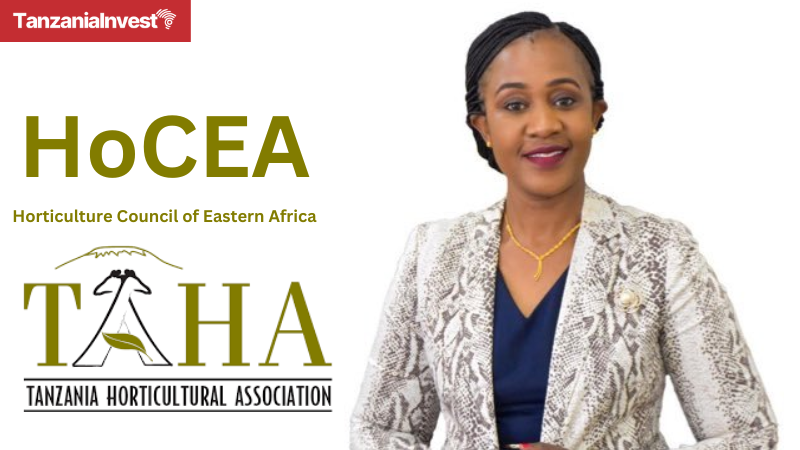
The Horticulture Council of Eastern Africa (HoCEA) has been launched to strengthen the region’s horticultural sector. Tanzania’s Jacqueline Mkindi, CEO of the Tanzania Horticultural Association (TAHA), has been named the council’s first Chairperson.
Jacqueline Mkindi TAHA HoCEA

The Horticulture Council of Eastern Africa (HoCEA) has been officially launched to drive growth and address challenges in the region’s horticultural sector.

These include market access, pests and diseases, logistics, financing, climate change, and compliance.

The council aims to enhance East Africa’s global competitiveness through strategic initiatives and regional collaboration.

Tanzania Investment Guide 2026 Free Edition

Tanzania’s Jacqueline Mkindi, CEO of the Tanzania Horticultural Association (TAHA), has been appointed as the council’s first Chairperson. This appointment highlights Tanzania’s leadership role in advancing the horticultural industry.

TAHA is a key organization representing Tanzania’s horticultural sector, contributing to the country’s agricultural growth.

HoCEA’s leadership team also includes Clement Tulezi, CEO of the Kenya Flower Council, as Secretary, and Esther Nekambi, Executive Director of the Uganda Flower Exporters Association, as Treasurer.

Together, they will guide the council’s mission to address industry-wide challenges and unlock opportunities.

The council’s key objectives include developing a regional quality mark and branding strategy, monitoring plant health, improving market access, and enhancing logistics for better supply chains.

TanzaniaInvest Capital Markets Report Banner

These initiatives aim to position East Africa as a competitive player in the global horticultural market.

“With strong leadership and focus, we are set to improve competitiveness,” Ms. Mkindi stated during the announcement in Arusha.

The launch of HoCEA aligns with the East African Community (EAC) Secretariat’s Fruits and Vegetables Value Chain Strategy for 2021-2031.

The strategy seeks to increase intra-EAC trade from US$ 10 million to US$ 25 million and boost global exports to US$ 1.3 billion by 2031. Horticulture currently contributes between 20% and 36% of the region’s GDP, demonstrating its economic relevance.

The establishment of HoCEA brings together key players in East Africa’s horticultural sector under a unified agenda, with a focus on addressing challenges and pursuing shared opportunities for growth.

Want to know more about Agriculture in Tanzania? Our free overview of the Tanzania Business and Investment Guide 2026 covers Agriculture, plus key sectors and investment opportunities. The complete 141-page edition includes policies, taxation, key regulations, full macroeconomic data, and sources, and is also available at no cost upon completion of a short form.

Download Free OverviewGet the Full Edition for Free


Related Posts
EU-Tanzania Roadshow 2026 APM Terminals at Maasvlakte Rotterdam
Read More

EU–Tanzania Roadshow Ends With Rotterdam and Antwerp Port Visits as Tanzania Pitches Port, Rail and Logistics Opportunities to European Companies

The EU-Tanzania roadshow ended in Antwerp on 6 October 2026 after port visits in Rotterdam, with Tanzania's port and rail authorities pitching openings for terminal operators, EPC contractors, private rail operators and digital rolling stock tracking, while rail operator Vecturis, minerals logistics group Polytra, heavy lifting company Sarens and marine data company GEOxyz outlined their plans in Tanzania. The EU said it will join the World Bank and the EIB, which has a formal financing request, in supporting the Dar es Salaam port expansion, and offered Global Gateway guarantees, equity and feasibility funding for company projects screened by member states.
EU-Tanzania Roadshow 2026 The Hague day 1 opening Mkumbo
Read More

EU–Tanzania Roadshow Reaches The Hague With Coffee, Cashew, Critical Minerals, and Port Investment Pitches

The EU-Tanzania roadshow reached The Hague on 5 October 2026 for its final leg, where Tanzania pitched coffee and cashew processing, wheat and edible oils, critical minerals, the new Bagamoyo and Mwambani ports on the mainland, Zanzibar's Mangapwani port hub, four dry ports, and two new lines of the standard gauge railway network to around 90 businesses. Agriculture emerged as the priority sector for European and Dutch investors, with the best opportunities in food production and value addition, backed by Dutch expertise as the world's second-largest agricultural exporter.
Read More

Tanzanian Delegation Visits Agribusiness, AI, Data Centre and Railway Facilities on Day Two of EU–Tanzania Roadshow in Italy

On 2 October, Tanzanian agribusiness and digital delegations visited facilities in Emilia-Romagna during the EU–Tanzania roadshow’s Italian leg. On the second day of the EU–Tanzania roadshow in Italy, the agribusiness delegation visited Apofruit–Almaverde, Martini Group and Unitec to examine post-harvest handling and cold storage, livestock and food operations, and fruit sorting, grading and training. A separate group led by Deputy Minister Pius Chaya visited the University of Bologna, DAMA Tecnopolo and Bologna San Donato to learn about artificial intelligence, Industry 4.0, supercomputing, data centres and railway testing.
Read More

EU–Tanzania Roadshow Continues in Italy With Rice, Cashew, Coffee and Renewable Energy Investment Pitches in Cesena

At the Cesena stop of the EU–Tanzania roadshow, Tanzanian agencies presented investment opportunities in rice, cashew and coffee processing, renewable energy, power transmission and digital infrastructure. Italy’s Ministry of Foreign Affairs cited USD 8.6 billion in foreign investment registered in Tanzania in the last year, up 56%, while EU and Italian institutions outlined grants, guarantees, export credit and blended finance.