

Tanzania launched a National Poultry Development Strategy on 1 August 2026, targeting TZS 3,526.6 billion (USD 1.33 billion) in investment by 2036 to lift poultry’s GDP share from 1.8% to 3%.
The Prime Minister, Dr. Mwigulu Lameck Nchemba, unveiled the ten-year strategy during the opening of the National Nane Nane Agricultural Exhibition at the Dr. John Samuel Malecela Grounds in Dodoma, positioning poultry as a driver of food security, nutrition, jobs, incomes and trade.
The strategy was developed through a consultative process that the Ministry of Livestock and Fisheries initiated in 2024, beginning with a technical committee of poultry stakeholders tasked with drafting the strategy.

The drafting committee received early technical support from the Agricultural Growth Corridors of Tanzania (AGCOT) and from the USAID Feed the Future Tanzania Private Sector Strengthening Activity (PSSA), before the Tanzania Poultry Executive Compact Committee (TPECC) took over to produce the strategy’s first draft, with continued technical support from AGCOT.
The strategy was then validated with World Bank funding through a technical review workshop, meetings with Ministry of Livestock and Fisheries directors, and two zonal workshops held in Morogoro and Mwanza that gathered input from farmers, processors, government institutions, development partners, and donors across the poultry value chain.
Situational Analysis & Strategy
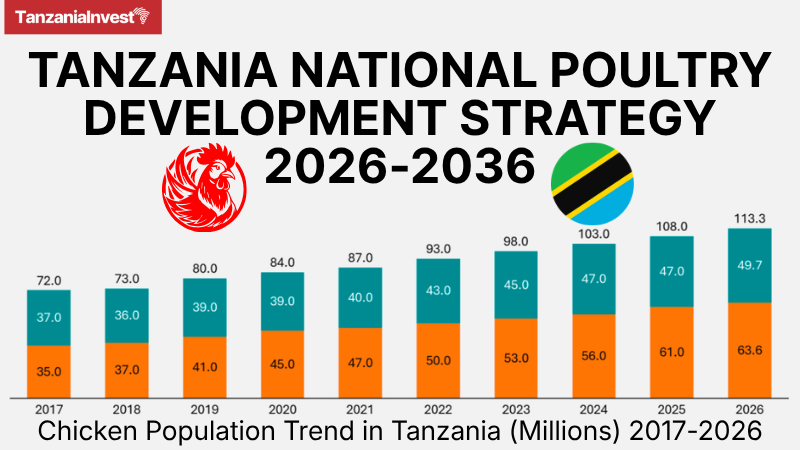
Tanzania’s poultry sector has expanded rapidly in recent years, with the national chicken population rising from 79.1 million birds in 2019 to over 108.2 million in 2024/25, while day-old chick production reached approximately 83.9 million in 2026.
Poultry currently accounts for about 30% of Tanzania’s livestock GDP, within a livestock sector that contributes 6.2% of national GDP, and supports more than four million households, representing about 55.4% of the country’s agricultural households.

Despite this growth, feed costs still account for approximately 70% of production expenses, per capita consumption remains low at about 107 eggs and 2.07 kg of poultry meat per person annually, and less than 10% of poultry products are processed, compared with about 30% in neighbouring Kenya.
The strategy is structured around four pillars: 1) quality and competitive inputs, 2) productive and resilient production, 3) processing and market access, and 4) cross-cutting enablers such as finance, research and institutional coordination.
Under the input pillar, the strategy targets increasing local maize production for animal feed from 750,000 to 1,500,000 metric tonnes and soybean production from 25,000 to 300,000 metric tonnes by 2036/37, cutting the feed share of production costs from 70% to about 50%.
The strategy also targets raising national day-old chick production capacity to over 250 million birds annually and increasing farmer access to quality chicks through formal market channels to about 80%.
A further plan is to train and accredit more than 3,000 youth- and women-led SMEs as registered chick-rearing units linked to breeder farms, in a poultry sector where women account for 51.3% of participants and youth for 65%.
Under the processing pillar, the strategy targets raising the share of processed poultry products to at least 30% of total production from under 10% currently, expanding processing capacity to at least 260,000 metric tonnes, and cutting post-harvest losses by at least 40%.
The investment plan allocates TZS 1,601.4 billion (USD 604.30 million) to strengthening feed and breeding inputs, the largest single pillar, followed by TZS 1,001.3 billion (USD 377.85 million) for processing, markets and trade, TZS 732.6 billion (USD 276.45 million) for farm-level production, and TZS 191.3 billion (USD 72.19 million) for cross-cutting enablers, bringing the ten-year total to TZS 3,526.6 billion (USD 1.33 billion).
The private sector is expected to fund approximately 60% of implementation, with the strategy targeting to mobilise more than TZS 2.14 trillion (USD 807.55 million) in private investment, while government and development partners play a catalytic role in public goods, regulation, extension and research.
Nationally, the strategy also targets raising poultry’s share of livestock GDP from approximately 30% to 40%, increasing poultry meat production from approximately 156,000 metric tonnes to over 380,000 metric tonnes annually, and raising egg production from 7.1 billion to over 17 billion eggs by 2036.
Nchemba described the strategy’s launch as a significant step toward transforming the poultry sub-sector and lifting production, and instructed the Ministry of Livestock and Fisheries to ensure implementation translates into tangible gains for farmers, especially those in the Central Zone.
The Minister for Livestock and Fisheries, Ambassador Dr. Bashiru Ally Kakurwa, said the strategy would speed up growth in an industry that underpins incomes for many low- and middle-income households, and pointed to continued government investment in breeding, animal health, disease control and market infrastructure as part of the wider effort.
For his part, Geoffrey Kirenga, CEO of AGCOT, commented: “The National Poultry Development Strategy is a pivotal milestone for Tanzania’s livestock sector. Having supported this vision from inception, AGCOT (formerly SAGCOT) remains committed to transforming the poultry value chain into a commercial powerhouse for rural wealth and youth employment for resilient national food systems.”
Want to know more about Agriculture in Tanzania? Our free overview of the Tanzania Business and Investment Guide 2026 covers Agriculture, plus key sectors and investment opportunities. The complete 141-page edition includes policies, taxation, key regulations, full macroeconomic data, and sources, and is also available at no cost upon completion of a short form.
Download Free OverviewGet the Full Edition for Free