Poultry
Tanzania's cattle, goat, sheep, and poultry populations surged by an average of 83% between 2010 and 2022, with the total value of all livestock groups, including chickens, reaching TZS 33.22 trillion in 2024/2025.
Poultry is one of Tanzania's priority commodities under the national agricultural agenda, positioned alongside wheat, soybeans, aquaculture, and fertilizer for accelerated commercial development.
The country already ranks among the top ten African nations for chicken population size, and per capita, Tanzania's total livestock population is among the largest on the continent.
Poultry in Tanzania's Livestock Landscape
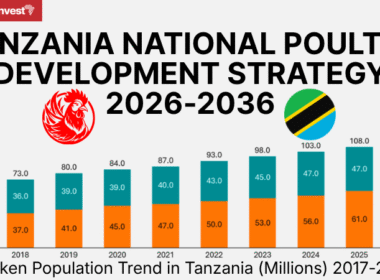
Tanzania hosts one of Africa's largest livestock populations, with chicken numbers ranking among the top ten on the continent.[1]
Per capita, the country's total livestock population is also among the largest in Africa.
Between 2010 and 2022, Tanzania's cattle, goat, sheep, and poultry populations expanded by an average of 83%, with the cattle herd more than doubling.
This sustained expansion in flock and herd sizes underpins the commercial scale-up potential of the poultry value chain.
Sector Value and Performance in FY 2024/25
The total value of all livestock groups, including cattle, goats, sheep, pigs, and chickens, reached TZS 33.22 trillion in 2024/2025.
This was up from TZS 30.49 trillion in 2023/2024, an increase that reflects rising production volumes and stronger market valuations across the livestock sub-sectors.
Meat exports grew by 5.75% in 2024/2025 compared to the previous year.
Total meat export volume reached 9,863.41 tonnes valued at USD 44.07 million, up from 9,326.3 tonnes worth USD 39.3 million in 2023/2024.
Meat Export Markets
Tanzanian meat markets have continued to expand, reaching 11 destination countries.
These markets include Bahrain, Comoros, Hong Kong, Jordan, Kenya, Kuwait, Oman, Qatar, Saudi Arabia, the UAE, and Vietnam.
Goat meat remained the leading export product, accounting for 64.69% of total meat exports in 2024/2025.
The expanding destination base, particularly across the Gulf and East Asia, signals demand headroom for processed poultry and other meat categories to follow established trade channels.
Policy Framework and Priority Commodity Status
Poultry is explicitly listed among the prioritized commodities under Tanzania's agricultural strategy, alongside red meat, dairy, fodder, and aquaculture.
Agriculture Master Plan 2050 Targets
The plan calls for accelerating the development of commercial activities of priority commodities, including wheat, soybeans, poultry, aquaculture, and fertilizer.
It also targets digitally registering 9.9 million farmers and stakeholders and digitalizing the agricultural ecosystem.
Coverage of extension services is to be boosted by approximately two times, with access to financing extended to 1.7 million beneficiaries in groups and 30,000 small and medium-sized enterprises.
Regional and international exports are targeted to reach USD 6 billion.
Ministerial Investment Priorities
One of the core priorities for the Ministry of Livestock and Fisheries for both the 2024/2025 and 2025/2026 budgets is encouraging investment in the Livestock and Fisheries Sectors.
Within this mandate, Poultry and Meat Processing is explicitly named as a focus area for investment, together with Livestock Breeding, Fodder Production, Processed Feeds, Dairy Transformation, Leather Processing, and Vaccine Production.
Investment Opportunities in Poultry
Poultry and Meat Processing is among the specific areas where investment is actively encouraged under the Ministry of Livestock and Fisheries' 2024/2025 and 2025/2026 budget priorities.
Commercial development of poultry as a priority commodity opens space for integrated operations spanning breeding, grow-out, slaughter, processing, and cold chain logistics.
Adjacent opportunities reinforce the poultry value chain, including Processed Feeds, Fodder Production, and Vaccine Production, all of which feed directly into reducing input costs and disease risk for commercial flocks.
Export-oriented processors can leverage the existing 11-country meat export network spanning Bahrain, Comoros, Hong Kong, Jordan, Kenya, Kuwait, Oman, Qatar, Saudi Arabia, the UAE, and Vietnam to position branded Tanzanian poultry products.
Upstream and downstream market linkages for more than 2 million smallholders, together with a tenfold increase in processing of specific commodities through warehouses and market linkages, are set to widen the commercial base for poultry producers and aggregators.
Last Update: May 2026
References
- https://openknowledge.worldbank.org/server/api/core/bitstreams/3ae63843-d8c3-4708-8947-24faf928ec88/content (Guide reference #68)
- https://www.mifugouvuvi.go.tz/uploads/documents/en-1756496407-Sera%20ya%20Taifa%20ya%20Uchumi%20wa%20Buluu%20ya%20Mwaka%202024.pdf (Guide reference #69)
- https://www.fao.org/4/t0473e/T0473E09.htm (Guide reference #73)
Want to know more about Poultry in Tanzania? Our free overview of the Tanzania Business and Investment Guide 2026 covers Poultry, plus key sectors and investment opportunities. The complete 141-page edition includes policies, taxation, key regulations, full macroeconomic data, and sources, and is also available at no cost upon completion of a short form.
Download Free OverviewGet the Full Edition for Free