



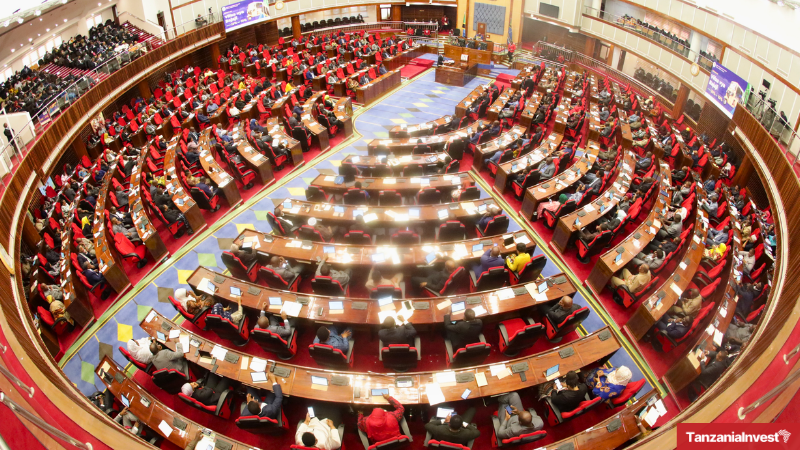
Tanzanian Parliament Approves TZS 62.33 Trillion 2026/27 Budget, Taking Effect 1 July 2026

Tanzania’s Parliament approved the TZS 62.33 trillion (± USD 24 billion) 2026/27 Government Budget on 23 June 2026 by 385 of 393 votes, after seven days of debate and passage of the Finance Bill 2026. The spending plan takes effect on 1 July 2026, with the government committing to TZS 1.2 trillion in arrears settlement and tighter expenditure controls.
Tanzania Parliament National Assembly Bunge

Tanzania’s Parliament approved the TZS 62.33 trillion (± USD 24 billion) Government Budget for 2026/27 by 385 of 393 votes on 23 June 2026, with the spending plan and its tax measures taking effect on 1 July 2026.

The budget was presented to Parliament in Dodoma on 11 June 2026 by the Minister for Finance, Ambassador Khamis Mussa Omar, and debated over seven working days from 15 to 23 June 2026.

Parliament Speaker Mussa Azzan Zungu announced the results on 23 June 2026, with 385 Members of Parliament voting in favour, eight against, and eight absent, a majority of approximately 98%.

Tanzania Investment Guide 2026 Free Edition

Before the final vote, Members of Parliament reviewed and voted on the Finance Bill 2026 line by line, approving the individual tax measures it contains.

The debate concluded after Ambassador Omar and Professor Kitila Mkumbo, Minister of State in the President’s Office for Planning and Investment, responded to issues raised by Members of Parliament during the seven days of discussion.

Ambassador Omar said the government was committed to tighter spending controls, settlement of arrears owed to contractors and suppliers, and improved revenue collection through tax administration reforms, in line with President Samia Suluhu Hassan’s directives on fiscal discipline. He acknowledged room remained to improve oversight and spending efficiency.

The government has set aside TZS 1.2 trillion (± USD 462 million) for clearing arrears in 2026/27, with about TZS 100 billion expected to be paid out each month, subject to cash flow, a measure intended to support private sector liquidity and continued project implementation.

Professor Mkumbo said 54.2% of the workforce remains engaged in agriculture, livestock, and forestry, and that industrialisation efforts would continue to be anchored in agricultural transformation.

TanzaniaInvest Capital Markets Report Banner

The budget takes effect on 1 July 2026, subject to the President signing the Finance Act into law.

Want to know more about the Economy in Tanzania? Our free overview of the Tanzania Business and Investment Guide 2026 covers the Economy, plus key sectors and investment opportunities. The complete 141-page edition includes policies, taxation, key regulations, full macroeconomic data, and sources, and is also available at no cost upon completion of a short form.

Download Free OverviewGet the Full Edition for Free


Related Posts
DRC Julien Paluku Kahongya Tanzania Judith Kapinga trade cooperation agreement
Read More

Tanzania and DRC Sign Trade Facilitation and Cooperation Agreement

Tanzania and the DRC signed a trade facilitation and cooperation agreement in Dar es Salaam, establishing a joint trade committee to expand bilateral trade and investment. Priority areas of cooperation include transport, exports, trade facilitation, infrastructure, and cross-border trade.
Group Photo 2026 IISD Investment Policy Forum Dar es Salaam Tanzania
Read More

17th Investment Policy Forum Held in Dar es Salaam, Focused on Jobs, Skills, Technology and Domestic Value

The 17th Investment Policy Forum was held in Dar es Salaam from 16 to 18 September 2026, bringing together investment officials and negotiators from Africa, Asia, Latin America and the Caribbean. Discussions focused on aligning investment governance across national, regional and international levels and ensuring that investment generates jobs, skills, technology, stronger supply chains and domestic value addition.
Tanzania national land database digital service
Read More

Tanzania National Land Database to Centralize Records as Land Boards Digitize Services

Tanzania is building a central national land database under the National Land Data Infrastructure (NLDI) project to deliver accurate, modern, and officially recognised land information. The system aims to cut land disputes arising from conflicting boundaries and ownership and make tenure more secure for investment. The valuers’ and town planners’ registration boards have also been directed to accelerate the digitization of their services.
Tanzanian and JETRO officials exchange an Invest Tanzania gift set during Tanzania's investment promotion campaign in Japan
Read More

Tanzania Targets Doubling Japanese Investments

Tanzania's government told a Tokyo investment seminar on 8 September 2026 that it is ready to attract long-term Japanese investment, aiming to double Japanese-invested projects, under the Vision 2050 plan. State Minister Kitila Mkumbo pointed to opportunities across automotive assembly, pharmaceuticals, agro-processing, strategic minerals, energy and other sectors, citing Tanzania's EAC and SADC membership as access to a combined market of around 300 million consumers.