
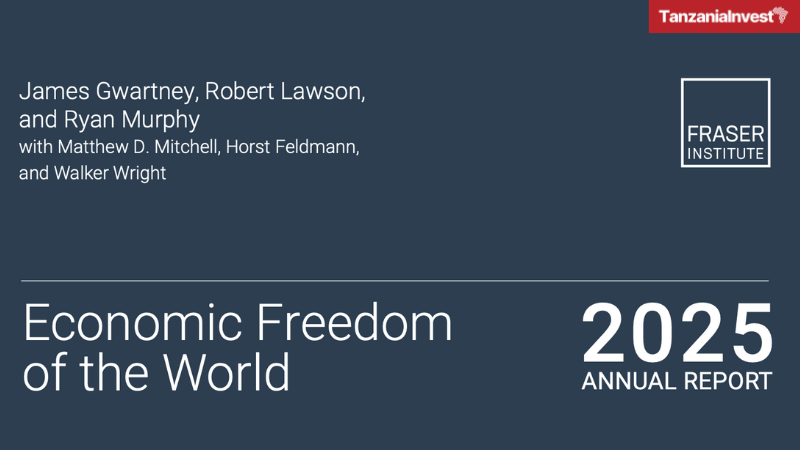
The Fraser Institute has released the Economic Freedom of the World 2025 Annual Report, which ranks 165 jurisdictions worldwide based on the degree to which their institutions and policies support economic freedom.
The Economic Freedom of the World (EFW) index assesses the degree to which institutions and policies of countries permit individuals to make their own economic choices, such as working, transacting, contracting, and owning property.
Governments are considered to protect economic freedom when they safeguard voluntary exchange, defend property rights, and enforce contracts in a fair manner.

Economic freedom is also supported by access to sound money, low barriers to trade, moderate taxation, and regulations that do not restrict personal choice or limit market entry.
The 2025 report–based on data from 2023–uses five broad areas to evaluate economic freedom: 1) size of government, 2) legal system and property rights, 3) sound money, 4) freedom to trade internationally, and 5) regulation.
The index does not measure living standards, corruption, or political freedoms, but focuses specifically on economic institutions.
Scores are presented on a 0–10 scale, where higher values represent greater economic freedom. Data are available as far back as 1970, making the EFW index one of the most comprehensive long-term measures of economic freedom.
Countries with high scores are characterized by strong legal protections, voluntary exchange, low trade barriers, limited regulation, and access to sound money. Conversely, low-scoring countries tend to have weak property rights, high levels of government intervention, and significant barriers to trade and investment.

Global Rankings
For 2023, the latest year of assessment, Hong Kong retained the top position, followed by Singapore, New Zealand, Switzerland, the United States, Ireland, Australia and Taiwan (tied for 7th), Denmark, and the Netherlands.
Other large economies ranked as follows: Canada (11th), United Kingdom (13th), Germany (15th), Japan (17th), South Korea (38th), France (44th), Italy (46th), Indonesia (65th), Mexico (70th), India (86th), Brazil (87th), China (108th), and Russia (148th).
The 10 lowest-ranked countries were Chad, Libya, Syria, Argentina, Myanmar, Iran, Algeria, Sudan, Zimbabwe, and Venezuela.
Sub-Saharan Africa
Sub-Saharan Africa recorded one of the greatest improvements in economic freedom between 2000 and 2023.
However, like all regions, its overall score in 2023 (5.9) was lower than in 2019, reflecting a decline in institutional quality.
The region continues to face significant challenges in the rule of law and property rights, which remain among the weakest globally.
Studies cited in the report show that higher levels of economic freedom in African countries are associated with reduced conflict, improved cooperation, and lower risks of ethnic violence.
East Africa and Tanzania
In East Africa, Uganda ranks 72nd globally, Kenya 81st, Rwanda 97th, Somalia 101st, Tanzania 102nd, the Democratic Republic of the Congo 151st, and Burundi 152nd. South Sudan is not covered.
| Country | Overall Rank | Size of Government (Score/Rank) | Legal System & Property Rights (Score/Rank) | Sound Money (Score/Rank) | Freedom to Trade Internationally (Score/Rank) | Regulation (Score/Rank) |
|---|---|---|---|---|---|---|
| Tanzania | 102 | 5.87 / 125 | 5.22 / 82 | 7.92 / 80 | 5.76 / 137 | 6.60 / 67 |
| Uganda | 72 | 6.94 / 66 | 4.96 / 90 | 8.97 / 38 | 7.03 / 95 | 6.48 / 80 |
| Kenya | 81 | 6.54 / 88 | 5.10 / 86 | 8.88 / 42 | 6.41 / 121 | 6.48 / 79 |
| Rwanda | 97 | 4.98 / 150 | 5.99 / 52 | 6.77 / 111 | 7.56 / 70 | 6.54 / 73 |
| Somalia | 101 | 9.53 / 1 | 2.15 / 164 | 9.00 / 35 | 6.38 / 123 | 4.33 / 157 |
| Democratic Republic of the Congo | 151 | 7.44 / 42 | 2.62 / 158 | 5.16 / 145 | 5.27 / 147 | 4.66 / 148 |
| Burundi | 152 | 6.48 / 96 | 3.41 / 143 | 5.74 / 140 | 3.61 / 162 | 5.79 / 122 |
Tanzania’s strongest performance is in regulation, where it ranks 67th globally, the best in East Africa.
This places Tanzania ahead of Rwanda (73rd), Kenya (79th), and Uganda (80th), reflecting comparatively stronger frameworks in labor markets, credit, and business regulation.
In legal system and property rights, Tanzania ranks 82nd globally, second in East Africa after Rwanda (52nd), and ahead of Kenya (86th), Uganda (90th), and well above Burundi (143rd) and the Democratic Republic of the Congo (158th).
In sound money, Tanzania scores 7.92 with a global ranking of 80th. This places it above Rwanda (111th), the Democratic Republic of the Congo (145th), and Burundi (140th), though it lags behind Uganda (38th) and Kenya (42nd).
However, Tanzania performs poorly in freedom to trade internationally, ranking 137th worldwide, second lowest in East Africa after Burundi (162nd). This reflects persistent trade barriers and restrictions that continue to undermine competitiveness.
In size of government, Tanzania is ranked 125th globally. It performs worse than Uganda (66th), Kenya (88th), and Burundi (96th), but better than Rwanda (150th).
Overall, Tanzania’s performance highlights relative strengths in regulation and institutional quality in property rights, but significant challenges remain in trade openness and the size of government.
Want to know more about the Economy in Tanzania? Our free overview of the Tanzania Business and Investment Guide 2026 covers the Economy, plus key sectors and investment opportunities. The complete 141-page edition includes policies, taxation, key regulations, full macroeconomic data, and sources, and is also available at no cost upon completion of a short form.
Download Free OverviewGet the Full Edition for Free