

The fifth review of the International Monetary Fund (IMF) program in Tanzania indicates that the country faces downside macroeconomic risks that could adversely affect its economic growth.
These risks include the currently tight stance of macroeconomic policies, the slow pace of credit growth, slow implementation of public investment, and private sector uncertainty about the government’s new economic strategies.
The conclusion was made by the Executive Board of the IMF after they completed the fifth review of Tanzania’s macroeconomic performance under the Policy Support Instrument (PSI), on January 9th, 2016.

The PSI helps low-income countries to design effective economic plans that once approved by the IMF, are addressed to international donors, multilateral development banks, and foreign markets.
Despite the risks, the IMF notes that Tanzania’s macroeconomic performances remain strong.
“Economic growth was robust during the first half of 2016 and is projected to remain at about 7% this fiscal year. Inflation came down below the authorities’ target of 5% and is expected to remain close to the target […],” the IMF indicates.
The IMF also states that the authorities of Tanzania have recently stepped up efforts to advance structural reforms identified under the IMF program.
These include measures taken to strengthen public financial and debt management, modernize the monetary policy framework, and improve monitoring of parastatal enterprises.

“The current tight macroeconomic conditions should be addressed by loosening the short-term policy stance, in line with program targets. After recording a small fiscal surplus in July-September, the government is committed to stepping up budget implementation, particularly in public investment, including by mobilizing external financing. Monetary policy should be eased to address the tight liquidity situation and support credit to the private sector,” the IMF advises.
The IMF further notes that the strong drive against corruption and tax evasion has led to higher fiscal revenues, which, if sustained, will provide a good foundation for the envisaged scaling up of infrastructure investment, starting with the 2016/17 budget.
The IMF concludes that full involvement of all stakeholders in policy design and implementation, including importantly the private sector, will be crucial.
Tanzania Macroeconomic Performances
Tanzania’s GDP grew by 7% in 2015, with activity particularly strong in the construction, communication, finance, and transportation sectors.
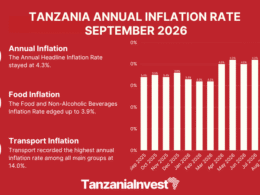
Inflation in Tanzania remained in single digits throughout 2015, averaging 5.6%, close to the authorities’ target of 5%. In September 2016, the country’s annual inflation rate fell to 4.5%.
Bhaswar Mukhopadhyay, Resident Representative of the IMF in Tanzania, said in a recent interview with TanzaniaInvest: “Tanzania does not need financial assistance for maintaining macroeconomic stability. The country is not facing pressures on its balance of payments and its debt is at safe levels. Inflation is low, and the exchange rate has stabilized after a depreciation in 2015. Overall, these broad indicators of macroeconomic stability show that Tanzania is on the right track.”
Want to know more about the Economy in Tanzania? Our free overview of the Tanzania Business and Investment Guide 2026 covers the Economy, plus key sectors and investment opportunities. The complete 141-page edition includes policies, taxation, key regulations, full macroeconomic data, and sources, and is also available at no cost upon completion of a short form.
Download Free OverviewGet the Full Edition for Free