Tanzania Inflation Stayed at 3.4% in September 2025 with Food Prices Easing to 7.0%

The annual headline inflation rate in Tanzania remained stable at 3.4% in September 2025, while annual food and non-alcoholic beverages inflation eased to 7.0%. Between August and September 2025, prices of specific goods such as cocoyams (+8.9%), sweet potatoes (+7.6%), industrially bred live chicken (+5.0%), dried peas (+4.0%), and sorghum flour (+3.6%) recorded the largest monthly increases, driving the overall rise in the National Consumer Price Index to 119.86.
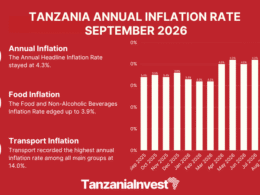
TANZANIA ANNUAL INFLATION RATE SEPTEMBER 2025

The National Bureau of Statistics of Tanzania (NBS) announced that the annual headline inflation rate for September 2025 remained unchanged at 3.4%, as it was recorded in August 2025.

This stagnation indicates that the pace of price changes for commodities in the year ending September 2025 was the same as in the year ended August 2025.

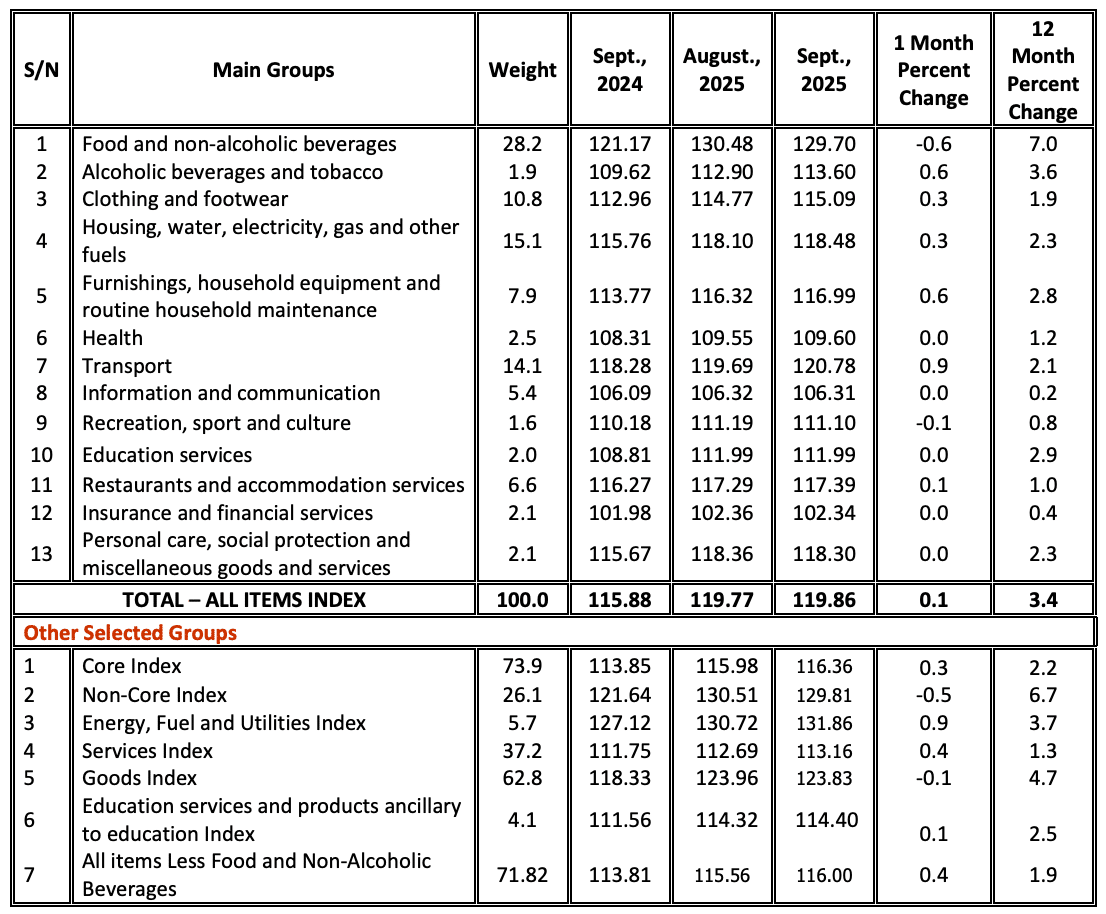
The overall index increased from 115.88 in September 2024 to 119.86 in September 2025.

Tanzania Investment Guide 2026 Free Edition

Food Inflation

The Food and Non-Alcoholic Beverages Inflation Rate for September 2025 has decreased to 7.0% from 7.7% in August 2025.

Non-Food Inflation

In contrast, all items excluding food and non-alcoholic beverages recorded a slight increase to 1.9% in September 2025, from 1.6% in August 2025.

Core Inflation

Tanzania Investment Guide 2026 Full Edition

The Core Index excludes items with volatile prices, namely unprocessed food, energy, and utilities (with the exception of maize flour) to obtain a more stable measure of inflation.

The Core Index covers 297 items, representing 73.9% of the total NCPI weight.

In September 2025, the Core Inflation Rate rose to 2.2% from 2.0% in August 2025.

Monthly Consumer Price Index August-September 2025

Between August 2025 and September 2025, the National Consumer Price Index increased from 119.77 to 119.86.

This increase in the overall index is mainly attributed to the increase of prices for some food and non-food items.

Food items contributing to the increase included: sorghum flour (by 3.6%), bread and bakery products (by 1.0%), industrially bred live chicken (by 5.0%), meat of poultry (by 3.6%), fresh fish (by 1.0%), fruits (by 2.2%), irish potatoes (by 0.8%), sweet potatoes (by 7.6%), fresh cassava (by 2.2%), cocoyams (by 8.9%), cooking bananas (by 1.8%) and dried peas (by 4.0%).

Non-food items contributing to the increase included: alcoholic beverages and tobacco (by 0.6%), clothing materials (by 0.5%), garments for men (by 0.9%), footwear for men (by 0.4%), liquefied hydrocarbons (by 0.1%), kerosene (by 1.1%), wood charcoal (by 2.7%), household furniture (by 1.0%) and small household appliances (by 0.5%).

Changes in Tanzania National Consumer Price Indices (NCPI) for September 2025, (2020 = 100)
Want to know more about the Economy in Tanzania? Our free overview of the Tanzania Business and Investment Guide 2026 covers the Economy, plus key sectors and investment opportunities. The complete 141-page edition includes policies, taxation, key regulations, full macroeconomic data, and sources.

Download Free OverviewGet the Full Guide — USD 99
Related Posts
TanzaniaInvest Interview FAyaz Bhojani Managing Partner FB Attorneys
Read More

Interview with Dr FAyaz Bhojani, Managing Partner of FB Attorneys, on the Evolution of the Firm, and Litigation, Arbitration and Taxation Issues in Tanzania

TanzaniaInvest interviewed Dr FAyaz Bhojani, Managing Partner of FB Attorneys, the only law firm in Tanzania ranked at the top by all three leading international legal directories, Chambers and Partners, IFLR1000, and The Legal 500. He discusses the firm’s cross-border and arbitration work, its strength in mining, oil and gas, and M&A, and the two factors foreign investors weigh most before entering Tanzania: the rule of law and a fair, predictable tax system.
Juma Malik Akil Zanzibar Budget 2026-2027 House of Representatives
Read More

Zanzibar Passes 2026/2027 Budget of TZS 8.52 Trillion, Targeting 7.5% GDP Growth, Stock Exchange Launch, and Investment Priority on Tourism, the Blue Economy, and SMEs

Zanzibar passed a TZS 8.52 trillion (± USD 3.28 billion) budget for 2026/27, a 22.11% increase, targeting 7.5% economic growth and reducing external financing dependence to 2.8% as tourist arrivals rose 21.9% to 800,968. Priority sectors are tourism, agriculture, fisheries, small and medium enterprises and the blue economy, with investor measures including the planned launch of a Zanzibar stock exchange, raw materials relief for small and medium manufacturers outside ZIPA, and a 25% stamp duty cut on commercial vehicles.
European Parliament Plenary Voting session
Read More

European Parliament Approves Objection to EUR 156 Million Tanzania Funding Plan

The European Parliament has formally approved an objection to the European Commission's proposed EUR 156 million Annual Action Plan for Tanzania in 2026, calling for the financing decision to be withdrawn and replaced with a new proposal. Tanzania's government has responded by stating that the vote does not represent the European Union's final decision and that any review of the programme would require agreement between both parties.