Tanzania Investment Centre Registers 2,020 Projects Under President Samia, a 177% Increase to US$23.67B, Targets 1,500 More Worth US$15B by End of 2025

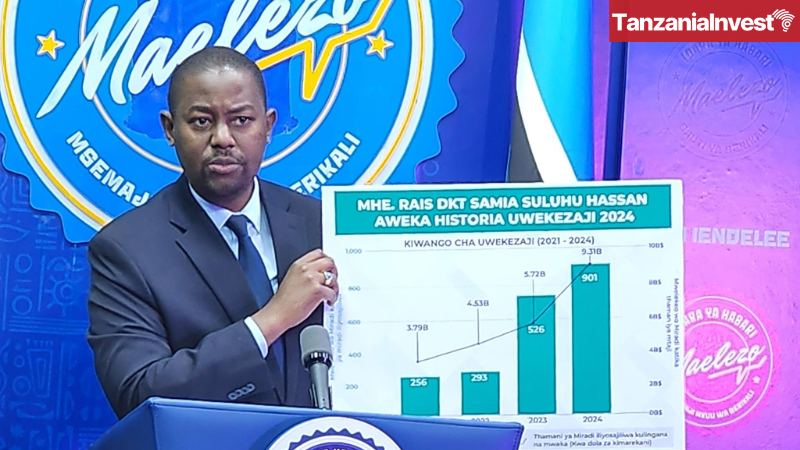
The Tanzania Investment Centre (TIC) registered 2,020 projects between March 2021 and February 2025 under President Samia, marking a 177% increase. The projects, worth US$23.67 billion, created over 523,000 jobs, with TIC aiming for US$15 billion more by December 2025.
Gilead Teri Tanzania Investments Samia Government

The Tanzania Investment Centre (TIC) has registered 2,020 investment projects between March 2021 and February 2025 under President Samia Suluhu Hassan’s administration, marking a 177.47% increase compared to the 728 projects registered from March 2018 to March 2021, which represented a 63.19% growth.

Speaking at a press conference on February 27, 2025, in Dodoma, TIC Executive Director Gilead Teri highlighted the Centre’s achievements over the past four years, emphasizing the impact of President Samia’s pro-investment policies and economic diplomacy.

Teri noted that President Samia’s engagements in the U.S., China, South Korea, the European Union, South Africa, Turkey, and Egypt have boosted investor confidence, leading to increased domestic and foreign investments.

Tanzania Investment Guide 2026 Free Edition

He detailed that 34% of the new investments are from Tanzanians, 42.6% from foreign investors, and 23.1% from joint ventures.

The registered investments have created 523,891 jobs, a major rise from the 104,172 jobs generated between 2018 and 2021.

TIC’s revenue collections have also increased from an average of TZS 400 million to TZS 1 billion per month.

The total capital investment value of these projects stands at US$23.67 billion, reflecting a 188% increase from the US$8.2 billion recorded in the previous period.

Looking ahead, TIC aims to attract 1,500 new investment projects and US$15 billion in capital by December 2025, with a focus on manufacturing, agriculture, transport, energy, tourism, mining, and services.

TanzaniaInvest Capital Markets Report Banner

Want to know more about the Economy in Tanzania? Our free overview of the Tanzania Business and Investment Guide 2026 covers the Economy, plus key sectors and investment opportunities. The complete 141-page edition includes policies, taxation, key regulations, full macroeconomic data, and sources, and is also available at no cost upon completion of a short form.

Download Free OverviewGet the Full Edition for Free
Related Posts
Innovation Week Tanzania (IWTz) 2026
Read More

Innovation Week Tanzania (IWTz) 2026: 31st August-4th September 2026, Dar es Salaam

Innovation Week Tanzania (IWTz) 2026, the platform’s 12th edition, runs from 31st August to 4th September at JNICC in Dar es Salaam under the theme “From Aspirations to Transformation.” Hosted by UNDP Tanzania’s FUNGUO Programme with the EU, UK, Vodacom and COSTECH, it brings investors, innovators and policymakers together around Tanzania’s Vision 2050 target of a USD 1 trillion economy.
Tanzania Fitch Ratings
Read More

Fitch Revises Tanzania Outlook to Positive, Affirms ‘B+’ Rating, Forecasts GDP Growth of 5.8% in 2026 Driven by Tourism and Mining

Fitch Ratings revised Tanzania's outlook to positive from stable while affirming the sovereign rating at 'B+', citing strengthening reserves and a gradual decline in government debt, warning, however, that the credit rating remains constrained by weak governance and low government revenue. The agency forecasts real GDP growth of 5.8% in 2026 and an average of 6.1% in 2027 and 2028, driven by public investment, tourism, the country's role as a regional logistics hub, and expansion in the mining sector.
Tanzania World Bank
Read More

Tanzania and World Bank Finalize KAZI MPA Central Corridor Jobs Programme to Boost Youth Employment and Private-Sector Growth

The Government of Tanzania and the World Bank have finalized technical preparations for KAZI MPA, the Catalyzing Jobs and Resilient Growth in the Central Corridor Multiphase Programmatic Approach. The programme aims to expand youth employment, increase investment and strengthen private-sector participation along the Central Corridor in line with Tanzania Development Vision 2050.