

On 5th May 2025, the Tanzanian Chamber of Commerce, Industry, and Agriculture (TCCIA) and the United Arab Emirates signed a Memorandum of Understanding (MoU) to establish a bilateral Business Council aimed at enhancing trade and investment cooperation between the two countries.
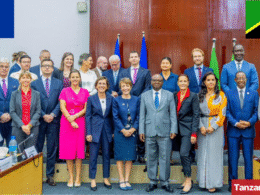
The MoU was signed in Dar es Salaam by Saeed Mubarak Al Hajri, Assistant Minister for Economic and Trade Affairs of the UAE, and Vincent Minja, President of the Tanzanian Chamber of Commerce, Industry, and Agriculture (TCCIA).
The signing took place in the presence of H.H. Sheikh Abdullah bin Zayed Al Nahyan, UAE Deputy Prime Minister and Minister of Foreign Affairs, and H.E. Dr. Samia Suluhu Hassan, President of the United Republic of Tanzania.

The agreement establishes a formal framework for cooperation between Emirati and Tanzanian private sector stakeholders and aims to promote joint business initiatives, information sharing, and market access in both countries.
The signing occurred during a high-level UAE delegation’s working visit to Tanzania and was accompanied by the signing of two additional bilateral agreements: an administrative cooperation agreement on customs matters, and an MoU on investment cooperation in the mining sector.
Also present at the signing were Mahmoud Thabit Kombo, Tanzanian Minister of Foreign Affairs and East African Cooperation, Mwigulu L. Nchemba, Minister of Finance, and Anthony Peter Mavunde, Minister of Minerals.
The UAE delegation included Sheikh Shakhboot bin Nahyan Al Nahyan, Minister of State, Noura bint Mohammed Al Kaabi, Minister of State, and Khalifa Abdulrahman Al Marzouqi, UAE Ambassador to Tanzania.
During the meeting, Sheikh Abdullah conveyed greetings from UAE President Sheikh Mohamed bin Zayed Al Nahyan to President Samia Suluhu Hassan and delivered the ‘Mother of the Nation Order’ awarded to her by the UAE in recognition of her achievements in sustainable development and social cohesion.

President Hassan, in turn, conveyed her greetings and appreciation to the UAE President and affirmed her commitment to deepening bilateral cooperation.
The United Arab Emirates has emerged as one of Tanzania’s key trade and investment partners in recent years.
UAE investments in the country span various sectors, including energy, logistics, telecommunications, agriculture, and mining.
Trade between the two countries has also grown, with the UAE serving as both a source of capital and a gateway for Tanzanian exports to Gulf and Asian markets.
The creation of the Business Council is expected to further facilitate investment flows and joint ventures between Emirati and Tanzanian businesses.
Want to know more about Trade in Tanzania? Our free overview of the Tanzania Business and Investment Guide 2026 covers Trade, plus key sectors and investment opportunities. The complete 141-page edition includes policies, taxation, key regulations, full macroeconomic data, and sources, and is also available at no cost upon completion of a short form.
Download Free OverviewGet the Full Edition for Free