Tanzania to Increase Availability of Geological Data Reducing Investment Risks in Mining

Tanzania’s Mining Vision 2030 aims to de-risk the mining sector by expanding geological data access, attracting foreign investment, and promoting sustainable development. STAMICO outlined the strategy’s goals at the Africa Critical Minerals Summit, emphasizing Tanzania’s unique mineral wealth, including rare gemstones like Tanzanite.
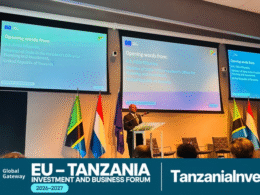
Mwasse speaking on Tanzania to increase availability of geological data reducing investment risks in Mining

Tanzania’s Mining Vision 2030 strategy aims to de-risk the mining sector by increasing the availability of geological data, thereby reducing potential investment risks.

This statement was made on 6th November 2024 by Dr. Venance Mwasse, CEO of Tanzania’s State Mining Corporation (STAMICO) at the Africa Critical Minerals Summit in Cape Town, South Africa.

Dr. Mwasse elaborated that the strategy includes expanding airborne mineral exploration surveys to cover 50% of the country by 2030, a significant increase from the current 16%.

Tanzania Investment Guide 2026 Free Edition

Mwasse highlighted that the geology of Tanzania has endowed the country with critical minerals essential for clean energy and mineral resources including Tanzanite.

Tanzanite is a gemstone found nowhere else in the world and considered 100 times rarer than diamonds and 1,000 times rarer than other gemstones.

Dr. Mwasse explained: “With detailed geological information, investors will have a clear understanding of mineral locations, particularly for critical resources.”

In addition to geological data, Dr. Mwasse also discussed Tanzania’s commitment to infrastructure improvement to support mining and other sectors.

Dr. Mwasse further highlighted Tanzania’s successful management of small-scale mining operations, positioning the country as a model for other African nations seeking to improve regulation and oversight in artisanal mining.

TanzaniaInvest Capital Markets Report Banner

Tanzania’s Mining Vision 2030

Tanzania’s Mining Vision 2030 is a strategy aiming to transform the country’s mining sector into a cornerstone of economic growth and sustainable development.

Through this initiative, the government plans to conduct advanced geological surveys, including high-resolution airborne geophysical surveys, to locate and evaluate mineral deposits across Tanzania.

The strategy also includes establishing modern geoscience laboratories and a mineral museum to enhance research capabilities and raise awareness of Tanzania’s rich mineral resources.

The primary focus of the strategy is to attract foreign direct investment (FDI) by creating a favorable investment environment with streamlined regulations and incentives such as tax exemptions.

Additionally, the strategy emphasizes sustainable mining practices that reduce environmental impacts while providing economic benefits to local communities.

Infrastructure improvements are integral to this plan, with upgrades to roads, railways, and energy systems aimed at supporting efficient mineral extraction and transport.

Want to know more about Mining in Tanzania? Our free overview of the Tanzania Business and Investment Guide 2026 covers Mining, plus key sectors and investment opportunities. The complete 141-page edition includes policies, taxation, key regulations, full macroeconomic data, and sources, and is also available at no cost upon completion of a short form.

Download Free OverviewGet the Full Edition for Free
Related Posts
EU-Tanzania Roadshow 2026 APM Terminals at Maasvlakte Rotterdam
Read More

EU–Tanzania Roadshow Ends With Rotterdam and Antwerp Port Visits as Tanzania Pitches Port, Rail and Logistics Opportunities to European Companies

The EU-Tanzania roadshow ended in Antwerp on 6 October 2026 after port visits in Rotterdam, with Tanzania's port and rail authorities pitching openings for terminal operators, EPC contractors, private rail operators and digital rolling stock tracking, while rail operator Vecturis, minerals logistics group Polytra, heavy lifting company Sarens and marine data company GEOxyz outlined their plans in Tanzania. The EU said it will join the World Bank and the EIB, which has a formal financing request, in supporting the Dar es Salaam port expansion, and offered Global Gateway guarantees, equity and feasibility funding for company projects screened by member states.
EU-Tanzania Roadshow 2026 The Hague day 1 opening Mkumbo
Read More

EU–Tanzania Roadshow Reaches The Hague With Coffee, Cashew, Critical Minerals, and Port Investment Pitches

The EU-Tanzania roadshow reached The Hague on 5 October 2026 for its final leg, where Tanzania pitched coffee and cashew processing, wheat and edible oils, critical minerals, the new Bagamoyo and Mwambani ports on the mainland, Zanzibar's Mangapwani port hub, four dry ports, and two new lines of the standard gauge railway network to around 90 businesses. Agriculture emerged as the priority sector for European and Dutch investors, with the best opportunities in food production and value addition, backed by Dutch expertise as the world's second-largest agricultural exporter.
EU-Tanzania Roadshow 2026-2027 Helsinki day 2 critical minerals visit
Read More

Tanzanian Delegation Visits EU’s Only Nickel Smelter, Metso Research Center, and Nokia on Day Two of EU-Tanzania Roadshow in Finland

On 29 September 2026, the second day of the EU-Tanzania roadshow in Finland, the Tanzanian delegation visited Metso's Pori Research Center, where around 180 experts work on mineral processing, hydrometallurgy, battery materials, and smelting, and Boliden's Harjavalta site, home to the only nickel smelter in the EU. The digital track included visits to Nokia, the Finnish Information Security Cluster, and technology company Gofore, with talks on digital sovereignty, digital public infrastructure, and Tanzania's move to a cashless economy.