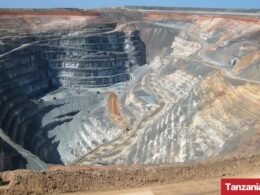
The Tanzanian Government has recently assigned a multi-disciplinary team of professionals to be in charge of redacting and negotiating contracts in the extractive industry and aiming at maximize the country’s benefits from its natural resources.
The measure is in line with the Africa Mining Vision (AMV) resolution adopted by Tanzania during the 13th Ordinary Session of the African Union which took place in Ethiopia’s capital, Addis Ababa between July 1st and 3rd, 2009 and seeks to create a transparent, equitable and optimal exploitation of mineral resources to support sustainable growth and human development.
The announcement of the new strategy was done by Tanzania’s Energy and Minerals Minister George Simbachawene, whom recently organised a meeting with lawmakers and governmental bodies to explain the Ministry’s new approach to reach the AMV’s goals.

With the support of the multi-disciplinary team, Tanzania will maximize and ensure that is fairly benefiting from its natural resources as minerals and natural gas, explained Minister Simbachawene.
After the convenient training, the team will be in better position of advising the government before entering into agreements with new investors that seek to benefit from Tanzania’s growing mineral and natural gas industry, he added.
Recent discoveries of natural gas fields that have brought Tanzania’s reserves of gas to 55 trillion cubic feet (tcf), have raised investments in the country from multinational oil and gas companies as Statoil from Norway, Exxon-Mobil from USA and British Petroleum from UK according to the Wall Street Journal (WSJ).
A Tanzania’s average GDP growth of 7.0% in the last 13 years have also raised the investments in the minerals industry, raising gold exports to USD 1,570 million gold, precious stones to USD 56.9 million and diamonds to USD 46.4 million in 2013 from gold exports at USD 206 million and precious stones at USD 20.5 million in 2001, according to the Massachusetts Institute of Technology (MIT).
Want to know more about Mining in Tanzania? Our free overview of the Tanzania Business and Investment Guide 2026 covers Mining, plus key sectors and investment opportunities. The complete 141-page edition includes policies, taxation, key regulations, full macroeconomic data, and sources, and is also available at no cost upon completion of a short form.
Download Free OverviewGet the Full Edition for Free