


Private Equity
Tanzania attracted approximately USD 600 million in cumulative private equity deal values between 2013 and 2023, based on data from The East Africa Venture Capital Association (EAVCA).
Private equity (PE) is stock in a private company that does not offer stock to the general public, but is instead placed with specialised investment funds and limited partnerships that take an active role in managing and structuring the companies.[1]
In Tanzania, private equity capital is deployed by private equity firms, venture capital funds, and angel investors to finance expansion, product development, operational restructuring, management changes, and shifts in ownership and control across a range of enterprises.[1]
Contents
Private Equity Activity in Tanzania
Tanzania recorded around USD 600 million in cumulative private equity deal values between 2013 and 2023, based on data compiled by The East Africa Venture Capital Association (EAVCA).
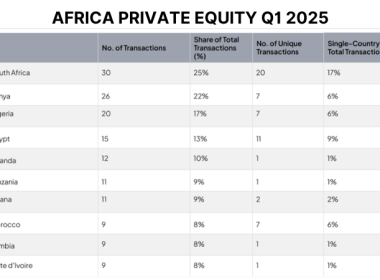
The Q1 2025 Stears Private Capital in Africa Report indicated that Tanzania accounted for 11 private equity transactions during that quarter.
This volume represented 9% of total deals recorded across East Africa in Q1 2025.
By comparison, Kenya accounted for 72% of transactions in the region during the same period, underscoring the concentration of regional PE activity in Nairobi.
Deal Value and Forecasts
Statista projects that the total private equity deal value in Tanzania will reach USD 4.99 million in 2025.
The same source forecasts an average deal size of USD 1.68 million in Tanzania for 2025 and anticipates approximately 2.97 deals during the year.
For global context, Statista data shows the highest global deal value projection for 2025 is in the United States, at USD 640.67 billion.
Working capital, operational restructuring, and buy-and-build strategies remain relevant use cases for PE deployment in Tanzania, consistent with the core functions of private equity as a long-term, illiquid financing product.[1]
Structural Constraints in the Ecosystem
The Stears report noted that in Uganda, Tanzania, and Rwanda, early growth-stage companies face difficulties raising capital, particularly outside the energy and fintech sectors.
The absence of local Limited Partner (LP) participation in General Partner (GP) fundraising is identified as a persistent bottleneck in the regional investment ecosystem.
Most East African investors rely on international LPs, while local institutional capital, such as from pension funds and insurers, shows slow entry into this asset class.
Local Institutional Capital
Combined pension and insurance assets in Kenya, Uganda, Tanzania, and Rwanda surpass USD 25 billion, yet local allocations to private capital remain negligible.
Kenya's pension sector, controlling over USD 13 billion, allocates less than 1% to private equity, well below the 10% regulatory ceiling.
The report indicates similar gaps exist in Uganda and Tanzania, citing risk appetite, regulatory clarity, and pipeline visibility as barriers to greater domestic institutional participation.
Global Private Equity Context Relevant to Tanzania
Private equity firms use capital from institutional investors to invest in private companies with potential to return a profit, typically realising that potential within 3 to 7 years by selling their stake at a price higher than the purchase.[2]
Private equity deals globally range from tens to hundreds of millions of dollars and are expected to deliver 20% to 30% returns.[2]
Common tactics used by private equity firms include reducing costs, improving efficiency by consolidating and internalizing previously outsourced processes such as billing, and, in service sector acquisitions, increasing prices, volume, and ancillary revenue streams.[2]
These global playbooks inform how international fund managers approach entry into frontier markets such as Tanzania, where fragmentation and consolidation potential often mirror the characteristics that attract PE capital elsewhere.[2]
Investment Opportunities in Tanzania
With cumulative PE inflows of approximately USD 600 million over a decade and only 11 transactions recorded in Q1 2025, Tanzania offers a comparatively under-penetrated market for private capital in East Africa.
Early growth-stage financing gaps outside energy and fintech point to openings for funds targeting agribusiness, consumer goods, healthcare, manufacturing, and logistics, where pipeline visibility can be built through direct sourcing.
The forecast 2025 average deal size of USD 1.68 million signals scope for lower mid-market and growth-capital strategies aligned with the ticket sizes of small and medium enterprises operating in the country.
The negligible allocation of Tanzanian pension and insurance capital to private equity, mirrored across the region within a combined USD 25 billion asset pool, creates room for fund managers to structure vehicles that can attract domestic LPs alongside international investors.
Buy-and-build strategies, operational restructuring, and working capital deployment remain relevant approaches, consistent with the core functions of private equity as a long-term, illiquid financing product for privately held companies.[1]
Last Update: July 2026
References
- 非上場株 - Web NDL Authorities
- Potential Implications of Private Equity Investments in Health Care Delivery - PMC
- Potential Implications of Private Equity Investments in Health Care Delivery - PubMed
- Dermatology Practice Consolidation Fueled by Private Equity Investment: Potential Consequences for the Specialty and Patients - PubMed
- Changes in Hospital Adverse Events and Patient Outcomes Associated With Private Equity Acquisition - PMC
- Changes in Hospital Adverse Events and Patient Outcomes Associated With Private Equity Acquisition - PubMed