Paratus Group Launches Internet and Digital Infrastructure Services in Tanzania as Part of East Africa Expansion

Paratus Group, a pan-African network services provider, has launched licensed operations in Tanzania to deliver internet, cloud, cybersecurity and managed network services to enterprises. The expansion is part of its East Africa rollout, supported by its East–West fiber backbone, as the region’s GDP share is forecast to grow to 29% by 2040.
Paratus Group East Africa Tanzania

Pan-African telecommunications and network services provider Paratus Group has entered the Tanzanian market, establishing licensed operations to deliver internet, cloud, cybersecurity, and managed network services to enterprise and wholesale customers nationwide.

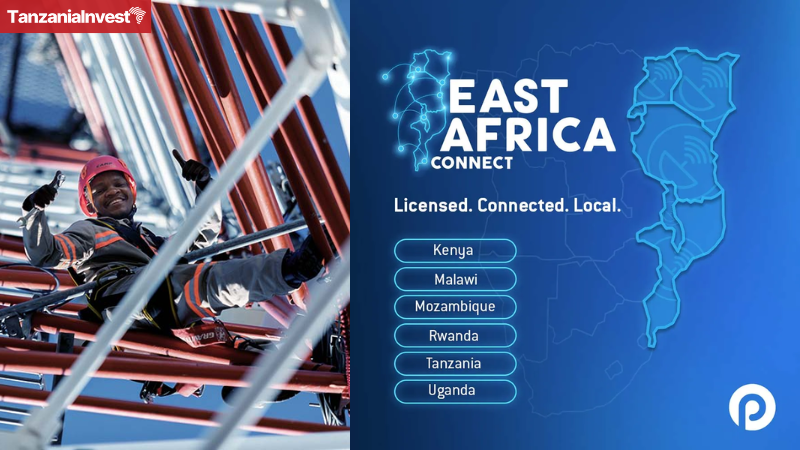
The launch in Tanzania forms part of the Group’s wider expansion into East Africa, where it has also established licensed entities in Kenya, Rwanda and Uganda.

Paratus Kenya has been operational since November 2024 as an internet service provider and authorised reseller of Starlink satellite internet. Rwanda and Uganda recently launched ISP operations, with Rwanda also offering Starlink services.

Tanzania Investment Guide 2026 Free Edition

Paratus is targeting businesses and institutions in key sectors including retail, transport and logistics, education, healthcare and tourism, aiming to provide secure and scalable connectivity across Tanzania and the region.

The Group’s East–West fiber route, which runs from Maputo in Mozambique to Swakopmund in Namibia, supports this expansion by connecting to the Equiano subsea cable and ensuring low-latency, high-capacity redundancy between Africa and Europe.

Martin Cox, Chief Commercial Officer at Paratus Group, said: “We now hold operational licenses in key East African markets. Our network and infrastructure enable enterprise and wholesale customers to access reliable, cross-border connectivity within the region and beyond, supporting their digital operations and growth.”

Cox added: “You can’t trade if you can’t connect. We’re providing the infrastructure and delivering 24/7 connectivity across borders to enable businesses to thrive in the digital age. Our role in building East Africa’s digital highways is as vital today as the traditional trade routes were centuries ago.”

ICT and Digital Infrastructure in Tanzania

TanzaniaInvest Capital Markets Report Banner

Tanzania has identified ICT development as a priority for economic transformation, with the government investing in the National ICT Broadband Backbone and promoting the adoption of digital services in trade, education, and health.

Expanding connectivity is critical for businesses as the country pursues its industrialisation agenda and integrates into regional and global value chains.

East Africa as a whole, with a population of over 200 million people and a combined GDP exceeding USD 200 billion, is forecast to grow its contribution to Africa’s GDP from 18% today to 29% by 2040, according to Euromonitor.

The region’s young population and reforms in agriculture, energy, mining, manufacturing, and ICT are driving demand for modern services and infrastructure.

Want to know more about Telecoms in Tanzania? Our free overview of the Tanzania Business and Investment Guide 2026 covers Telecoms, plus key sectors and investment opportunities. The complete 141-page edition includes policies, taxation, key regulations, full macroeconomic data, and sources, and is also available at no cost upon completion of a short form.

Download Free OverviewGet the Full Edition for Free
Related Posts
Read More

Tanzanian Delegation Visits Agribusiness, AI, Data Centre and Railway Facilities on Day Two of EU–Tanzania Roadshow in Italy

On 2 October, Tanzanian agribusiness and digital delegations visited facilities in Emilia-Romagna during the EU–Tanzania roadshow’s Italian leg. On the second day of the EU–Tanzania roadshow in Italy, the agribusiness delegation visited Apofruit–Almaverde, Martini Group and Unitec to examine post-harvest handling and cold storage, livestock and food operations, and fruit sorting, grading and training. A separate group led by Deputy Minister Pius Chaya visited the University of Bologna, DAMA Tecnopolo and Bologna San Donato to learn about artificial intelligence, Industry 4.0, supercomputing, data centres and railway testing.
Read More

EU–Tanzania Roadshow Continues in Italy With Rice, Cashew, Coffee and Renewable Energy Investment Pitches in Cesena

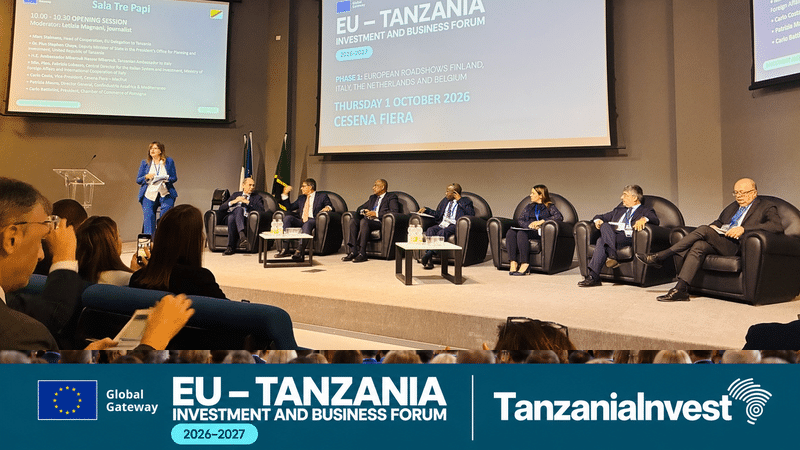
At the Cesena stop of the EU–Tanzania roadshow, Tanzanian agencies presented investment opportunities in rice, cashew and coffee processing, renewable energy, power transmission and digital infrastructure. Italy’s Ministry of Foreign Affairs cited USD 8.6 billion in foreign investment registered in Tanzania in the last year, up 56%, while EU and Italian institutions outlined grants, guarantees, export credit and blended finance.
EU-Tanzania Roadshow 2026-2027 Helsinki day 2 critical minerals visit
Read More

Tanzanian Delegation Visits EU’s Only Nickel Smelter, Metso Research Center, and Nokia on Day Two of EU-Tanzania Roadshow in Finland

On 29 September 2026, the second day of the EU-Tanzania roadshow in Finland, the Tanzanian delegation visited Metso's Pori Research Center, where around 180 experts work on mineral processing, hydrometallurgy, battery materials, and smelting, and Boliden's Harjavalta site, home to the only nickel smelter in the EU. The digital track included visits to Nokia, the Finnish Information Security Cluster, and technology company Gofore, with talks on digital sovereignty, digital public infrastructure, and Tanzania's move to a cashless economy.
EU-Tanzania Investment & Business Forum 2026-2027 Helsinki day 1
Read More

EU–Tanzania Roadshow Opens in Helsinki With Mineral and Digital Investment Pitches

At the EU-Tanzania roadshow in Helsinki, the EU and Finland said they want to invest in Tanzania's critical minerals and digital economy, backed by a new EUR 156 million EU package and by Finnish financiers Finnvera and Finnfund, which confirmed they are open to Tanzanian deals. Tanzania offered European companies entry into graphite, nickel and rare earths processing, including at a former gold mine converted into a mineral processing zone, as well as into data centres, submarine cables and broadband, backed by TZS 7 trillion in planned public spending.