Tanzania Develops Swahili Large Language Model, Plans Dodoma Techno Valley

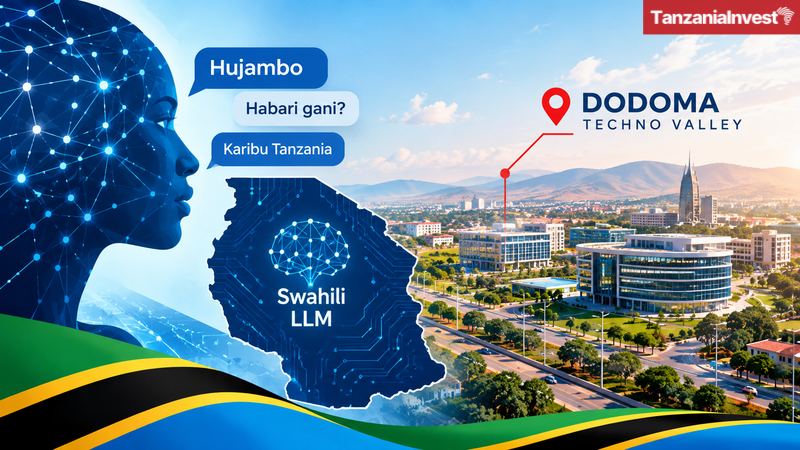
Tanzania has begun developing a Swahili Large Language Model (LLM) to expand artificial intelligence across education, health, agriculture, and public services. The government is also promoting the Nala Techno Valley, a technology hub on 400 acres in Dodoma.
Swahili LLM Tanzania Dodoma Tech Valley

Tanzania has begun developing a Swahili Large Language Model (LLM) to expand artificial intelligence across education, health, agriculture and public services, and has used the Global AI & Digital Summit 2026 in Seoul to promote the planned Nala Techno Valley technology hub in Dodoma.

The Deputy Minister for Communication and Information Technology, Dr. Switbert Zacharia Mkama, announced the initiative while speaking at the summit held from 19 to 22 October 2026 in Seoul, Republic of Korea.

The summit is organised by the World Bank in partnership with the Government of Korea.
Tanzania Investment Guide 2026 Free Edition

The event focuses on applying artificial intelligence and digital technologies to grow economies, increase employment and improve public services.

Mkama said the Swahili LLM would broaden the use of the technology in education, health, agriculture and public services.

He stressed the importance of strengthening cooperation with other countries, international institutions and technology companies to attract investment, access expertise and advance the technology domestically.

Tanzania is using the summit to promote the Nala Techno Valley project planned for Nala, Dodoma, on 400 acres set aside by the government.

The project aims to establish a centre for technology, innovation, artificial intelligence, robotics, and technology startups.
TanzaniaInvest Capital Markets Report Banner

Tanzania Swahili Large Language Model

In January 2025, the ICT Commission under the Tanzania Communications Regulatory Authority (TCRA) partnered with ALMAWAVE, an Italian technology company specialising in artificial intelligence language tools, to develop advanced Kiswahili tools for AI systems.

Officials noted that the use of Kiswahili in AI systems had remained underdeveloped despite rapid global AI adoption, and that Tanzania, as the birthplace of Kiswahili, sees itself as a natural leader in promoting the language through such innovations.

Presenting the ministry’s 2026/2027 budget estimates, then Minister for Communication and Information Technology Angellah Kairuki said the government, through the Information and Communication Technologies Commission (ICTC), was in the final stages of developing the Swahili Large Language Model aimed at advancing the use of artificial intelligence in delivering digital services in Kiswahili.

Officials have framed the model as a tool for digital inclusion, explaining that it would enable all citizens, including those in rural areas, to access ICT services powered by artificial intelligence in a language they understand.

Want to know more about Telecoms in Tanzania? Our free overview of the Tanzania Business and Investment Guide 2026 covers Telecoms, plus key sectors and investment opportunities. The complete 141-page edition includes policies, taxation, key regulations, full macroeconomic data, and sources, and is also available at no cost upon completion of a short form.

Download Free OverviewGet the Full Edition for Free
Related Posts
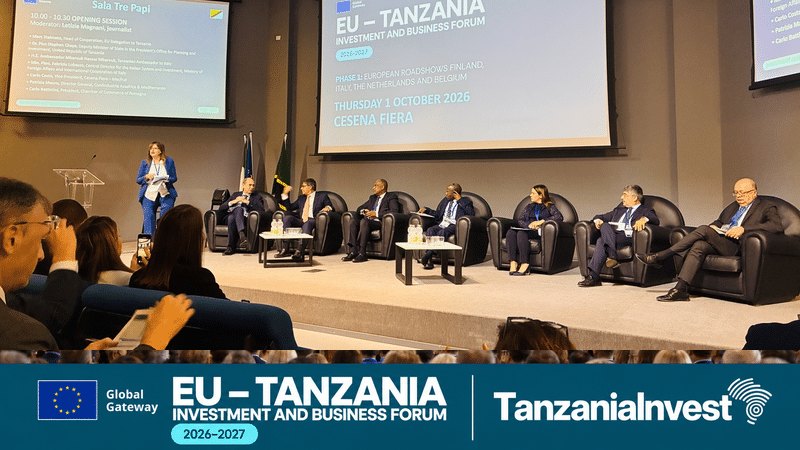
EU-Tanzania Investment & Business Forum 2026-2027 Helsinki day 1
Read More

Tanzania Pitched a 68-Project, USD 30.1 Billion Pipeline at the EU–Tanzania Roadshow in Finland, Italy, the Netherlands and Belgium Ahead of the Early 2027 Dar es Salaam Forum

The EU-Tanzania roadshow 2026 took Tanzanian ministers and agencies to Helsinki, Cesena, The Hague, Rotterdam, and Antwerp between 28 September and 6 October, pitching critical minerals, agribusiness, renewable energy, digital, and port and rail projects from a 68-project, USD 30.1 billion pipeline. The roadshow leads to a high-level EU-Tanzania Investment and Business Forum in Dar es Salaam planned for early 2027.
Read More

Tanzanian Delegation Visits Agribusiness, AI, Data Centre and Railway Facilities on Day Two of EU–Tanzania Roadshow in Italy

On 2 October, Tanzanian agribusiness and digital delegations visited facilities in Emilia-Romagna during the EU–Tanzania roadshow’s Italian leg. On the second day of the EU–Tanzania roadshow in Italy, the agribusiness delegation visited Apofruit–Almaverde, Martini Group and Unitec to examine post-harvest handling and cold storage, livestock and food operations, and fruit sorting, grading and training. A separate group led by Deputy Minister Pius Chaya visited the University of Bologna, DAMA Tecnopolo and Bologna San Donato to learn about artificial intelligence, Industry 4.0, supercomputing, data centres and railway testing.
Read More

EU–Tanzania Roadshow Continues in Italy With Rice, Cashew, Coffee and Renewable Energy Investment Pitches in Cesena

At the Cesena stop of the EU–Tanzania roadshow, Tanzanian agencies presented investment opportunities in rice, cashew and coffee processing, renewable energy, power transmission and digital infrastructure. Italy’s Ministry of Foreign Affairs cited USD 8.6 billion in foreign investment registered in Tanzania in the last year, up 56%, while EU and Italian institutions outlined grants, guarantees, export credit and blended finance.
EU-Tanzania Roadshow 2026-2027 Helsinki day 2 critical minerals visit
Read More

Tanzanian Delegation Visits EU’s Only Nickel Smelter, Metso Research Center, and Nokia on Day Two of EU-Tanzania Roadshow in Finland

On 29 September 2026, the second day of the EU-Tanzania roadshow in Finland, the Tanzanian delegation visited Metso's Pori Research Center, where around 180 experts work on mineral processing, hydrometallurgy, battery materials, and smelting, and Boliden's Harjavalta site, home to the only nickel smelter in the EU. The digital track included visits to Nokia, the Finnish Information Security Cluster, and technology company Gofore, with talks on digital sovereignty, digital public infrastructure, and Tanzania's move to a cashless economy.