Tanzania National Parks Authority To Attract Domestic Tourism With New Marketing Campaign

During the last Dar Es Salaam International Trade fair (DITF), the Tanzania National Parks Authority (TANAPA) announced that is undertaking a marketing campaign to boost domestic tourism by unveiling new products.

The announcement was done by TANAPA’s Director of Tourism and Marketing, Mr. Ibrahim Mussa, who explained that the Government is aiming to change the tourism’s image with locals, due to the great economic impact that it has on its economy.

Mussa indicated that the purpose of the 6 months campaign is to explain to Tanzanians that the notion of tourism goes beyond sitting in vehicles for long drives to see animals and that walking safari and campsite are also available.

Tanzania Investment Guide 2026 Free Edition

The Tanzanian domestic tourism is increasing annually with Serengeti National Park, the second largest in Tanzania and the preferred destination for local people due to their proximity to the city, currently receiving 450,000 people per year, compared with 350,000 in 2012, and 2013, explained Mr. Mussa.

Domestic arrivals accounts for about 48% according to TANAPA stastics. .

According to the World Travel & Tourism Council (WTTC), the Tanzanian domestic travel spending represents 30.2% of the direct contribution of Travel & Tourism to Tanzanian Gross Domestic Product (GDP), which was TZS 2,492 billion or 4.67% of the GDP in the year 2014.

The domestic travel spending allowed the creation of 121,555 jobs in 2014, representing 1.15% of the total employment created in Tanzania for that year..

Accoridng to WTTC, Tanzania’s domestic travel spending was TZS 752.5 billion in 2014 and is expected to growth by 6.1% by 2024 and generate 170,821 additional jobs.

TanzaniaInvest Capital Markets Report Banner

Want to know more about Tourism in Tanzania? Our free overview of the Tanzania Business and Investment Guide 2026 covers Tourism, plus key sectors and investment opportunities. The complete 141-page edition includes policies, taxation, key regulations, full macroeconomic data, and sources, and is also available at no cost upon completion of a short form.

Download Free OverviewGet the Full Edition for Free
Free Newsletter

Get our monthly update on business and investment in Tanzania.

Related Posts
Tanzania Tanga 17 PPP Investment Projects
Read More

17 PPP Projects Open in Tanga to Investors in Transport, Trade, Tourism, Livestock, Agriculture, and Mining

Seventeen Tanga PPP projects with title deeds are open to private investors in transport, trade, tourism, livestock, agriculture, and mining, led by the 595,785-square-metre Pongwe Dry Port. Councils can approve projects below USD 20 million without the national PPP Board, and the government can co-finance capital costs through viability gap funding.
Tanzania TANAPA revenue arrivals 2025-2026
Read More

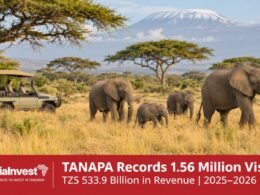
Tanzania Records 1,559,441 Visitors to its National Parks as Revenue Reaches TZS 533.9 Billion; Allocates 130 Investment Sites for New Lodges and Camps

The Tanzania National Parks Authority (TANAPA) recorded 1,559,441 visitors and TZS 533.9 billion (± USD 201.5 million) in revenue in 2025-2026, up from 788,940 visitors and TZS 174.7 billion in 2021-2022. To meet growing demand, TANAPA has allocated 130 investment sites for new lodges and camps, mainly in the Southern, Eastern and Western tourism circuits, after bed capacity rose from 575 in 2021 to 1,294 in 2026.
Tanzania Khamis Mussa Omar World Bank Anna Bjerde
Read More

Tanzania and World Bank Map Central Corridor Investment Opportunities in Agriculture, Logistics, Mining, and Tourism

Tanzania and the World Bank are mapping Central Corridor investment opportunities in agriculture, mining, tourism, transport, and logistics, with a possible extension to Rwanda, while UNDP prepares investor-ready projects for a June 2027 investment conference and seeks Asian Infrastructure Investment Bank financing. The World Bank named job creation its top priority and discussed shifting small business lending from collateral to cash-flow assessment, while Tanzania pursues a 40% value addition target through agriculture, livestock, and minerals.