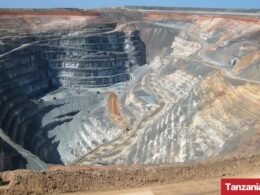




Tanzanian based coal exploration and development company Tancoal Energy achieved record coal sales of 38,877 tons in December 2016 from its mine at the Ngaka coalfield in southwestern Tanzania.
This is a result of the new policy restricting imports of coal to Tanzania, according to the Australian mining company Intra Energy Corporation (ASX:IEC), which owns 70% of Tancoal.
Tancoal has already achieved record coal sales in October and November 2016 thanks to the new policy.

In November 2016, coal sales amounted to 35,370 tons, an increase from the reported record achieved in October of 29,767 tons.
In December 2016, Intra Energy announced that customers have indicated they will place coal orders of approximately 60,000 tons per month in 2017.
Consequently, Tancoal will increase its production capacity to have a stockpile and ongoing production available to meet that level of sales.
To achieve this, the company will mobilize new equipment, which includes one 40T excavator, one 85T excavator, four 55T dump trucks and a grader for haul road maintenance.
Additionally, forty 20T haulage trucks have been contracted to increase haulage capacity from minesite to the sales stockpile.

Tancoal was established in 2008, as a 30%-70% Joint Venture between the National Development Corporation of Tanzania (NDC) and Intra Energy (Tanzania) Limited (IETL), an 100% owned subsidiary of Intra Energy Corporation.
In October 2016, the Chinese hydropower company Sinohydro Corporation signed Memorandum of Understanding (MoU) with Intra Energy for joint development of 270MW Ngaka coal power station.
The Ngaka power station is expected to consume up to 1.2m t of coal per year from Tancoal, which has a coal resource of 423m t.
Upon completion, the power station will provide more than 15% of Tanzania’s current electricity generation needs through a 220kV transmission system.
Ngaka Coal Project
The Ngaka Coal Project is operated by Tancoal since 2011. The Ngaka basin comprises the Mbalawala sub-basin in the south and the Mbuyura-Mkapa sub-basin to the north.
Tancoal indicates that the Ngaka basin has the potential to host up to 1b t of high quality thermal coal.
Want to know more about Mining in Tanzania? Our free overview of the Tanzania Business and Investment Guide 2026 covers Mining, plus key sectors and investment opportunities. The complete 141-page edition includes policies, taxation, key regulations, full macroeconomic data, and sources, and is also available at no cost upon completion of a short form.
Download Free OverviewGet the Full Edition for Free