

According to the Tanzania Port Authority (TPA), the Dar es Salaam port has increased its container handling capacity from 60,000 to 100,000 containers per month.
This statement was made on 7th October 2024 by the Director General of TPA, Plasduce Mbossa, during the launch of the customer service week in Dar es Salaam.
Mbossa attributed the increase to the improvement of digital systems integrated with other institutions, deepening of berths, purchasing of modern equipment, and the opening of offices in neighboring countries such as Uganda, Burundi, Rwanda, the Democratic Republic of Congo, Malawi, and Zimbabwe.

He also assured that TPA remains committed to continuously enhancing the infrastructure of all its ports to meet customer needs.
Speaking about the Dar es Salaam Port, TPA’s Senior Public Relations Officer Leonard Magomba highlighted: “Currently, our Dar es Salaam port can accommodate large vessels measuring up to 300 meters in length. This has been made possible by deepening the entrance channel and the turning basin, which allows larger ships to access the port.”
On his part, the Deputy Director of the Dar es Salaam Port, Abeid Galus, stated that the current efficiency observed at the Dar es Salaam Port is attributed to significant investments in infrastructure and modern equipment made by the government.
He added that ships now take three to four days to be serviced, down from the previous seven days.
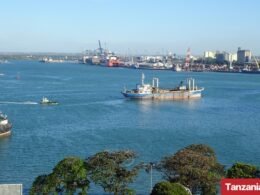
Tanzania’s Dar es Salaam Port
The Dar es Salaam Port is Tanzania’s principal port, handling 95% of the country’s international trade.

The Port handles over 18 million tons of cargo annually, including 5.2 million tons of general cargo, 6.8 million tons of containerized goods, and 6.0 million tons of liquid bulk.
The port features a 2,600-meter quay with eleven deep-water berths and serves landlocked nations such as Zambia, the Democratic Republic of Congo, Burundi, Rwanda, Malawi, Uganda, and Zimbabwe.
Key facilities include general cargo berths, a container terminal, a grain terminal with 30,000 tons of storage, and Inland Container Depots (ICDs) with 24,000 Twenty-foot Equivalent Unit (TEU) capacity.
The port also manages oil shipments through a 150,000 MT Single Point Mooring (SPM) and the Kurasini Oil Jetty.
Want to know more about Transport in Tanzania? Our free overview of the Tanzania Business and Investment Guide 2026 covers Transport, plus key sectors and investment opportunities. The complete 141-page edition includes policies, taxation, key regulations, full macroeconomic data, and sources, and is also available at no cost upon completion of a short form.
Download Free OverviewGet the Full Edition for Free