

On 20th November 2024, Tanzania’s Minister of Minerals, Anthony Mavunde launched the second edition of the Industrial Minerals Book during the second day of the 2024 International Mining Investment Conference in Dar es Salaam.
The book, published by the Geological Survey of Tanzania (GST), identifies 43 types of industrial minerals critical to the country’s industrial development and economic sector integration.
The book lists key minerals, including gypsum, limestone, lithium, helium, manganese, copper, iron, uranium, heavy marine sands, and strategic minerals.

It categorizes Tanzania’s minerals into industrial minerals, gemstones, metallic minerals, strategic minerals, rare earth elements (REE), and energy minerals.
Minister Mavunde emphasized that GST, as the core institution of the Ministry of Minerals, plays a crucial role in conducting studies that lead to the discovery of both major and minor projects, contributing to the establishment of mines across the country.
Minister Mavunde noted that the findings and publications from GST have been instrumental in identifying and launching significant mining projects.
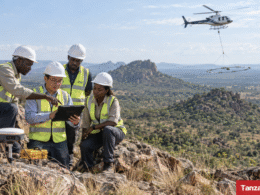
He highlighted that ongoing research is expected to reveal more mineral types through advanced aerial surveys.
On his part, GST’s Chief Executive Officer, Dr. Mussa Budeba, invited stakeholders to utilize GST’s research data for accurate information on mineral locations in Tanzania.

Dr. Budeba further highlighted that, in addition to the industrial minerals book, GST provides maps and other publications detailing the availability of minerals through geological, geophysical, and geochemical research.
The Geological Survey of Tanzania (GST)
Established in 1925 during British colonial rule under the name British Oversea Management Authority (BOMA), GST continues to play a pivotal role in advancing Tanzania’s mining sector.
The GST has achieved mapping approximately 94% of Tanzania’s geology and identifying key mineral deposits that have supported major mining operations like the Kahama and the Geita Gold Mines.
To enhance its capabilities, the GST has adopted modern technologies, such as the Geological and Mineral Information System (GMIS) for data access and advanced laboratory facilities for geochemical analyses.
Recent initiatives include geophysical surveys to aid in mineral exploration and plans for new laboratory infrastructure.
Want to know more about Mining in Tanzania? Our free overview of the Tanzania Business and Investment Guide 2026 covers Mining, plus key sectors and investment opportunities. The complete 141-page edition includes policies, taxation, key regulations, full macroeconomic data, and sources, and is also available at no cost upon completion of a short form.
Download Free OverviewGet the Full Edition for Free