
Tanzania’s Annual Average Headline Inflation Rate Increased to 3.3% in 2025 From 3.1% 2024

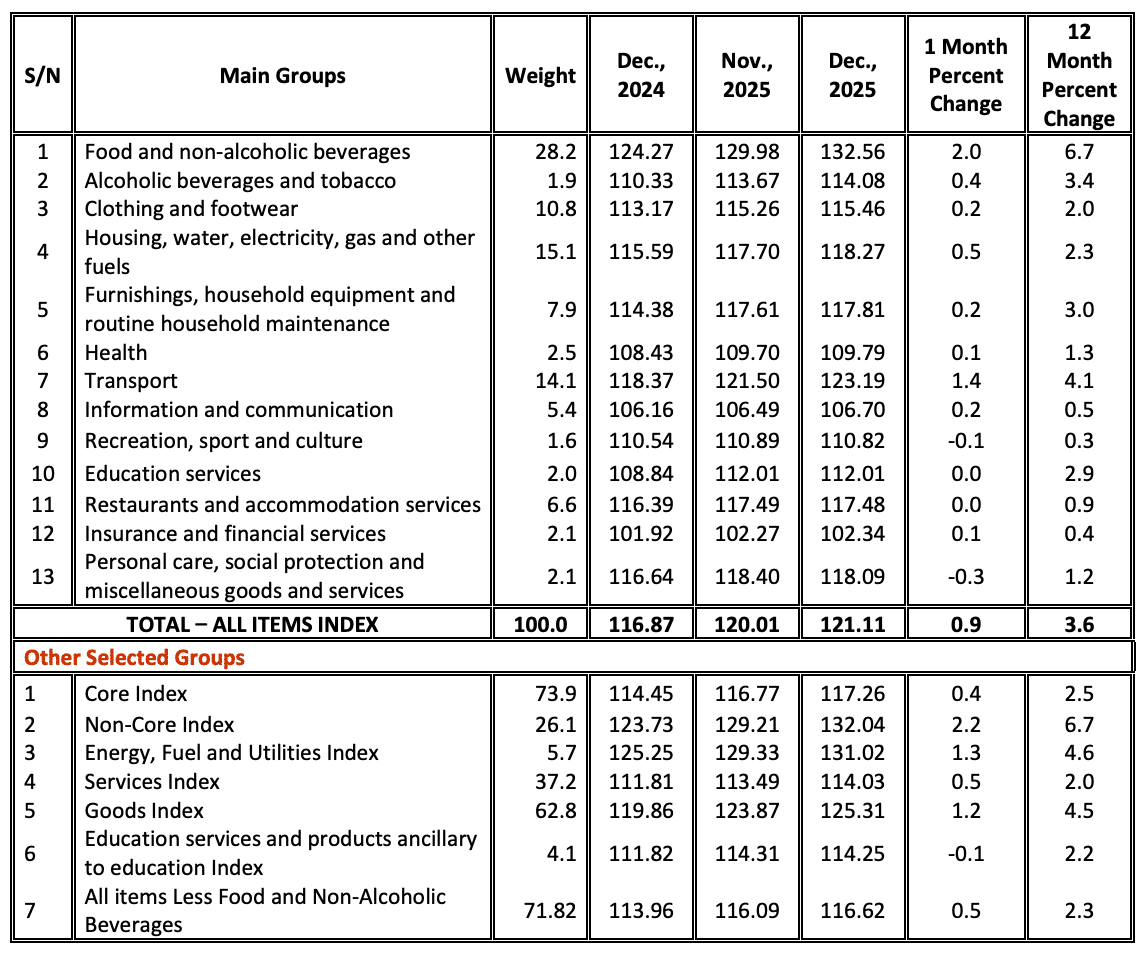
Tanzania’s annual average headline inflation rate increased to 3.3% in 2025 from 3.1% 2024. The annual headline inflation rate for December 2025 increased to 3.6%, up from 3.4% recorded in November 2025.
TANZANIA AVERAGE ANNUAL INFLATION RATE 2025

The National Bureau of Statistics of Tanzania (NBS) revealed that Tanzania’s average annual inflation rate in 2025 was 3.3%. This marks a slight increase from 3.1% recorded in 2024.

In the year ending December 2025, the annual Headline Inflation Rate increased to 3.6%, up from 3.4% recorded in November 2025.

The overall Consumer Price Index rose from 116.87 in December 2024 to 121.11 in December 2025.

Food Inflation

The Food and Non-Alcoholic Beverages Inflation Rate for December 2025 has slightly increased to 6.7% from 6.6% in November 2025.

Non-Food Inflation

On the other hand, the inflation rate for all items excluding food and non-alcoholic beverages for December 2025 has slightly increased to 2.3% from 2.1% recorded in November 2025.

Core Inflation

Computation of the Core Index excludes items with volatile prices, such as unprocessed food, energy, and utilities, except for maize flour.

Excluding volatile prices from the total National Consumer Price Index (NCPI) provides a more stable Inflation Rate figure for policymakers.

The Core Index covers 297 items, and its share of weight in the total NCPI is 73.9%.

In December 2025, the Core Inflation Rate increased to 2.5% from 2.3% that was recorded in November 2025.

Monthly Consumer Price Index November-December 2025

Between November 2025 and December 2025, the National Consumer Price Index increased from 120.01 to 121.11.

This increase in the overall index is mainly attributed to the increase of prices for some food and non-food items.

Food items contributing to an increase included: beef meat (by 9.3%); bread and bakery products (by 5.6%); sweet potatoes (by 5.1%); live poultry (by 3.7%); maize flour (by 3.6%); rice (by 3.5%); groundnuts (by 2.7%); sorghum flour (by 2.2%); live Goats (by 2.2%); fresh cassava (by 2.1%); poultry meat (by 2.0%); eggs of hen (by 1.8%); fruits (by 1.5%); sorghum grains (by 1.3%); Irish potatoes (by 1.2%); finger millet grains (by 0.8%); maize grains (by 0.7%); vegetables (by 0.6%) and wheat grains (by 0.4%).

Changes in Tanzania National Consumer Price Indices (NCPI) for December 2025, (2020 = 100)
Want to know more about the Economy in Tanzania? Our free Tanzania Business and Investment Guide 2026 covers the Economy, plus regulations, key sectors, and investment opportunities—all in one place.

Download Free Guide
Related Posts
Tanzania Khamis Mussa Omar Parliament bunge
Read More

Tanzania 2026/27 Budget of TZS 62.33 Trillion Targets 6.3% GDP Growth and Investments in Railways, Offers New Businesses One-Year Tax Holiday

Tanzania's 2026/27 budget is set at TZS 62.33 trillion (USD 24 billion), up 10.3% from the previous financial year, targeting 6.3% GDP growth with 74.2% financed from domestic revenue as grants fall 39.1%. Key investor measures include halving the deemed profit-distribution tax from 30% to 15%, a one-year income tax holiday for newly registered businesses, retained VAT deferment on imported capital goods, and VAT exemptions across compressed natural gas, electric vehicle charging equipment, and LPG infrastructure.
Samia Suluhu Hassan Tharman Shanmugaratnam
Read More

Tanzania and Singapore Sign Double Tax and Other Agreements, TISEZA Hosts Business Forum to Strengthen Trade and Investment

Tanzania and Singapore signed five agreements and memoranda of understanding during President Tharman Shanmugaratnam’s state visit to Tanzania, covering taxation, trade facilitation, public service capacity building and diplomatic cooperation. The two countries also reaffirmed plans to deepen collaboration in investment, digital transformation, logistics, financial services and industrial development as bilateral trade reached USD 74 million and Singaporean investments in Tanzania exceeded USD 535 million.
Kitila Mkumbo Parliament Bunge
Read More

Tanzania Planning and Investment Budget 2026/2027 Backs New Investment Policy and Diaspora Bonds, with Five Strategic SEZs to Draw TZS 797 Billion

Beyond a new National Investment Policy 2026 and five strategic Special Economic Zones expected to draw over TZS 797 billion, Tanzania's TZS 144.85 billion Planning and Investment Budget 2026/27 sets a target to make the country a leading African vehicle producer by 2030 and creates Youth Industrial Special Economic Zones across six regions. Flagship projects already underway include Hengya Cement (USD 530 million), Airtel's USD 480 million 5G rollout, and Songea Sukari's USD 352 million sugar complex.
Samia Suluhu Hassan Vladimir Putin
Read More

Tanzania and Russia Expand Investment Cooperation as Air Tanzania Launches Moscow Flights and TISEZA Signs Cooperation Agreement

Tanzania and Russia have expanded economic cooperation following President Samia Suluhu Hassan’s state visit to Russia, with Air Tanzania announcing direct flights to Moscow, the Tanzania Special Economic Zones Authority (TISEZA) signing a cooperation agreement with Russia’s Roscongress Foundation, and both countries identifying new investment opportunities in mining, agriculture, energy, infrastructure, and technology.