
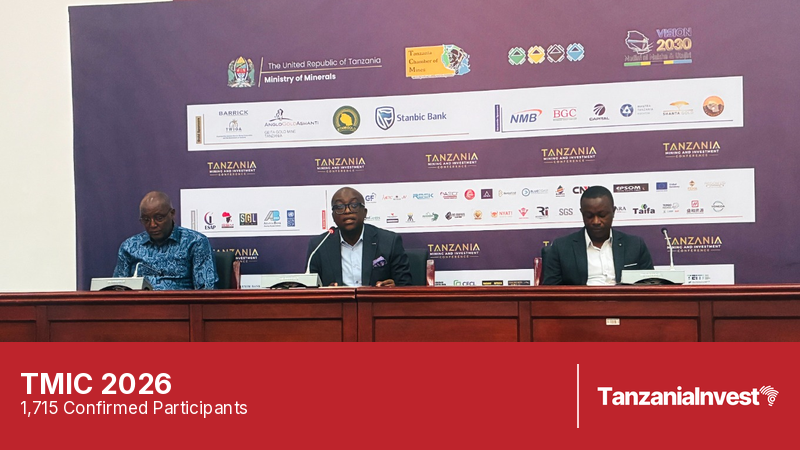
The Tanzania Mining and Investment Conference 2026 (TMIC) had 1,715 confirmed participants as of 17 November, Minister of Minerals Anthony Mavunde said.
At the 17 November press conference at the Julius Nyerere International Convention Centre (JNICC) in Dar es Salaam, which will also host the conference, Mavunde said 226 of the confirmed participants were from outside Tanzania and more than 57 speakers were expected.
The Ministry of Minerals’ written statement listed Afghanistan, Burundi, Kenya, Mali, Rwanda, Saudi Arabia, Somalia and Uganda among the countries whose mining ministers had confirmed participation.

President Samia Suluhu Hassan is scheduled to open the seventh edition on 19 November, Zanzibar President Hussein Ali Mwinyi is due to close it on 21 November, and Prime Minister Mwigulu Lameck Nchemba is scheduled to attend the Mining Gala Night on 20 November as guest of honour.
Under the theme “Value-Added Minerals: The Engine of Industrial and Economic Growth,” the programme includes ministerial side meetings, business-to-business meetings, a government one-stop centre, a masterclass on mineral value addition, an awards ceremony and an exhibition covering the supply chain from extraction to finished products.
TanzaniaInvest is a conference partner and has published a preview of TMIC 2026, with registration and further information available on the official conference website.
Mineral Processing Projects
During the press conference, when asked what had changed since Tanzania’s 2017 mining reforms, Mavunde said the country now had eight gold refineries and more than 16 mineral processing plants under construction, mainly for copper and nickel.
He cited a plant producing copper cathodes at Nala in Dodoma, small operators installing copper processing equipment in Katavi, and a salt refinery in Kilwa run by the State Mining Corporation (STAMICO) that processes salt supplied by local producers.

Mavunde also cited plans to relocate Songwe Prison for a niobium mining and processing project in Mbeya Rural District, a mineral separation plant in Pangani District intended to process heavy mineral sands from Tanzania, South Africa and Madagascar, and processing plants under construction in the Kahama Special Economic Zone.
In Arusha, he said a gemology centre under construction in Njiro would train young people to cut and polish gemstones.
Support for Small-Scale Miners
Responding to a question about equipment shortages among small-scale miners in Geita, Mavunde outlined how the government had improved access to primary mining licences and how STAMICO and the Geological Survey of Tanzania (GST) were using drones and magnetometers to help miners identify promising areas before drilling.
STAMICO began offering subsidised drilling after the president directed the purchase of more than 15 rigs, and charges TZS 10.7 million (± USD 4,043) per 100 metres, compared with at least TZS 25 million (± USD 9,445) at commercial rates.
A credit guarantee scheme launched on 1 July 2026 aims to help small-scale miners borrow to buy equipment, while an airborne survey and related programme near the North Mara mine in Tarime District are expected to involve more than 2,000 young people.
For the North Mara initiative, Barrick returned unused prospecting licences to the government, according to Mavunde.
Tanzania has 117 mineral buying centres, and the government opens new centres near emerging mining areas to shorten the distance miners travel to sell their output.
Mavunde also discussed a proposed seminar with the University of Dar es Salaam to help young miners reinvest their earnings in equipment and mining operations.
Tanzania’s Mining Sector
TMIC was first held in 2019, two years after amendments to the Mining Act introduced requirements for domestic processing.
Mining and quarrying accounted for 10.3% of mainland Tanzania’s gross domestic product in 2025, up from 7.8% in 2024, while Mavunde said mineral exports rose from USD 4.12 billion to USD 5.40 billion over the same period.
The Ministry reported that government revenue from mining reached TZS 1.39 trillion (± USD 525.2 million) in 2025/26, up from about TZS 526 billion (± USD 198.7 million) in 2020/21.
According to Mavunde, mining supported 19,874 formal jobs as of April 2025, 97.4% held by Tanzanians, while sector purchases of goods and services rose from TZS 884.09 billion (± USD 334.0 million) in 2010 to TZS 5.2 trillion (± USD 1.96 billion) in 2025.
He said small-scale miners accounted for about 40% of national mineral production and that the government had signed mining framework agreements with 14 joint venture companies to develop graphite, nickel, niobium, rare earth and helium projects. Meanwhile, the government is setting aside 10% of annual mining revenue to fund mineral exploration.
Want to know more about Mining in Tanzania? Our free overview of the Tanzania Business and Investment Guide 2026 covers Mining, plus key sectors and investment opportunities. The complete 141-page edition includes policies, taxation, key regulations, full macroeconomic data, and sources, and is also available at no cost upon completion of a short form.
Download Free OverviewGet the Full Edition for Free