

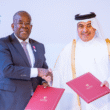

Tanzania’s Minister of Foreign Affairs and East African Cooperation, Ambassador Mahmoud Thabit Kombo, conducted a high-level diplomatic mission to Moscow on February 9, 2026, to strengthen strategic cooperation between the two nations.
During the visit, Minister Kombo held talks with the Russian Foreign Minister Sergey Lavrov and the Minister of Economic Development Maxim Reshetnikov to discuss expanding Russia-Tanzania trade and investment across key economic sectors.
The primary objective of the mission was to deliver a special message from President Samia Suluhu Hassan to President Vladimir Putin, reaffirming Tanzania’s commitment to elevating bilateral ties.

Economic data shared during the meetings revealed that mutual trade turnover between Russia and Tanzania increased by nearly 20% during the first 11 months of 2025.
Russian officials estimated that the current trade volume has significant unrealized potential and could feasibly double in the near term as new commercial channels open.
A central pillar of the discussions was the preparation for the third session of the Joint Intergovernmental Russian-Tanzanian Commission on Trade and Economic Cooperation, which is scheduled to take place in May 2026.
The commission will focus on diversifying trade beyond traditional commodities, with Russian enterprises expressing specific interest in the Tanzanian pharmaceutical market and livestock product supplies.
In the energy sector, the two countries are exploring joint projects involving the production and export of hydrocarbons and natural gas, as well as the potential construction of a coal-fired thermal power plant.

In tourism, both parties are reviewing the prospects for resuming direct flights to boost visitor numbers to national parks and Zanzibar.
Minister Kombo also proposed a joint program of business forums to coincide with the 65th anniversary of diplomatic relations between the two countries later this year.
“Once again thank you for elevating our strategic cooperation, which was mentioned in the President’s speech when she was speaking to the world via all the diplomatic missions,” stated Minister Kombo during the talks.
The Russian Foreign Minister Sergey Lavrov expressed satisfaction with the partnership, noting, “We are now discussing the timing and venue of the third Russia-Africa summit and look forward to hearing assessments regarding our bilateral cooperation across economic, commercial, and financial domains.”
For his part, the Minister of Economic Development, Maxim Reshetnikov, added, “Tanzania is one of Russia’s important trading partners among African countries, and we know that Tanzania is interested in establishing gas exports where large Russian companies are ready for cooperation.”
The deepening of ties comes as Russia remains one of the five largest suppliers of fertilizers to Tanzania, while also providing essential imports of wheat, aluminum, and newsprint.
Tanzania’s exports to the Russian market are currently dominated by agricultural products, specifically tobacco, coffee, and tea, with coffee purchases contributing significantly to the recent 20% trade growth.
In the mining sector, the flagship of bilateral cooperation remains the uranium development project at the Mkuju River in southern Tanzania, operated by Mantra Tanzania Limited, a subsidiary of the Uranium One Group, which is owned by Russia’s State Atomic Energy Corporation, Rosatom.
The project recently saw the commissioning of a pilot uranium processing facility, signaling a major milestone in Tanzania’s pursuit of becoming a regional hub for industrial mineral processing.
As of 2026, Tanzania continues to maintain a non-aligned foreign policy, allowing the country to engage in strategic economic partnerships with a diverse range of global powers to drive its domestic development agenda.
Want to know more about the Economy in Tanzania? Our free overview of the Tanzania Business and Investment Guide 2026 covers the Economy, plus key sectors and investment opportunities. The complete 141-page edition includes policies, taxation, key regulations, full macroeconomic data, and sources, and is also available at no cost upon completion of a short form.
Download Free OverviewGet the Full Edition for Free