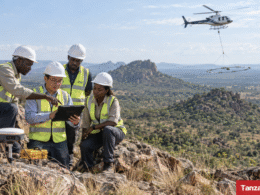


A government-appointed committee has recommended the establishment of a Tanzania Mining Fund, a future Miners’ Bank and expanded access to financing, technology and geological information to accelerate the development of Tanzania’s small-scale mining sector.
The recommendations were presented to the government on 13th June 2026, by a team of experts formed to advise the Ministry of Minerals on measures to economically empower small-scale miners and increase their contribution to employment creation, poverty reduction, and economic growth.
The committee, chaired by Dr. Victor Tesha, proposed the creation of a Tanzania Mining Fund to support eligible mining projects, finance the acquisition of equipment and machinery, and improve mining operations.

According to the recommendations, the proposed fund could pave the way for establishing a dedicated Miners’ Bank that would provide financial services tailored to mining operators’ needs.
Speaking during the presentation ceremony in Dar es Salaam, the Minister of State in the President’s Office for Planning and Investment, Prof. Kitila Mkumbo, said resolving challenges related to financing, technology, and geological information was essential to increasing employment, reducing poverty, and supporting economic growth under Tanzania’s Vision 2050.
Mkumbo said President Samia Suluhu Hassan has directed that development programmes should address three national priorities: increasing access to capital, creating jobs and reducing poverty.
He added that empowering small-scale miners through access to finance and technology would increase production, create jobs and raise incomes.
Mkumbo also pointed to Geita Region, Tanzania’s leading gold-producing region, where poverty remains at 38%, saying support for small-scale miners could help address such challenges.

For his part, the Minister for Minerals, Anthony Mavunde, said the committee was formed because of the significant contribution made by small-scale miners–currently contributing 40% of government revenue collected from the mining sector–despite the challenges they continue to face in accessing capital, technology, and financial services.
He said reforms implemented in recent years, including amendments to mining legislation, the establishment of mineral markets, and measures to curb illegal mineral trading, have significantly increased government revenue from mining activities.
Mavunde said mining sector revenue increased from TZS 161 billion in the 2015/16 financial year to TZS 1.107 trillion in 2024/25, while collections had already reached TZS 1.3 trillion by June 13, 2026.
He added that the government’s objective is to help small-scale miners grow into medium-sized and eventually large-scale mining operators.
Addressing financing challenges, Mavunde said the government has begun implementing the Credit Guarantee Corporation, which will help miners access loans from financial institutions.
Presenting the committee’s findings, Tesha said a lasting solution to the challenges facing small-scale miners requires an integrated system that improves access to financing, technology, geological information and institutional support.
“The committee has also recommended that loans should be directed more towards the purchase of machinery and technology rather than cash alone, in order to increase productivity, production and safety in mining operations,” Tesha said.
The Federation of Miners Associations of Tanzania (FEMATA) President John Bina welcomed the recommendations, saying they reflected the government’s willingness to listen to and address concerns raised by small-scale miners.
Bina also commended the government for allocating 10% of revenue generated from mining activities to mineral research.
Small-Scale Mining in Tanzania
Small-scale mining is one of the largest sources of employment in Tanzania’s mining industry and plays an important role in mineral production across the country.
The government has identified mining as one of the key sectors expected to drive economic transformation, employment creation and poverty reduction under Vision 2050.
Recent reforms, including the establishment of mineral markets and tighter controls on illegal mineral trading, have contributed to a sharp increase in government revenue from the sector, while current policy efforts are focused on improving access to finance, technology, and geological information for local mining operators.
Want to know more about Finance in Tanzania? Our free overview of the Tanzania Business and Investment Guide 2026 covers Finance, plus key sectors and investment opportunities. The complete 141-page edition includes policies, taxation, key regulations, full macroeconomic data, and sources, and is also available at no cost upon completion of a short form.
Download Free OverviewGet the Full Edition for Free