


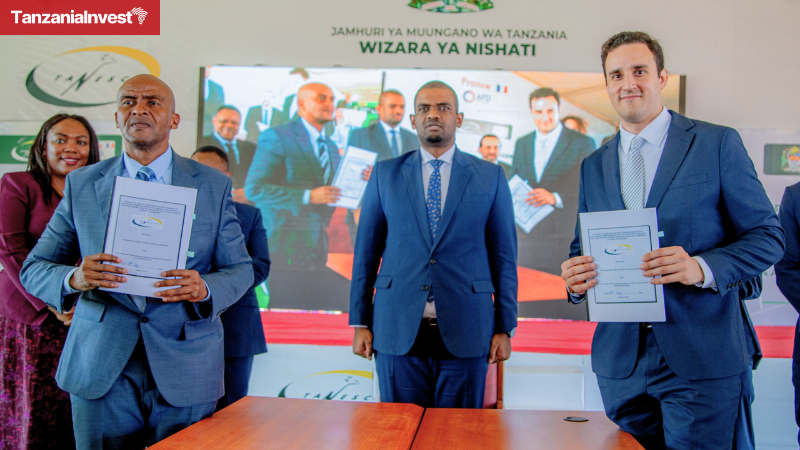
The Tanzania Electric Supply Company (TANESCO) signed a contract on 27 July 2026 for the second phase of the Kishapu Solar Power Project, valued at approximately TZS 204.4 billion and expected to add 100 MW of renewable energy to the national grid.
The contract was signed between TANESCO and a consortium of two companies from France and Tunisia, Sagemcom Energy & Telecom SAS and STEG International Services, for the project located in Ngunga area, Kishapu District, Shinyanga Region.
The signing follows completion of the project’s first phase, with a capacity of 50 MW, which has been integrated into the National Grid and has increased the grid’s capacity and stability while strengthening electricity availability in various parts of the country.

The Minister for Energy, Deogratius Ndejembi, said at the signing ceremony that the energy sector is a pillar of national development and that the Government continues to increase its mix of electricity generation sources so that Tanzania does not depend on a single source alone.
“Residents of these areas used to depend on electricity transmitted from long distances. Completing this project will give Tanzania a safer power system and make it a model country in climate-resilient electricity generation,” Ndejembi explained.
Ndejembi thanked the French Development Agency (AFD) for its continued partnership with the Government of Tanzania through concessional loan financing, saying it reflects strong confidence from development partners in the country’s management of strategic projects.
He also commended TANESCO for its continued oversight of major power projects reshaping the energy sector, while directing the utility to closely supervise the project at every stage so that it is completed on schedule and benefits citizens.
The Chairman of the Parliamentary Standing Committee on Energy and Minerals, Subira Mgalu, said the project’s implementation demonstrates the Ministry of Energy’s commitment to directing 97% of its budget toward development projects.

“This signing is the result of the effective diplomacy of our President, Dr. Samia Suluhu Hassan, which has kept our development partners confident in Tanzania’s implementation of power generation, transmission and distribution projects. We believe Tanzania will continue to have sufficient electricity,” Mgalu stressed.
The Vice Chairperson of the TANESCO Board of Directors, Ambassador Zuhura Bundala, said the board closely supervised implementation of the first phase and was satisfied that it delivered value for the funds invested, adding that the second-phase signing is a further step confirming the project’s success.
The Managing Director of TANESCO, Lazaro Twange, said the entire Kishapu Solar Power Project, with a combined capacity of 150 MW, will cost approximately TZS 323 billion.
He said the first phase, with a capacity of 50 MW, cost TZS 118.6 billion, while the second phase, with a capacity of 100 MW, is expected to cost approximately TZS 204.4 billion.
“This project will be implemented over a period of 17 months in partnership between the Government of the United Republic of Tanzania through TANESCO and AFD, which has provided a concessional loan,” Twange said.
The ceremony was also attended by the Deputy Minister for Energy, Salome Makamba; the Regional Commissioner for Shinyanga, Mboni Mhita; the Permanent Secretary for Electricity and Renewable Energy, Engineer Felchesmi Mramba; along with other government officials, ruling party representatives and energy sector stakeholders.
Solar Power in Tanzania
Solar power accounted for 65 MW, or 1.44% of Tanzania’s total installed capacity on the National Grid, as of March 2026, according to the Ministry of Energy’s 2026/27 Budget Speech.
The government’s National Energy Compact, known as Mission 300, targets raising the share of renewable energy in electricity generation from 61.8% in 2025 to 75% by 2030, guided by the Renewable Energy Strategy and Implementation Roadmap 2024-2034.
Other utility-scale solar projects in the pipeline include the 130 MW Zuzu Solar Project in Dodoma, where the government has signed a memorandum of understanding with Mirambo Power Limited for an initial 15 MW pending due diligence, and 100 MW solar projects at Same, in Kilimanjaro Region, developed with Swedfund, and at Singida.
The government is also using solar power for rural and island electrification, installing independent solar systems in 20,000 households across 143 small islands in the Indian Ocean, Lake Victoria and Lake Tanganyika under its Solar Home System programme.
Want to know more about Energy in Tanzania? Our free overview of the Tanzania Business and Investment Guide 2026 covers Energy, plus key sectors and investment opportunities. The complete 141-page edition includes policies, taxation, key regulations, full macroeconomic data, and sources, and is also available at no cost upon completion of a short form.
Download Free OverviewGet the Full Edition for Free